Showing posts with label observation. Show all posts

Sunday, 17 March 2024

Identifying Something Special in Every Student?


The title of this post is the first of 20 statements, or imperatives for successful teaching, from 'Pedagogy and Education for Life'. I'm revisiting it as I believe it's VERY important. Let me first ask a question. Do we believe there is something commendable in every child we teach? In the first week of first term in any school year, this might not be surprising, but if you're well into the year and you still haven't recognised something it's a problem.  It might just be that we don't know them at all. I'd hope that after 4-6 weeks we would know every child's name (more difficult for secondary teachers), and a little about their personality, the things they're good at, the areas where they struggle, and even their closest friendship group. But in the first 2 months we should know much more. 

Some children hide in the background of classroom life. It's easy to quietly withdraw, keep a low profile, look out the window, and count the minutes till recess, lunch and home time. This presents a problem for every teacher, for we must get to know our students, including their strengths, weaknesses, hopes, fears and life challenges.

Across my teaching career, I observed children who could be disinterested, under-performing and at times difficult in one class, who suddenly blossomed in a different class. "Why is this so"? Or at times, do we see children in our classrooms who we assume haven't as much to offer?


Above: My students in 1978

God loves and seeks us all, has no favourites; nor should we have them in our classrooms. I taught in three different elementary schools across all age ranges. In many ways, it was my third school where this lesson became even clearer to me. I was the sole teacher and head of a small school. While it had two buildings, two classrooms (one in each building), a small library, a staff room and office, I was the only teacher as well as 'Head' of the school, the person who ran the 'Tuck Shop' each week etc. I had 26 children across seven grades. That is, Kindergarten (5 year olds) to Grade 6 in the same room. The school was situated in a small town with just 430 people.

So why am I stressing the imperative to know our students? Because, all students need to understand they are known, valued in some way, and seen as capable of doing new things. Perhaps this is obvious to some, but how is it achieved in the busy life of the classroom? Let me tackle this from three angles.

a) Every child needs to feel valued, and seen as able to do things

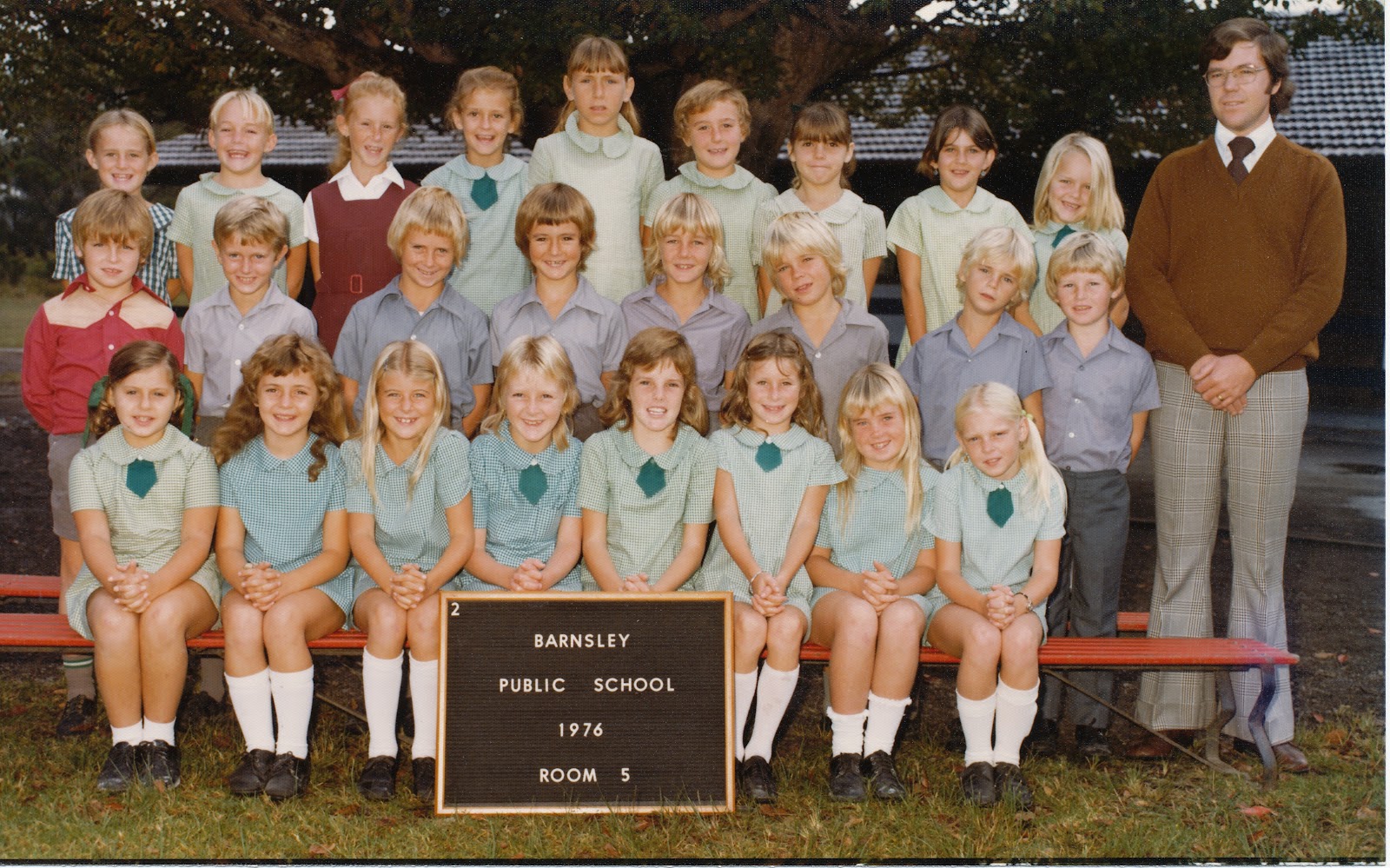
An important ingredient for any child's success is the realization they can be successful at something. It took me until 4th grade to realize that I was good at a few things. I enjoyed Kindergarten and learnt to read and write. But by grade 3, I spent most of the day looking out the window and thinking about the fun I'd have when I got home. I managed to learn to read, write and so on, but I was pretty naughty and easily distracted. But, in grade 4 a new teacher invested some time in me. He could see my problems, including a tough home background and my previous disruptive behaviour, but he was prepared to invest in me, even in a class of 41 students across two grades (see below). I'm 4th from the left in the back row.

Mr Campbell had the sense to channel what he saw as potential in me, in a way that would motivate. I became the garbage monitor, milk monitor, duster cleaner etc to try to keep me out of trouble (to little effect at first). This was against a backdrop of the Principal who saw me as a 'drop kick'. He simply caned me every time I messed up, which was often the case in his eyes in grades 3 to 5 Grade. But even as my behaviour improved, he found excuses to cane me. Once when he saw me looking out the window during a lesson, as he walked along the verandah past my classroom. He caned me twice!

But a big change occurred when an aquarium with tropical fish was purchased by the school and placed in my classroom. My teacher put me in charge of it. He handed me a book on tropical fish and asked me to study it. He later asked me to give a presentation to the class on raising tropical fish. It was a success, and the fish and I both flourished.

The challenge for all teachers is that some students will present as disinterested, difficult and annoying (as I was), while others will take the front seats, smile, look engaged and answer all the questions. Being able to identify the gifts and abilities of all students is our greatest challenge, and much more important than seeing their weaknesses and problems.
Years later, after I'd become a teacher, I recall a day while on playground duty at a small Primary school in my home city that had an impact on me. I was standing next to the Principal who would come out from time to time to watch our students. The boys were playing cricket and a new boy broke a cricket bat. The Principal called him over and said "how did that happen?" The boy replied "I don't know Sir", I just missed the ball and hit the pitch. To which the principal replied, "I'm watching you son, I can remember your older brother breaking a cricket bat when he attended this school too." A colleague nearby whispered in my ear, "and I bet he's never forgotten it." How easily children are labelled. At that moment I thought, I was that kid once, and this principal was like my old principal in primary school who had caned me over 40 times before Grade 5.

A fundamental mark of a good teacher is the intent to look for the good in students, and to seek to identify their abilities and potential, not just their weaknesses and failures.

b) Teachers need to gain the trust of their students and in the process, seek to identify gifts in unusual places.

In 'Pedagogy and Education for Life' I share a vignette about a student name Chanda who I taught while living in the US as a visiting scholar at Indiana University some 40 years ago. As part of my research, I team taught with a relatively new teacher who was keen to have me working with her. I met a student named Chanda almost immediately. She was a larger than life boisterous student who made her presence known; but often not in the right way. 

Chanda rarely did her work. In fact, after being in her class for 6 months, I couldn't recall her completing any task. Often, she didn't even start them. One morning as usual, the children raced down the corridors having left the buses that brought them from the Trailer Courts that most lived in. Chanda burst through the door, and threw her bag onto her desk. It bounced off, fell open and at my feet, and a bundle of writing dropped out. I was helping to pick them up and she quickly grabbed them off me. I said, "Hey, that looks like writing!" She quickly replied, "It's nothin Sir, just some music I did at home." As I held one piece, I saw it was in the form of a song. I asked could I read some. As I took one, she said, "Sir, you won't like it." I pleaded, "let me read some, PLEASE?" After saying no three times, she reluctantly agreed, and said "just a couple". There must have been 30 works in the bag. I quickly realized she was writing music, which was in effect poetry.

None of her writing had been revealed previously to her teacher or me. It's difficult at times to gain the trust of our students so that we are in a position to identify special gifts. Chanda was a difficult student from a troubled background. She didn't enjoy school subjects, but had hidden potential. You can read a bit more about Chanda and see one of her songs/poems in "Pedagogy and Education for Life" (Ch 2, pp 25-27).

c) Students need to know their teachers know them, and in some way 'gets them'.

This statement might sound like waffle, but in reality all relationships only succeed when both parties understand the other. Mr Campbell was the first teacher who 'knew' me. He could see beyond the grubby and sometimes difficult poor kid, to a child with potential. Even the extreme introvert in a classroom can be understood. But it requires patience and close observation of the child in class, as well as their behaviour and interests outside the classroom. The latter is difficult, but nonetheless there are ways to read the signs that disclose what makes each child tick. In particular, what they like, dislike and feel passionate about. As a young teacher, I coached many of the school sporting teams and spent much of lunchtime in the playground talking to students, playing paddle tennis with other teachers (and some students). In essence, I was observing and getting to know them in different contexts. This was easy at my One Teacher School, but a little harder with classes of 35+ as I had in my early years of teaching in large city schools.

Teacher expectations matter. The school principal who caned me so many times in my early primary school years had no idea who I really was. I say that even though my sister had been at the school before me and was well-loved. Her sporting skill and a beautiful singing voice made her a stand out. Mr Whitaker saw little good in me, and had no idea who I really was. But Mr Campbell took the time to get to know what made me tick. My interests, my hidden abilities and what switched me on as a learner, weren't that obvious. As a result, I often withdrew and gazed out the window. Dreaming up ideas for what I'd do after school. Projects to start, cubby houses to build, boats to build and bushland to explore near my home. 

Working hard to engage every student is a challenge for all of us. It might well be that it's only across many years of schooling that each of us experience teachers who see something special in us. One such teacher will make a difference. Mr Campbell was mine. Who might you change and help to shape? Perhaps a kid like me, or Chanda?


Friday, 31 March 2023

God Made us as Unique Creatures

Since not all readers of this blog have read my book 'Pedagogy and Education for Life', I thought it might be helpful to look at the foundational principles of the pedagogy I developed and encourage. There are three major purposes and each has a number of things we do as people of faith in God to reflect and encourage a right view of education. In this post I will briefly outline the actions that are required to demonstrated that we see this as foundational to our teaching and faith-based education. 

The first is that God made us unique creatures! When we enter a classroom we need to keep in mind that:

1. We need to identify that which is valuable in each child

This is a fundamental part of being a great teacher. Of cours, this is not confined to Christian teachers. As a young boy living in a dysfunctional household with alcoholic parents I didn't always see this in my parents, but I did see it in some other people. As a consequence, in every school holidays my older sister and I I would escape to the security of maternal Christian grandparents. As well, I had one or two early teachers that could see I came from a troubled background on sought ways to encourage me and develop my character.


But the Christian teacher is to be constantly looking for the things that are valuable in each child. As a former school teacher I know how hard that can be with some students from Christian families and other non-Christian families. But this is a key component of my pedagogical framework.  


2. As teachers we build on the foundations of families


This second principle is important too! We need to know something of the parents of our students whether Christian or otherwise. This should help us to work out why at times our students act as they do. If we know nothing of their family background that will make it hard. Seek to find out more about them. If you know your students well, it will help. I can recall many occasions as a teacher when I observed things in my students that could be negative and sometimes disturbing. The child who is always late for school, poorly dressed, emotionally unstable, aggressive and so on, should not immediately be labelled as a problem you need to deal with. Yes you do, but before drawing conclusions about the child, find our more about them. First by observing them, and second, if necessary, by seeking out their parents.  


3. We need to demonstrate and encourage service


Because God made all of us to be different, we need to look closely at what gifts our students have beyond their grades and observable behaviour in the classroom. Do they serve others, or expect to be served, even by you as the teacher! As a young child at school, one or two of my elementary teachers saw things in me that others didn't. Some saw me as simply a pest, while a couple saw more, and tried to direct my energy and at times disruptive behaviour in better and more productive directions. Do we know our students well enough to observe such things.


4. We need to develop a right view of work and effort

God made us all to "...contribute to the order and running of his world in our work. (Gen 2:15). If as teachers our central focus is the assumed difficulty of children today, our attitude towards them will be a negative one. Having taught many troubled children, I know how hard it is not to interpret every action of the troubled child as their fault. But as teachers we mustn't lose sight of the reality that their work is part of God's plan, whether that year 9 class is difficult or not. How can we as colleagues encourage each other to encourage and help one another?

I write much more about these basic elements of Christian pedagogy, but I would encourage readers to look afresh at their own situations in light of this first major. In my next post I will look at the second major purpose 'God's Creatures as Learners'.


Tuesday, 30 August 2022

Why 'Kidwatching' is critical for parenting and teaching.

One of the greatest challenges for Christian education institutions, is how to build and sustain the centrality of their Christian beliefs, with pedagogy that is consistent with this faith. While a specific faith would have underpinned all religious schools when first established, maintaining such a focus and foundation can be difficult. Far too many faith-based educational institutions end up measuring their success based on the maintenance of academic, cultural and sporting standards and whether parents are satisfied ‘customers’. This is not to say that these things are unimportant, although parents are partners not 'customers' or clients! Faith-based institutions were always meant to offer so much more. They were established to educate and shape students spiritually, not simply academically. To help students grow in body, mind and soul!


Any faith-based institution will find after successfully founding and growing a school or university, that over time the pursuit of excellence in academic, sporting and school rankings of all kinds will begin to dominate key decisions and practices.  If this drift occurs, we should ask, is it still possible to achieve the original founders’ goals? A key factor critical in achieving this aim, is whether teachers actually get to know their students well enough to have an impact on their character and lives, not just their success in public exams, sporting achievements and career outcomes.


A key starting point is that teachers need to get to know their students more deeply. They need to observe and be concerned for more than just school results and behaviour in class, but also their wellbeing and moral character. What is the key to doing this? I believe that teachers need to be ‘Kidwatchers’ (Owocki & Goodman, 2002). I’ve written about this in my book ‘Pedagogy and Education for Life’ in detail. But in essence, it requires teachers to be more attentive to student life in our classes and schools, and even in the playground.


As teachers, we need to use our eyes to observe the behaviour of students, and ears to listen to the things they say. Not just in class, but in the ‘cracks’ of school life. Perhaps as students gather on arrival at our classes, or simply by observing their behaviour in the playground. Why? So that we might understand our students’ priorities, passions and interests? Who are the people who seem to have greatest influence on them? Other students and friends! We need to understand what they are learning from other students that shape their values and beliefs? ‘Kidwatching’ is one of the twenty actions in my ‘Framework for Christian Pedagogy’. Teachers need to have or develop this key ability (Cairney, 2018, 138-155).


One of the most helpful discussions of the challenges in sustaining focus in Christian education is offered by Smith & Smith (2011, 9-10). When discussing the work of Alasdair MacIntyre, they remind us that Christian schools and educators fight on two key fronts. One concerns the objects and focus of our students’ attention, and the other is the ‘absorbing’ and ingraining of habits, skills and dispositions (‘Habitus’) as they live and learn together within varied communities of practice in and outside school. Each and every student we teach takes on an “embodied history, internalized as a second nature” (Bourdieu, 1990, p.56).


Etienne Wenger (1999) has contributed much to our understanding of how groups work together. Our students are part of many formal and informal physical and virtual communities of practice, and over time some of these ideas and practices become accepted as part of life together. Their life together in such groups can extend even to the incorporation of specific ‘secret’ codes that reify certain ideas and beliefs as part of the community. Of course, as I have said already, most of this ‘life’ is unseen by teachers and parents. Taylor suggests that below the surface of life, imagination is at work helping our students to consider stories, myths, dreams and hopes. They begin to imagine the world as they would want it to be (Taylor, 2004; Smith, 2009; Smith & Smith, 2011).


Every day our students share their lives, their hopes and dreams for the future, and the unseen struggles that occur along the way. We need to understand that most critical discussions of things that ‘matter’ to them, do not occur with parents and teachers, but rather with their friends. If they do have adult ‘influencers’, they usually have celebrity status in the wider world. They do this by consuming large amounts of social media each day, where ‘influencers’ promote ideas, values, challenges and hopes. Sadly, we can discover far too late, that our children and students can have double lives. 


In my own writing, I find James Gee’s (Gee, 1996) idea of being ‘apprenticed’ to social groups as a partial explanation of what occurs in our classrooms and schools. The behaviour of our children, their beliefs, the activities they value, and the personal image they seek to create, is shaped by others as part of group life. This is not to say that parents and teachers are powerless in such things, just that we cannot assume they will look to us first for guidance and even their values (Cairney, 2018).


What can we do about the issue that I highlight? As I have already said, first place a priority on becoming ‘kidwatchers’ (Owocki & Goodman, 2002). This is 'simply' being attentive to student life in and out of class. As I said above, use our eyes to observe behaviour, and ears to listen to what is said in different situations. Primarily in class, but also in the 'cracks' of school life. What are their passions and interests, the people who influence on them most, their hopes and dreams? Kidwatching is one of my twenty key actions I believe teachers should demonstrate in their classroom and school practices (Cairney, 2018, 138-155). If you want to know you will find additional detail in the book.

Thursday, 22 April 2021

The Hidden Challenges of School Life


1. School aims and hidden realities


The aims of our schools typically stress that the development of good character in students is central to the purpose of the school. The quotes that follow are taken from school websites. All have as part of their key values the development of "good character and integrity in students". And how do they seek to develop these things? With good "…teaching, example, learning and practice". Schools like parents accept that "good character is not formed automatically; it is developed over time through a sustained process of teaching, example, modelling, learning and practice." Pretty much every school says they offer an educational experience that will develop good character. Most seem to assume that this occurs through intentional development, in order to enable students to take their place in society. But how?


As I argue in my book, this occurs within multiple communities of practice students inhabit. "Education is the whole of life of a community, and the experience of its members learning to live this life, from the standpoint of a specific end goal." This occurs as students interact in everyday life (primarily with other students and teachers). It includes their behaviour and interactions with one another in corridors, on buses, in classrooms, after sporting events, at social events. In fact, just about any situation connected to school life. Of course, much of this is outside the gaze of the teacher, as well as outside their control. It is possible for some students to experience many years of education and be continually, lonely, isolated, misunderstood, and ridiculed; all without teachers having any idea. What’s more, the students’ parents might have no idea either.


In recent decades, our schools have tended to suggest that our youth face opportunities and dangers "unknown to earlier generations". The argument seems to be backed up with comments to the effect that children are "... bombarded with more negative influences through the media and other external sources prevalent in today’s culture than ever before." I want to suggest that such statements, while fine sounding, can at times mask underlying ugliness experienced in previous generations. Many parents and teachers who lived in earlier times had experiences of hidden misogyny, bullying, ridicule, mocking, sexual harassment and so on. As well, like today's youth and children, they experienced it at school, in the home and in the community. Students then and now, have diverse experiences at home, in the community and at school.


As a student at high school I received my share of criticism, hurtful jibes, and physical attacks due to my weight, clothing, parents, family poverty, hair, and more. All occurred in the cut and thrust of daily school life, including school corridors, on buses, in the gym change rooms, on the sporting fields, just about anywhere. Usually, such challenges were outside the gaze of any teacher. And the point I'm slowly getting to? What students value and how they see themselves, is shaped in the messiness of life, whether inside, or outside the school. It has ever been so.


As I've written many times on this blog "Education is the whole of life of a community, and the experience of its members learning to live this life, from the standpoint of a specific end goal." The behaviour of our students in corridors, on buses, after sporting events, at social events, in fact just about anywhere connected to school life, is often invisible to teachers. As a result, it’s quite possible that for some students the school experience is marked by loneliness, isolation, ridicule and misunderstanding. Of course, life can be the reverse for some children who experience all of the above at home. For such students, school can be a wonderful escape and sanctuary from the pain of life in homes and communities where they might have experienced abuse, oppression and mistreatment.

In every school, on every day, there will be children covering up the challenges and horrors of home life. For these students, school is a sanctuary. But for others, school is a lonely place where they have trouble fitting in and where ridicule and bullying are a constant reality.


What is the role of the teacher in combating the hidden 'ugliness' of life for some?


In ‘Pedagogy and Education for Life’ I offer a number of examples of teachers who managed to more than just 'teach'. They in fact, were people who would oversee multiple communities, that collectively make up schools. Some of these 'communities of practice' are visible to the engaged teacher, others are not. But the good teacher is always observing his or her students to monitor the life of the classroom and school. I write about one such teacher in my book who was the ultimate ‘kidwatcher’.


As a teacher of 32 five year olds, Inta was constantly monitoring student well-being, happiness, focus, and participation in the life of the classroom and school. I asked myself as I taught with her, what was foundational to making her such a great teacher. It became obvious to me that it was her purposes and goals for teaching, and her sense of what mattered most for these children. She had a remarkable focus and intent, and higher-level goals that gave direction to her work.


I met another teacher of this kind in a small regional school withing a small country town in Australia. In a school known for its poor academic standards, Ruby's students skewed the scores of the grade level that she taught. When we went to observe her we discovered something interesting. This teacher knew every child not just as learners but as people. It wasn't just their behaviour that informed her, she sought to get to know them by asking after them, watching them, taking opportunities to speak to their family members etc. She was an exciting teacher who sought to engage her classes in every activity. In a school with below average scores on national tests, her students were well above average. As we observed her we went away saying, this teacher is pretty much the most interesting person in each child's life. 


There were at least three key things that marked the actions of these two fine teachers:

1. Both observed students closely and monitored progress in learning. But as they did this, they also tracked personal development and growth. This was not simply to correct and discipline inappropriate behavior, but rather to help each student to grow.

2. They also used a variety of teaching and learning strategies, not primarily as a counter to boredom and to reduce discipline problems through fun activities, but to engage all learners in varied ways that best suited their learning styles.

3. As well, they spoke to and rebuked the students when necessary to direct them toward higher purposes for learning. In doing so, they were also encouraging patience, self-control, love, kindness, and an interest in how God was at work in their lives as well as their fellow students. This constant monitoring of behaviour, supported the twin goals of learning and also the growth spiritually and emotionally of all students. Both teachers were involved in the lives of their children.


I'm sure that there will be some teachers who read this post and will say, "Trevor, I'm not a social worker, I go to school to teach students mathematics. Parents send their kids here to be educated and do well, then get places in great universities. I just don't have time." If you do think like this, I’m very sorry, for you miss the point that education must do more than just grow children intellectually, they should also help them to grow in character. Christian schools should be wonderful places, where we see students grow in knowledge and personal maturity, and where many go on to do great things. Our schools are always a reflection of the world at large, so we will also observe tragedies like suicide, sexual assault, abuse and failure of varied kinds. Nevertheless, our schools must build special communities of learners that support and grow children in every dimension of life. 


The reality in our world is that there is can be an ugly and hidden side to community life in all schools, just as there can be in families, communities and work places. The role of the Christian teacher is to be present in the school not just as a subject specialist, nor the best teacher of Kindergarten, Grade 6 or whatever. Rather, they are to manage and shape communities of practice where the students and the staff grow together in Christian maturity and faith. Only with such commitment will we observe schools where there is less 'hidden ugliness' and more evidence of God working by his Spirit to transform lives for the good.


As James K. A. Smith argues, education is an “holistic endeavor” with a focus on formation of the child. And of course, the elements of our wholeness extend well beyond our skills and capabilities to bodily health, the mind, desires, and imagination. Teachers and their students all vary in characteristics, abilities, strengths and weaknesses, but the sum of all we are, is seen in our unique identities (see Cairney, ‘Pedagogy & Education for Life’, p. 48). 


The most important characteristic of the great teacher is their ability to see beyond the appearance, gestures and at times contrived language and behavior of our students. They do this in order to tap away and open up students to be honest with you as their teacher, so you can support them and help them to grow in character as they live their daily lives.


Monday, 2 March 2020

The need to be ‘kidwatchers’ - Principle 12

As I discuss in my book ‘Pedagogy and Education for Life’, if we are to influence the life of our classrooms, we need to be engaged with our students and consciously monitor the day-to-day classroom life. But as well as classroom life, we need to be aware of each student’s life outside the classroom, for invariably this has an impact on life within school. My 12th Principle from my Christian Pedagogical Framework is framed by the question “how aware am I of the life activities and behavior of my students outside the classroom?” This starts with the playground, but also extends to the home and community life of our students across their many external communities of practice. This might seem a ‘bridge too far’, but if our students are demonstrating inappropriate, ‘interesting’ or unusual behavior in other contexts, how might this inform our understanding of them within school. 

Essentially, teachers need to be sensitive to any signs that their life at home, or in varied wider contexts outside school, might create additional challenges or opportunities. The latter is just as important, life and learning might just be much more exciting and rewarding in the wider world than in the school or classroom. The example of Chanda in Chapter 2 of my book illustrates this perfectly. A student who wouldn’t write at school was a prolific writer of music at home.

Understanding the student world outside school
How can we as teachers have any idea what occurs outside the school for our students? This can be positive and negative. At times in our schools there are children who at home or in the wider world, might face abuse, poverty, fear and disadvantage. How can we tell such things? Understanding and discerning the needs of our children involves observation and attention to the whole of life of our students as much as we are able. Might some students come to school hungry? If a child arrives at school in an untidy state, what might this tell us? Or if they seem to lack basic resources for school should we be concerned? Is their homework done, and so on? What is our relationship like with their parents? Do we know them at all? Do we have any idea how supportive or otherwise their families might be?


In a more positive frame, what passions and interests do our students have outside school? Are there areas of life outside school that demonstrate unusual gifts, special abilities, perhaps just different and more positive behavior? How can we build on what we know about our children to encourage them and form them? Do we listen to and observe them as they arrive and leave, play and chat with friends in informal moments? What insights might we gain in the diverse and multiple communities of practice they inhabit?

Using 'Open' Questions
One basic and practical way to learn more about our students is to ask open questions that invite response and offer a window into their ‘hearts’ and minds. This will generally be done one-to-one or in small groups. This type of close observation has been referred to by some as ‘kidwatching’ which I refer to in chapter 9 of my book. An American colleague of mine coined the phrase over 30 years ago. She discusses the practice in full in her book ‘Kidwatching: Documenting Children’s Literacy Development’. As the name suggests, the technique was designed to provide “…a framework for engaging in systematic, yet very personalized, data collection”.  While she coined the phrase for a narrower application to literacy, I have developed a much broader application in relation to each child’s participation in school and community life. How might we use such a technique in our schools? And what can we learn from using it?

 For example, do we demonstrate a desire to come to a greater understanding of why our students do or don’t engage in activities within the classroom and school? My basic contention is that only by listening, observing and asking the right questions, will we understand our students more fully, and be able to assess their well-being and journeys towards faith. I’m constantly surprised by how little teachers know about their students. Or, in some cases, how they often offer inappropriate activities for their children, or fail to identify when children are unwell, unhappy, under stress, withdrawn, and so on. I saw this as a parent when observing other parents, but also constantly as a teacher. At times teachers fail to see telling signs that students are withdrawn and distant, stressed, frustrated or sad. This might be due to issues beyond the classroom, or perhaps an inability to cope within the school.

Two real life examples
Let me share two real examples from my teaching. I have changed the names and some details to ensure that there is no chance of identifying individuals. The first was a 3rd grade boy (I’ll call him Ralph) who I taught in a city school. He came to school tired, late, untidy and smelling of cigarette smoke every day. He was withdrawn, always late in finishing work at school, he rarely completed homework, and he struggled to make friends. After some weeks and endless frustrations, I was to find out from varied professional sources that the child lived in a two-room shed, that his father was an alcoholic, chain smoker and occasional drug user. Life was chaotic at home, sleep was difficult and study or homework at the dining room table (the only space to work), impossible due to communal use, as well as the scattering of empty bottles and full ashtrays.

The second student was an attractive and precocious girl in Grade 5, who had no end of friends at school. But she struggled to complete schoolwork due to her tendency to be easily distracted from any work activity. This behavior continued for all of one term. She was referred to our school counsellor. After a number of sessions, she discovered that the student’s mother had left their family home during the school holidays and had not been seen or heard of for 3 months. With her father working five days per week and shift work at times overnight, and her older brother at university, she was frequently left alone. 

Understanding the lives of both children was essential for understanding my challenges with both in the classroom. Kidwatching involves paying close attention to the behavior of our students, and being prepared to look more deeply for telltale signs of disrupted lives outside the classroom. And perhaps ask that one more question that could elicit a personal response.        

Attentiveness to student life - 'Kidwatching'
In chapter 6 of my book I suggest that we need an attentiveness to the student life of the
classroom to create opportunities to observe their actions, emotions, hopes, fears,
frustrations and joys. At its most basic level, “kidwatching” requires teachers to use their eyes to observe student lives, and their ears to listen to what students do and don’t say. Not in order to pry, judge, or to indoctrinate, but to understand them. We need to demonstrate a desire to come to a greater understanding of why our students do or do not engage in activities within the classroom and school. In the case of Chanda, who I discuss in chapter 2 of my book, what I did was not startling. First, I acted on her noncompliance with the writing curriculum when I observed it. Second, I asked some questions. Finally, I took the time to observe her more closely, and I made an effort to know her better. This deliberate activity enabled me to learn about her avid writing at home and to build upon and use this knowledge to make a difference to her as a student.

The view of pedagogy outlined in my book defines learning as socially constituted within communities of practice, not simply classrooms and schools. Learning takes place within the life of many communities in which students and teachers participate. As teachers, we are doing much more than imparting knowledge and skills, we are also forming young lives as we engage with them in a rich life of apprenticeship, mentoring and discipleship. To quote Chapter 6 (p.86) of my book:

Christian pedagogy, will lead to an education that points towards Kingdom goals in the moment-to-moment life of the classroom. It is not simply the delivery of doctrine and teaching in chapel, Scripture classes and Bible studies, nor is it simply the reinforcement of a specific worldview. Pedagogy will always reflect the attitudes of the teacher, the purposes that drive classroom activities, discipline and praise, rewards and punishment, as well as the words spoken and the knowledge shared. This is an education that is implicitly, and sometimes explicitly, centered on God’s purposes for his creatures, not simply the pursuit of the goals of the world.
                                                                                              
To embrace such a view of pedagogy and to implement it in our classrooms, requires deep knowledge of our students. This is where ‘Kidwatching’ comes in.