Showing posts with label families. Show all posts

Friday, 31 October 2025

Story Telling Imagination & Life

Introduction

I have been writing this post while at the same time writing my monthly post for my Literacy blog titled 'Literacy, Families & Learning'. This of course has a different audience, but nevertheless many Christians read that blog as well as other faith-based people from around the world who are not Christians. One of the largest groups of followers overseas are parents who live as Muslims in a wide range of Muslim countries. Their concern for their children's education and growth is similar to many Christian parents. A case in point is seen in this month's topic, it is of relevance to people of all nations. 

In the post, I want to revisit the topic of Storytelling and discuss just how critical it is for the development of our children. This should not surprise you because I devote a full chapter to 'Imagination & Life' in my Pedagogy book. The book addresses pedagogy and teaching quite broadly. Considering the role of the  human imagination is one of the areas examined. The varied outputs of life are often expressed through the imagination, or at a minimum influenced by it.

1. Keeping Imagination in check 

C.S. Lewis talked often about the relationship between imagination and reason. He stressed we must not let imagination shape us so much, that we misuse it or allow it to replace reason. Jeremiah warns us not to walk "in the imagination of our hearts". By this, most commentators believe that he is stressing that while God gave us imaginations we must use them properly. 

Above: C.S. Lewis in his Study

I was an atheist to this point in my life, but went to church one day 40 years ago. I did so (much to her surprise) simply to accompany my wife, who while not a Christian herself, had an interest in God. She had attended Sunday School as child and her Grandparents were Christians. 

We moved to Bathurst (NSW Australia) in 1982 so I could take up a University appointment, my wife stayed at home to care for our two daughters aged 5 and three at the time. She took our 5 year old daughter to a Playgroup at the local Baptist Church after a neighbour (not a Christian) encouraged her to go with her.

To my wife's surprise, when she told me one day that she wanted our daughters to go to Sunday School, and a week later that she wanted to go to church herself, I surprised her (and inwardly myself). I replied "what makes you think I don't want to go too?" To this point in my life I saw myself as an Atheist. I was impacted by the sermon in the service on Matthew 11:28-30.

"Come to me, all you who are weary and burdened, and I will give you rest. Take my yoke upon you and learn from me, for I am gentle and humble in heart, and you will find rest for your souls. For my yoke is easy and my burden is light".

I was touched by the message and when I got went home to the bathroom, dropped to my knees and in tears cried out to God, "God, if you're real, reveal yourself to me". In that moment, I was deeply convicted, and committed my life to follow him then and there on my knees. My wife came to faith about two weeks later. 

2. But a warning!

Veith and Rustuccia in their helpful article "Between the Image and the Word" remind us that imagination can provide some of the "subject matter" and "impetus" for our feelings and choices (see also Trevor Hart's book that was a key source for Veith & Rustuccia). Ultimately it is God who must use the circumstances of our lives, the gift of the imagination and the work of his Spirit, in concert with His Word, to bring us to our knees, repent and believe.

The would be evangelist, who takes pride in "their work" saving people and leading them to Christ, must not forget that it is the work of God that drives all, not us.  

3. Where to from here?

C.S. Lewis helpfully draws the above ideas together in his work "Bluspels and Flanasferes" pp 10-11 (Oxford University Press, 1939). While accepting the above insights about the imagination and God's use of it in lives like mine, we must remember that our imaginations can just as easily lead us in unhelpful directions. We must battle not to be captured by imaginations to lead us to stray and away from the truth. Having said this, it is also wrong to fear the imagination which God gave us as a gift. So encouraging children's imaginations is not bad, rather it is a gift that must be nurtured, encouraged and used to help all grasp truth.

Above: A Playgroup that encourages children to explore 

As teachers, we are to create classroom environments and atmospheres, that encourage children to explore questions like "what if?" "how come" and of course "why"? Such questions might lead to the seeking of deep truths mirrored in God's word. 

As parents we shouldn't fear the imagination. It is good for children to experience all written and spoken genres, including fantasy, to rightly understand the place of God's word in our lives. Fantasy, and truth are not the same thing. We need to help our children to understand and manage both as they engage and live in the world. 

These are important challenges for teachers and parents, might God bless and teach you as you head down such paths. 

Friday, 31 March 2023

God Made us as Unique Creatures

Since not all readers of this blog have read my book 'Pedagogy and Education for Life', I thought it might be helpful to look at the foundational principles of the pedagogy I developed and encourage. There are three major purposes and each has a number of things we do as people of faith in God to reflect and encourage a right view of education. In this post I will briefly outline the actions that are required to demonstrated that we see this as foundational to our teaching and faith-based education. 

The first is that God made us unique creatures! When we enter a classroom we need to keep in mind that:

1. We need to identify that which is valuable in each child

This is a fundamental part of being a great teacher. Of cours, this is not confined to Christian teachers. As a young boy living in a dysfunctional household with alcoholic parents I didn't always see this in my parents, but I did see it in some other people. As a consequence, in every school holidays my older sister and I I would escape to the security of maternal Christian grandparents. As well, I had one or two early teachers that could see I came from a troubled background on sought ways to encourage me and develop my character.


But the Christian teacher is to be constantly looking for the things that are valuable in each child. As a former school teacher I know how hard that can be with some students from Christian families and other non-Christian families. But this is a key component of my pedagogical framework.  


2. As teachers we build on the foundations of families


This second principle is important too! We need to know something of the parents of our students whether Christian or otherwise. This should help us to work out why at times our students act as they do. If we know nothing of their family background that will make it hard. Seek to find out more about them. If you know your students well, it will help. I can recall many occasions as a teacher when I observed things in my students that could be negative and sometimes disturbing. The child who is always late for school, poorly dressed, emotionally unstable, aggressive and so on, should not immediately be labelled as a problem you need to deal with. Yes you do, but before drawing conclusions about the child, find our more about them. First by observing them, and second, if necessary, by seeking out their parents.  


3. We need to demonstrate and encourage service


Because God made all of us to be different, we need to look closely at what gifts our students have beyond their grades and observable behaviour in the classroom. Do they serve others, or expect to be served, even by you as the teacher! As a young child at school, one or two of my elementary teachers saw things in me that others didn't. Some saw me as simply a pest, while a couple saw more, and tried to direct my energy and at times disruptive behaviour in better and more productive directions. Do we know our students well enough to observe such things.


4. We need to develop a right view of work and effort

God made us all to "...contribute to the order and running of his world in our work. (Gen 2:15). If as teachers our central focus is the assumed difficulty of children today, our attitude towards them will be a negative one. Having taught many troubled children, I know how hard it is not to interpret every action of the troubled child as their fault. But as teachers we mustn't lose sight of the reality that their work is part of God's plan, whether that year 9 class is difficult or not. How can we as colleagues encourage each other to encourage and help one another?

I write much more about these basic elements of Christian pedagogy, but I would encourage readers to look afresh at their own situations in light of this first major. In my next post I will look at the second major purpose 'God's Creatures as Learners'.


Monday, 30 March 2020

‘Doing’ School at Home During the Covid-19 Virus - Some practical help


While this topic isn't from my book 'Pedagogy and Education for Life', it's such a critical issue right now that I thought I'd provide a link to one of my other blogs on which I've just posted some practical help for parents teaching their children at home.

Around the world right now there are many families trying to manage life at home during the Covid-19 Pandemic. While every family's situation and each nation, is dealing with this problem in different ways, all face similar challenges in relation to their children's education. As a trained teacher, author of varied learning activities for parents, and devoted father and grandfather I've tested these ideas and many more. But due to the Corona Virus many parents across the world have found themselves acting as teachers at home. This is a nightmare for some, but it can be rewarding and even fun!  In this first post in a practical series I deal with the most basic questions first:

  • How can I as a parent who isn't a trained teacher make this work?
  • What if my child gets through all of the school work in a couple of hours?
  • How can I make some of the work fun and engaging?
  • How do I juggle my paid work if I'm working at home as a parent at the same time?

I follow this with some basic rules

#1 Do establish some basic rules 

#2 Do complete the work that your children's teachers are setting - but don't assume that it has to be done first

#3 Do program in physical activities outside (weather permitting).

#4 If you are able establish a place within your home or apartment where school activities take place.

# 5 Do provide time for marking work (if that is the task of the parent not teachers) and give good feedback and praise.

# 6 Do be consistent! Discipline for the teacher always breaks down when they are inconsistent towards children in the class (or group). 

# 7 Do build into the day planned 'Tension Breakers'. 'Tension breakers' (i.e. things to stop chaos when the wheels are falling off the family, or a child is having a meltdown!) are used when everyone seems to have had enough.

Want to know more? Visit my blog 'Literacy, Families and Learning' and look out for future posts.


Tuesday, 6 November 2018

Building on the Foundations of the Family - Pedagogical Principle 2

As I wrote in my last post, the central concern of the Christian school teacher must be the formation of character in their students. While growing minds and bodies is also important, it is the character of every child that is the central concern of God. As James K.A. Smith argued in a conference that I convened in Sydney in 2012, education is much more than teaching skills or helping children to acquire knowledge, it is more fundamentally an exercise in the formation of the child. And of course, the outcome of such formation is what we would typically describe as 'character'. Martin Buber suggested that "education worthy of its name is essentially education of character" (Martin Buber, 'Between Man and Man'). And of course, character is not 'taught'; rather, it is acquired or developed in community.

The importance of community is a critical element in 'Pedagogy and Education for Life'. In the book I outline a framework that reflects a key foundational proposition in my pedagogy:
“Education is the whole life of a community, and the experience of its members learning to live this life, from the standpoint of a specific goal”
In the final chapter of my book I offer 20 statements that expand on this central definition and act as a framework for education in a Christian organization. I express them in the form of questions. In the last post I considered the first question, "Do I identify that which is valuable in each child?"

In this post I consider the second question.

Do my class and school build on the foundations of the family? 

I spent almost 20 years conducting research on family literacy and learning. This work offered valuable insights into the relationship between the home, school and community, and demonstrated that when schools understand and respect families, that education at school is more effective. One national project that I led for the Australian government, considered the role that parent support and understanding of school pedagogy played in helping children to succeed in literacy learning in the elementary school years. The outcome of the work is described in my book 'Beyond Tokenism: Parents as Partners in Literacy'. While my concern in 'Pedagogy and Education and Life' is the education of the whole child, the findings from my family literacy and learning research, showed that even in relation to school success, a strong open relationship between home and school is vital. This of course is even more clearly needed when we are concerned for the whole child as Christian parents and teachers. This in turn will reflect our faith, and a view of the world shaped by the Scriptures and the gospel-centred narrative that binds the Bible together from beginning to end.      

So why is it important to build on the foundations of the family?

First, it is important to understand families because our students are first and foremost the responsibility of parents under God. While we have the privilege of teaching the children of families, we must understand that our students arrive as people shaped initially by parents. As well, we need to respect the wishes of families for their children. Having said this, it is also important to remember that families are all different and so their parenting strategies will also be different. Also, our parents might not be people of Christian faith. Nevertheless, the school and its teachers need to take responsibility to ensure that parents understand what the school offers and the school's statement of faith that is meant to shape pedagogy and school life.

Second, and more fundamentally, the Bible has much to say about the importance of the family as a critical unit in any society. The Bible teaches that God made us to live in relationship first to him, and second to other people. And the family was the foundation of humanity (Gen 2:15-25), and continues to be the foundation for learning in the early years of life (Deut 6:1-9). Families also have a vital role throughout schooling, and hence the Christian school is to know the families of its students, to support them as they nurture their children, and as God works in their lives. Families are not problems to be managed, but rather partners in education and recipients of God’s grace, sometimes delivered through the school.

Any teacher reading this post will of course realize just how hard it can be at times to deal with parental attitudes and expectations, that do not mirror those of the teacher or the school. In the final chapter of my book I follow the pedagogical framework with a series of case studies that highlight some of the challenges that teachers face in their partnership with parents, who may not share their beliefs. In fact, many of our students do not accept the Christian faith themselves. I stress in the second case study in chapter 9 of my book, that the key challenge for the Christian teacher when teaching the children of non-Christian parents is "... to communicate honestly to parents whether  Christian, or non-Christian." And as well, as the teacher does so, they need to trust God will use her words according to his purposes."

Thursday, 29 March 2018

Student Formation: Avoiding the Indoctrination Trap

I often hear parents make statements like: "I just want my children to grow up to be the person they want to be." This seems a rather risky approach to parenting. From birth, parents of all faiths and none, are trying to 'shape' or 'form' their children in specific ways. Some may deny this, but it is true.

While this is all within an envelope of love and devotion for most parents, there is a very practical component to parenting. Being a good parent requires you to teach your children many things. It begins early with language and practical skills like sitting unaided, crawling and eventually walking.

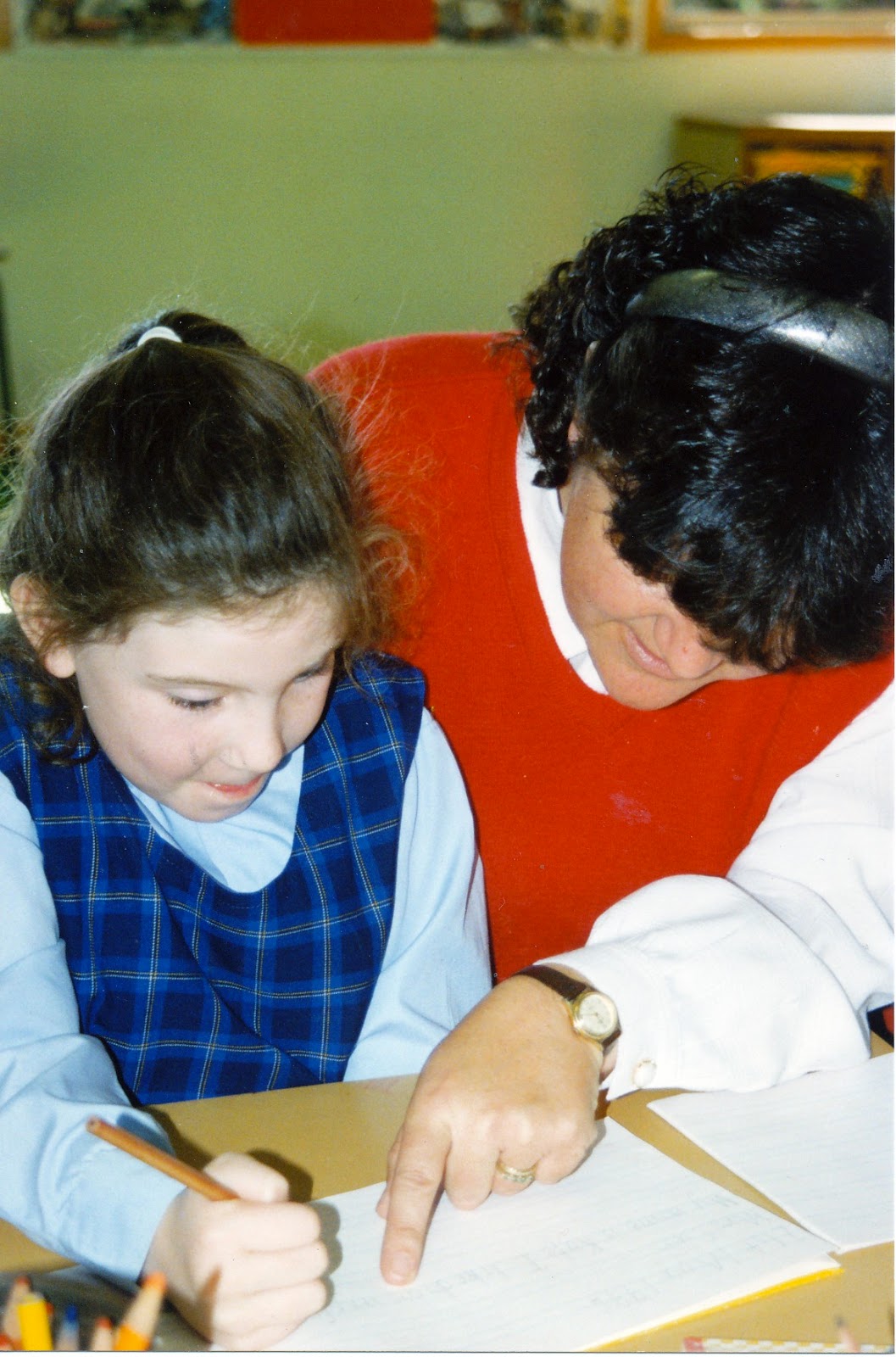
All seemingly natural processes. But in reality, parents coax and assist as children take risks and take on new challenges. The popular term for this adult support is 'Scaffolding' (a term from Russian pyschologist Lev Vygotsky). In this way, parents and teachers help children to do things with our assistance that they cannot do alone. The picture opposite of my wife helping our daughter to walk aged about 12 months is an example.

However, as children grow physically and intellectually, there comes a point (or more likely many points) where children challenge the 'authority' of parents to 'help'. "No!" Or, "I do it this way Daddy" should be familiar to any parent. Later, the Tween or teenager will simply think they (or their friends) know better.

How parents deal with growing independence is one of the great challenges and skills of parenting. Children fairly quickly learn that parents have expectations and try to place limits on their behaviour. In response, they begin to test the boundaries, to see what they can get away with. Increasingly, as children enter school and spend more time away from parents, they need to make judgements about how they act, what they believe, and how to judge right and wrong - without you being present! This is a hard time for most Christian parents.

How do we deal with this emerging independence? What's more, how does a teacher deal with this within their classes? What beliefs, values, ideas and teachings do we privilege? There are many responses from parents and teachers that range from a 'hands off' response that allows great freedom for children to work things out themselves, to more extreme forms of indoctrination. Christian schools face this dilemma each day. In fact, even non-Christian schools face this dilemma, even though few recognise it.    

Elmer Thiessen in his book 'Teaching for Commitment' has some helpful comments on the difference between open-mindedness and indoctrination, that are helpful for dealing with the tension between freedom and control by parents and teachers. Thiessen argues that to be open to the ideas of others is a good thing, and that in fact, “open-mindedness is closely related to critical thinking.”

In drawing from the work of Socrates’s famous statement that “the unexamined life is not worth living,” Thiessen suggests that “open-mindedness" is helpful and simply means being open to critical reflection concerning our beliefs as parents, teachers and children, and the beliefs of other people.

Thiessen reminds us that simply presenting Christian truth in an authoritative way “will of necessity discourage critical openness.” However, Thiessen suggests that if "critical openness" is promoted in our schools, then claims of indoctrination have no grounds. Conversely, if schools fail to allow open discussion of alternative views off the world, we may well be shuffling towards a stance of indoctrination.

One of the great dangers in Christian schools, is the temptation to wage a war against cultural practices that are seen as inconsistent with the faith. Faith though is not simply a set of practices, a specific set of values, or even a tightly defined worldview. Rather, our faith reflects “an integrated pattern of human knowledge, belief, and behavior.” How the life of the school mirrors this is of critical importance.

Kevin Vanhoozer in 'Everyday Theology?', suggests that “every part of life signifies something about the values and beliefs that shape culture. Therefore, every part of culture communicates something about the meaning of the whole.” As teachers, we need to 'read' culture, because as well as offering explicit messages, culture communicates basic orientations to life.

How the school manages and constructs the life of the school community and its interaction with and relationship to other diverse communities and sub-communities, as well as their culture and practices, is critical to student formation. As I have written elsewhere in 'Portraits of Literacy Across Families, Communities & Schools', “to be a teacher or a pupil in any school demands specific ways of using language, behaving, interacting, and adherence to sets of values, attitudes” and beliefs. Linguist James Gee argued in 'Social Linguistics and Literacies', schools engage in “particular” discourses. This concept of course has resonance with Etienne Wenger’s concept of “communities of practice.” Gee describes discourses as “ways of behaving, interacting, valuing, thinking, believing, speaking, and often reading and writing that are accepted as instantiations of particular roles (or “types” of people) by specific groups or people.”


The original foundational aim of Christian education, was always the quest to introduce children to the Christian faith. But the greatest challenge for Christian schools is how they present the message of Christianity. For the teacher, the even greater challenge is how do they penetrate the numerous communities of practice where the views and prejudices of every teenager grows. I will have more to say about this in my next post.