Showing posts with label community life. Show all posts

Friday, 11 April 2025

What is Christian pedagogy? It is much more than just advice on teaching

In my book 'Pedagogy and Education for Life: A Christian Reframing of Teaching, Learning and Formation' I argue that Christian education and pedagogy must be rooted in an understanding of God's people in-between this life and the next. 

We are shaped as we engage with others, and move in and out of varied 'communities of practice'. This is a reality for our students as they attend our schools, for it is one of the many 'communities of practice' they inhabit. This term was introduced to us by cognitive anthropologist Jean Lave and Etienne Wenger in their book "Situated Learning: Legitimate Peripheral Participation" (1991). The term describes how as we form groups, and as we inhabit them we begin to learn new things and take on many of the same concerns, passions, values and beliefs. 

The life we all experience includes many people, experiences, successes and disappointments, all of which influence us in varied ways. Such experiences also introduce us to new ideas, beliefs and practices. Our students have lived experiences in and outside school, we need to understand this as our remit, to teach and educate them for life.

1. A Vignette About Jackie

In my book I share an example of what this might look like for our students. I use Jackie (not her real name) as an example of the complexity of multiple communities of practice that influence our students. 

Her family is what we'd call middle class and is very important to her. Her mother is a university trained teacher and her father is in a government administrative role. Her parents are not Christian, but they have sent her to a Christian School 5km from their home, which they believe will give her a good all round education. 

Jackie is well liked at school and has a solid group of friends who are mainly non-Christians. Beyond being at school together, they have a number of common interests in music, film, fashion, dance and boys and so on. 

However, the complexity of the communities of practice she inhabits, goes much further than this and beside those mentioned already includes:

  • A close group within her art classes.
  • Her extended family including her grandparents, a special aunt and uncle and her cousins.
  • A dance group outside school where different friends are found.
  • She is also a part-time staff member at a local pizza restaurant.
  • A Saturday netball team in a Summer night competition.
  • She also has friends at a technical college, where she has been doing a part-time food service course at a local TAFE.
  • As well, she has 2,500 Facebook friends, many more on Instagram and some other platforms as well.

2. The Remit of Faith-based Schools

Given the broad cross section of children across faith-based schools, we can appreciate the complexities. They are responsible for a number of things. They were founded to support Christian students and their families, who are often confronted by beliefs and practices they find problematic.  They need to support students to grow in knowledge across the curriculum and to achieve success in life. But at their very foundations they are also responsible to assist students to grow in faith, knowledge, character, values and the consideration of ideas as presented. 

Teachers of course are not the only influencers. Families, friendship groups, and many other varied groups (or communities) in which our children live, will shape them in some way. Such groups include sporting teams, recreational activities, favourite authors, television, media and for, some churches. With this in mind, a central tenant in my book, is that:

"Education is the whole life of a community, and the experience of its members learning to live this life, from the standpoint of a specific end goal."  


You might be tempted at this stage to say, how can I as a teacher, possibly have much impact on my students when we see them so little, and they are embedded in multiple communities of practice both inside and outside school? There is some truth to this, but there are many areas where we can have an influence. I want to suggest there are three steps you might take that would make a difference. 

3. Three Key Steps Towards Excellence in Teaching

a) Step 1 - Know and love, and understand our students

James K.A Smith has a statement that is helpful here. He suggests that:

“Education is not just what we teach; it’s how we shape what students love.” 

The desires of our children's hearts are varied and are generally easy enough to observe and understand. So as we teach them the curriculum at hand, we should also seek to shape them as people. Some children are easy to love, and some more difficult, there is nothing new about this. But we need to look for good in all of our students as well as helping them change in areas that are problematic.

Of course, we cannot change things outside our control like annoying habits, laziness, rudeness and some personality traits. While we aren't counsellors, we do have a role in shaping our students in character. We can't treat our students as our friends, we are teachers and authority figures not their friends. But we can take an active interest in their lives and listen to the things they might share in the 'cracks' of school life. However, of course, we must set some boundaries here.

b) Step 2 - Pray and be concerned for your students

While being devoted and diligent in personal prayer 

Justin Taylor in a piece titled 'The Great Vision of Christian Education: Ten Foundational Truths' outlines some helpful foundations for our schools.

In the above article Taylor suggests rightly that Christian education is as big as God and his revelation. It goes beyond parenting and teachers and classroom instruction; it should infuse every aspect of the Christian life. In his words ".. it involves not merely donning gospel-centred glasses when we study 'spiritual' subjects, but being filled by the very presence of almighty God as we seek by his Spirit to interpret all of reality in light of the glory of God in the face of Jesus Christ."  

In my time as a teacher in non-Christian schools, I came across many things that were disturbing in the lives of my students outside school. For example, one of my year 6 girls who had withdrawn into the background as a student and looked very sad, revealed privately to me one morning just before school, that she had been subject of abuse from an older brother who had "been practising his kissing on her". Another year 5 student would come to school wreaking of cigarette smoke which I was to learn was due to her father's chain smoking in their 3-room house. Yet another student had was witnessed domestic violence regularly. Of course, such observations must not be set aside.

These few examples underline how we need to know our students well enough to pray for them, to be trusted by them, and at times to even intervene to protect them by reporting events up the line. The latter requires great care and would first be a conversation with your school principal. After that in most cases, there would be a meeting with the parents and then to other authorities if the situation required it.

In the 'cracks' of school life, we can at times observe and hear things that bother us. Some teachers might say this isn't my role. But staying silent in such matters isn't the right response. Somehow, we need to achieve clear boundaries.

I agree with Justin Taylor's statement, but also understand there are limits to what we can and should do. But we all need to be concerned for the welfare of our students. If I had allowed the conversation with my student about her brother, to be shuffled into a box marked "not my responsibility", it may have continued over time and perhaps become worse. 

c) Step 3 - Establish Our Education Based on sound Foundational Principles    

One of the most helpful set of principles I've found is outlined in an article by Justin Taylor, in 'Desiring God' titled 'The Great Vision of Christian Education: Ten Foundational Truths'. These might be helpful.

1. True Christian education involves loving and edifying instruction, grounded in God’s gracious revelation, mediated through the work of Christ, and applied through the ministry of the Holy Spirit, that labors to honour and glorify the triune God.

2. Christian education begins with the reality of God. God the Father, God the Son, and God the Holy Spirit — one God in three persons — creating and sustain all things (Genesis 1:1–2; Colossians 1:16; Hebrews 1:3). 

3. Christian education seeks to rightly interpret and correctly convey all aspects of God’s revelation, both his self-disclosure through the created world (called “general revelation”) and his self-disclosure through the spoken and written word (“special revelation”) Romans 1:20; Hebrews 1:1–2).

4. Christian education, building on the Creator-creature distinction, recognizes the fundamental difference between God’s perfect knowledge of himself and the limited, though sufficient, knowledge we can have of God through his revelation (Romans 11:34; 1 Corinthians 2:16).


5. Christian education recognizes that the recipients of our instruction — whether believers or unbelievers — are created in the image of God, designed to resemble, reflect, and represent their Creator by ruling over creation and relating to one another (Genesis 1:26–27).

6. Christian education reckons with the sobering reality of the Fall — because of Adam’s rebellion as our covenental head, all of us have inherited a rebellious sinfull nature and are legally regarded as guilty (Romans 3:10, 23; Romans 5:12, 15, 17–19). Creation itself is fallen and in need of liberation (Romans 8:19–22). Our disordered desires and every aspect of our thoughts, feelings, and actions are affected, hence we must still battle indwelling sin (Galatians 5:17).

7. Christian education is built upon the work of Christ — including, but not limited to, his substitutionary atonement and triumphant resurrection victory over sin and death (Galatians 4:4–5; 1 Corinthians 2:2; 15:1–5). All of our instruction is founded upon this great event that makes it possible for sinners to stand by faith in the presence of a holy and righteous God.

8. Christian education recognizes that to reflect the mind of Christ and to take every thought captive (2 Corinthians 10:5), we must be born again (John 3:3), putting off our old and renewed in knowledge after the image of God (Colossians 3:10).

9. Christian education insists on the indispensable work of the Holy Spirit, who teaches (John 14:26; 1 Corinthians 2:13), searches everything (including the depths of God) and comprehends the thoughts of God (1 Corinthians 2:10–11). He helps us in our weakness, intercedes for us (Romans 8:26–27), and causes us to bear good fruit (Galatians 5:22–23).

10. Finally, Christian education recognizes the insufficiency of merely receiving, retaining, and relaying notional knowledge (1 Corinthians 8:1; Matthew 7:21–23). Our knowledge must be relational and covenantal (1 Corinthians 13:12), such that our study results in delight (Psalm 37:4; 111:2), practice (Ezra 7:10), obedience (Romans 1:5), and discipling and teaching of others (Matthew 9:19–20; 2 Timothy 2:2).

Conclusion

Please take the time to reflect on these foundational principles, perhaps discussing them with other teachers, and working together to see what changes you might make in your schools and as teachers. Pray that God will use us as teachers and educators, to embrace sound Christian pedagogy. Such a pedagogy, while being true to the educational processes and and curricular required in all schools, will be shaped by the word of God, as we seek to grow our students in faith as well as in knowledge.

Wednesday, 5 March 2025

The Relationship Between Pedagogy and Student Formation in Schools

1. Formation as the ‘Practice of many Practices’


I write in my book 'Pedagogy and Education for Life' that:


Education is the whole of life of a community, and the experience of its members learning to live this life, from the standpoint of a specific goal”.  


And of course the formation of our students is a critical part of how this occurs as we enact this through our pedagogy.


The challenge within our schools is that our students arrive from at times very different backgrounds. This might well have included growing up in a Christian home, and attending a church with strong biblical teaching. They may have been challenged by God’s word, to live in ways consistent with the Scriptures. Of course, if only this was always the case, our job as teachers would be much easier.


Christian and in fact, all faith-based schools have a significant role to play in an environment where students not only learn and grow as students and people, but also in faith and character.


Faith-based schools whether Christian or of another faith, make a commitment to the spiritual formation of our students. Hopefully, this is not just by sending them off to Chapel once or twice a week. True formation occurs in multiple communities, or groups as the “Outcome of the ‘Practice of many Practices.” I borrowed this excellent comment, from Craig Dykstra and Dorothy Bass.


I point out in my book that this might not be realistic in all faith-based schools. When I wrote the book I was thinking of Christian schools. It's worth noting that I’ve been invited to speak to staff at varied faith-based schools in recent years, and all have shown considerable interest in my work. Other religions also see much which resonates with their own desire to see their children grow spiritually. For example, a large number of school leaders, teachers and parents read my blog in Muslim countries.  It seems, they also want their schools to demonstrate pedagogy and school communities that are true to their faith.


2. Going Deeper, to consider the subtle and almost unseen practices of our schools


Dykstra and Bass in their work, comment on formation and issue a challenge to teachers to bring to “consciousness the hidden dimensions embedded in and through our actions and relations.” (see p. 91). This sounds anything but practical, but hang in there. They define “Christian Practices” as:


… the things Christian people do together over time to address fundamental human needs in response to and in light of God’s active presence for the life of the world.


In short, Christian schools help students to see, respond to, and navigate all the practices of life (Christian and non-Christian), with a telos that is shaped by and directed toward the kingdom of God. NB: “telos” is an ancient Greek word meaning “ultimate end”, “purpose”, “goal” or “action”.


It is important to stress, that our task as Christian schools and teachers is NOT just to put our energy into inculcating our students with ideas, whether this is dressed up as “virtues”, “values”, "church traditions" or even “worldview”. If ideas become the focus of pedagogy, there is less chance of us inscribing a “Habitus” that actually ‘primes’ and shapes their actions.


Pierre Bourdieu developed the concept of “Habitus” (or Habit) and saw it as rooted in family life, and conditioned by social class. What’s more, “Habitus” is part of Aristotle’s teaching on Ethics. In a sense, it is within family life, and the way we bring our children up, that there is significant influence on how our children and students see ourselves in later life.


3. Being Shaped by ‘That Which is Invisible’


It is also important to discuss how the invisible things of life, have an influence on us and of course our students. I draw on the work of Charles Taylor and Lev Vygotsky in helping us to understand what I mean by this.


Charles Taylor argues that we need to stop assuming only ideas move people. James Smith makes a similar point drawing on Taylor. Taylor suggests that beneath any cognitive or intellectual discussion by a group or institution (e.g. a school), we have human imagination at work (p.99). This helps us to engage with stories, dreams, hopes, myths, images etc, and connect them with past and present experiences, as well as imagining the way we’d like the world to be.


Vygotsky used the word Obuchenie to discuss this ‘invisible’ action. In essence, this word points to the way that in life, as we live in communities, we adjust to one another. The teacher student relationship is a context in which this is very important. He argues that simply passing on knowledge doesn’t change people. If we follow his argument and apply it to our school context, then growing our students in knowledge and faith, might require us to make some subtle changes to our pedagogy.


Rather than simply transmitting knowledge about Christian faith which we hope students will accept and replicate, we need to grasp that our students must see connections themselves between such a life underpinned by faith, and the myriad of communities of practice they already inhabit. This of course, requires them to reflect on and adjust to these multiple communities.


So what might our role look like in such a context? Daniel Estes ('Ten Ways to Destroy the Imagination of the Child'), suggests that:


“The metaphor of the teacher as a guide includes both direction by the teacher and active involvement of the student in the learning process.”


As teachers in Faith-based schools, this needs to be part of our role. My hope is that at the very least, our focus in Christian schools should enable teachers and schools to “help students see, respond to, and navigate all of the practices of life (Christian and non-Christian), with a telos that that is shaped by and directed toward the Kingdom of God." Above, all we hope they will not take on different personas depending on where they are and who they are with. Rather, our goal with our students and our own children, should be for them mature in faith and understanding and seek to live consistent lives that honour their God.


Sunday, 29 September 2024

Is Christian pedagogy any different to sound secular pedagogy? Part 1

This was the question that shaped one of two plenary addresses I presented to the 'Christian Schools Australia' annual conference in Brisbane recently. I was asked to speak to the 300 delegates about the key points of difference in pedagogy in Christian schools compared to public schools. The brief was to unpack the ideas in my book 'Pedagogy and Education for Life'. It was a challenging task to synthesize all aspects of my work in two 45 minute addresses. But, it's even more difficult to do so in two posts. But here goes!

1. "Is There Such a Thing as Christian Pedagogy?" 

The word 'Pedagogy' is derived from the Greek word “Paidagogeo” which is a compound of “paidos” (child) and “agogos” (one who leads or guides) (Cairney, 2018, p.32). Some quick questions in response. Is this how we see the role of the teacher in Christian schools? I believe it should be. If so, how do we lead or guide our students? Does it look any different to secular schools?


The Apostle Paul used the word “Paidagogeo” in Ephesians 6:4 in relation to “discipline" which is how it is often translated. But Paul and others were using it in the sense of “bringing [them] up in the discipline and instruction of the Lord.” But what does he mean by this? Let me work through some key points.


2. What does it mean to teach 'Christianly'?

I think most Christian Christian leaders would agree that teaching is different in Christian schools. But as I have visited Christian schools, and talked with teachers and administrators, much of what they mean when using the term “Christian teaching”, or in some cases “Teaching Christianly”, is have a faith in God, and that their personal faith somehow shapes their work in the classroom. That's one of the reasons, I use the term Christian pedagogy NOT Christian teaching.

In a school with all (or mostly) Christian teachers, what's different about their practices? Is the relationship between teacher and students different? At a broader level, what do the principal, school board and parent body, see as the fundamental things that make their school a Christian school?


How recognisable would this be to others? Would they be recognisable to parents, students, other non-Christian schools and so on? Or, are our schools (and parents) just as distracted by academic success, and simply relegate matters of faith to the background?

I believe we need to devote more time in Christian schools to considering what faith-based pedagogy looks like in all classrooms. In fact, we need to develop a 'whole of life perspective' as well as a community perspective in our schools. Why? Because our schools should be places where faith is evident in varied ways, and where it is discussed and seen as a priority with teachers, students and parents.

3. Education is the whole of life of a school community?

One of the key assumptions and priorities in the type of pedagogy I'm suggesting, is that we create classroom and school environments where:

"Education is seen as the whole of life of a community, and the experience of its members learning to live this life, from the standpoint of a specific end goal" (Cairney, 'Pedagogy and Education for Life'). And of course, I'm suggesting that the "whole of life" of the school is more than studying subjects and succeeding academically, in order leading to gain good results and employment. 


Rather, the "whole of life of the school" should be just as much about shaping students to grow in faith, with an understanding that God created them to do more than simply being successful in life. Our God wants our students to know Him, seek to honour Him, and lead lives that bring glory to Him.

  • If so, what does such community ‘life’ look like?
  • How do we live from the standpoint of a specific goal? 
  • What might the goals of the school and the teacher look like?
  • What is our role in helping to achieve such communities? 

I will look more closely at some of these questions in my next post. But I quote John Hull in the introduction to me book, who helpfully notes:

"What normally passes for Christian Education can more accurately be named 'Christians educating'." Ouch!

Trevor Hart identifies rightly in the foreword to my book that I have sought to describe a “teleology” (i.e. a reason or explanation for the function or purpose of something) or an “eschatology” (i.e. seeing our students in the light of a bigger and more ultimate vision). We do not simply seek educational and intellectual accomplishments, or future wealth.

Hart also suggests, as I do, that what makes “Christian Education” distinctive, is not the curriculum, specific pedagogical methods and so on, but an “eschatology” that views our hopes for our students, in light of a much bigger vision than academic success, future employment and ongoing self-advancement.


4. Summing Up


I hope our schools, teachers and leaders, articulate and offer clear reasons for the faith that drives their every action? I implore all of us to assess whether our pedagogy and priorities demonstrate a much bigger vision for our students’ future (and their parents), than just top marks and rankings, careers and success. Of course, this might be different from what some parents (and even staff) perceive as the ‘good life’. But there is no reason to see these things are incompatible. We need to keep asking, what does “success” look like for students and us as teachers? Finally, if teachers, parents and students have different views, how do we reconcile them?


Christian schools should seek to create rich school environments, that point students towards faith in our Lord and Saviour, not just ‘success’ in life?


In my next post, I will look more closely at how Christian Pedagogy has a key role in shaping our students in the faith which at times might be invisible. While we can easily see and assess student growth in knowledge, skills, and commitment to learning, how do we assess growth in the inner life of our students?


John Hull, “Aiming for Christian Education, Settling for Christians Educating”, Christian Scholar Review 32 (2009) 203-23.


Tuesday, 30 April 2024

The Power of Community to Create Change in Disadvantaged Schools

Foundations for Change in Secular Education

While this blog has focused largely on pedagogy in faith-based schools, I've been reminded recently that secular schools face similar challenges with students, and also in relation to teacher development, I think there is more common ground than we might imagine. Having started my teaching life as a non-Christian in secular government run education, I have spent many years helping to develop teachers and schools in both sectors. As such, I have been an insider to both. I often ponder what's the same and what is different? In this post, I want to concentrate on teacher and school development.

A Helpful Recent Case Study of School Transformation

Cessnock is a rural town in Australia about 112km from Sydney. I know this area well. As a child, I spent all of my school holidays with my maternal Grandparents in Cessnock. My Mother also grew up there, and fell in love with a smooth Scotsman who was working in the coal mines nearby. Her family owned and ran mixed businesses, essentially 'General Stores' or shops in the days before major supermarkets, department stores, huge shopping centres and online shopping. My mother's family were staunch Methodists and from the late 1890s until 1964 they ran General Stores in the area.


Above: One of my Grandparents' Stores (Closed in 1964)

My Mother and her brothers attended a government primary school at Kearsley, just two doors from their store in the town. Later they attended Cessnock High School. One of my uncles (my Mother's brother) eventually taught at Cessnock High for many years and was Science Master. In those days, it was a 'tough' school and achievements were mixed. Decades later, I was posted to the town in the 1990s as a curriculum consultant for the Hunter region for English and Literacy learning, and could see that there were many problems. It was a tough place to be a teacher.

So, how is education going in this once difficult place for teachers? Cessnock High has been dramatically transformed! The change in this particular school has been so significant, that the Department of Education in our State (New South Wales) has decided to adopt and 'role out' the Cessnock model to seek reform in all of the schools in the Hunter Region of NSW, and perhaps the whole state, if not the nation.


Above: Cessnock High School

The school where teachers once feared having to work due to student violence and indifference, has undergone an amazing transformation. A dedicated principal, some excellent teachers and new education methods, have led to some of the most improved NAPLAN scores in the country. NAPLAN is an international assessment program that assesses student performance on a common test covering reading, writing, language and numeracy. I sat on the national committee that oversaw these tests for 15 years and understand how difficult it was to affect change and improvement.

Surprisingly, Cessnock High now has some of the most improved NAPLAN scores in the country. Its year 12 results have improved by 50 per cent. The learning model they have adopted may well be rolled out across Australia. I find this extraordinary. In a school where violence amongst students was rife and school performance was so poor, there has been such an incredible transformation.

While the principal is clearly a great leader, he is reluctant to take too much credit. He explains the change in these words:

"We've been able to build a culture … where there are very few negative behaviours," he said. "The violence doesn't exist at all in our school anymore and school is a calm place." Of course, there is more to it than that!

 A Whole School Approach

The transformation in this school is remarkable. One of the keys reasons appears to be a whole of school approach using a model developed with Newcastle University staff that they label "Quality Teaching Rounds". 


Just what is this model? In essence, it is a structured learning model to improve classroom teaching and student results. It does this by creating small groups of teachers who take turns to observe and critique colleague's lesson against three criteria:

  • Quality teaching: demonstrates a deep understanding of important knowledge and the best ways to communicate this to students.
  • Quality learning environment: ensures the classroom environment is optimized so students can absorb knowledge and learn.
  • Significance: effort is made to ensure lessons are relevant to students' lives and hold significance in order to boost engagement.

What have they found? In the words of the Principal, the "lessons are more engaging, the environment to learn is safer and the learning is more significant." As a result of the changes, the behaviour of students has changed dramatically allowing learning to blossom and as a result, academic achievement has risen markedly. I think our Christian schools can learn much from this, but how might it be slightly different?

So What's Different?

My definition of education in 'Pedagogy and Education for Life' is in short:

"Education is the whole of life of a community, and the experience of its members learning to live this life, from the standpoint of a specific goal."

There is no doubt that Cessnock High School has created a desire amongst parents, teachers and students to change community life, and in particular classroom behaviour and application to school and learning. One of the features of the 'Cessnock' approach is that teachers collaborate together, and even sit in on each other's lessons to offer feedback and advice. This is very helpful and shows that they are concerned not only for their own teaching, but that of others and even more importantly, the learning and welfare of their students. 

It would be wonderful if teachers could sit in each others classrooms at times to help one another reflect on how in the cut and thrust of each day, they are not only teaching their students, but are also shaping them for life. As I write this, I recall a colleague who taught next to me in a primary school in Sydney. His class was always out of control and he screamed constantly at the students, while they laughed and messed about. I coped by closing my door to shut out the chaos. But might I have been able to help him?

Above: My first school as a teacher

What might be different if used by Christian schools?

Central to the 'Cessnock Model' is the visitation of teachers to one another's classrooms. They do this to watch, learn from and help colleagues for example to:

  • Use effective and sound methods,
  • Maintain student attention,
  • Offer feedback and support to students, and
  • Use more engaging approaches to teach subject content etc.

But what might a Christian colleague also be looking for? Might they also use some extra lenses? For example:

  • How does the content and learning relate to their lives;
  • How does content (especially in the Humanities) relate to Christian views of the world;
  • How might student non-engagement with content, teaching etc, reflect more than disinterest or boredom;
  • How might some behaviour relate to life outside the classroom not just within it; and
  • How do student responses at times offer windows into where students stand in terms of personal happiness, faith and trust in God.

A good way to test such an approach in Christian schools would be to consider first the approach being used by Cessnock, and reflect on how their school might benefit. Some questions might help:

First, what is the balance in classroom and school life between promoting success in school learning and growth as people, citizens and ultimately, children of God. How is the school different to public schools, and what is common?

Second, staff might consider how the approach could be implemented in a way not only to make them better students, but also to help shape our student's as God's children who develop a whole of life understanding of how their faith should shape all of life.

I will continue to ponder how Christian Schools might respond to this new work. I hope you will too. I'd be keen to hear your thoughts on the topic which I might revisit later.


Monday, 23 October 2023

'Building Schools Where Everyone Understands that Each Member is a Gift'

Anyone who has been a teacher will testify that at times there have been children who were hard to like. I was one of those children for a number of my teachers. What about you? Can you recall students who were challenging and difficult to like? Perhaps ask yourself why they were hard to like?


Towards the end of my book 'Education and Pedagogy for Life', I suggest that one of the key marks of the good teacher is they are attentive to all their students. Note 'ALL'! What's more, they encourage students to tolerate one another, not simply those in their friendship groups. Community building in school is very important, and the best teachers will shape class and group communities to help students understand in some way, that every other student is a gift to all of us in a classroom.


Life is filled with many relationships, and each contributes to us in some way. We learn and grow in and out of school as we experience life together in varied communities of practice. School should not be seen as a place to which we simply send our children in order to have their heads filled with knowledge, and discipline instilled. Hopefully, we want them to grow in understanding and character. This requires "immersion in a life that is only partly lived at school... our students have complex lives in which they dwell in numerous communities of practice."  (Cairney, 2018, p.164).


The Christian school is to be a place where our students' presuppositions are challenged constantly, as they try to grapple with the experiences of life. Ricoeur ('Figuring the Sacred: Religion, Narrative and Imagination', 1995) reminds us that all of life impacts us, and our presuppositions are challenged daily. This includes the things taught in classes or the school Chapel, as well as ideas expressed by students in community life, playground conversations etc. 

Ricoeur suggests that as faith emerges, it will be challenged as we try to make sense of changed priorities and lives. How do we do this? He argues that "metaphorical imagination" is strongly implicated in such efforts to make sense of varied realities. My take on this is that as we encounter conflicts between the things we believe and value, we will need to reconcile such clashes by creating inner 'metaphors' to hold them in balance, rather than in tension. 


As a student comes to faith in our schools or begins to reflect more critically on the faith of other students, and also their own, they have the need to reconcile inner conflicts. They observe and listen to others and ask questions of them. But they also ask questions of themselves as they carry many inner conflicts alone.

Ricoeur's take on this is that for such inner conflicts, we can experience redemption by imagining the possibilities if we were to move in new directions in life. He suggests that by "imagining his possibilities, man (sic) can act as a prophet of his own experience." While I agree that at the point of key decisions about our faith and where we stand in a community like a Christian school, I also see the growth or loss of faith in our students as much more deeply interwoven with all of life. Bad life examples and good ones, all play their part.

God reveals himself in many ways within school communities. For the teacher, I suggest "the things we teach, the priorities we set, the activities we plan, the experiences that are structured, the books we share; indeed all of life in and outside the school acts upon us and shapes us" (Cairney, p.166).

For the student, this will often be the examples of teachers and students. This is demonstrated in their lives; the priorities they hold, the things they believe and so on. 

Christian schools exist to reveal God in every aspect of life. We are seeking to shape young lives for the good. Buber reminds us that teachers present a "selection of the world" to our students with formation of character as the key purpose. But every member of our school communities is used by God and plays their part.


As I say many times in my writings, the calling to be a teacher is an honorable one. We have the opportunity to help shape hearts and minds; we are vehicles for learning about God and revealing God through his word and our witness. We must continue to meditate on this truth. What a responsibility! But in his strength and power all things are possible.

Thursday, 22 September 2022

Building Communities of Literature & Learning in Our Classrooms

This is a cross-post from my literacy blog 'Literacy, Families & Learning'. It wasn't intended specifically for faith-based schools, but what I say has relevance NOT just for literacy, but also in informing our pedagogical ideas on how we sustain student communities in Christian and other religious schools.

One of the signs of a great book is that once it is finished you have a deep desire to tell someone about it, and perhaps even pass the book on to them. I can recall times when I reached the end of a moving novel and I would simply sit quietly, ruminating on the 'journey' I had just completed through the book. And later, there would be a deep urge to tell others about it. After a special book, we might read it again at some later point, or loan it to a friend and revisit the story in conversation with them.

Our classrooms and homes should be places where children read books and want to share their stories with others. This is certainly critical in the primary years of schooling, but so too it is possible and important within high schools. If literature is only read to prepare for exams, it is a sad state of affairs. Our classrooms can and should be 'communities of readers and writers'. But sadly, our students today are more likely to participate in groups in and outside school sharing social media videos like TikTok, talking about or sharing music, fashion, funny photos and so on online. While they are forming or supporting friendships and communities of practice, nonetheless these conversations are often trivial and superficial.

I shared in my book 'Other Worlds: The Endless Possibilities of Literature' stories from three class 'communities'. Classroom communities where literature was part of what bound the students together. One was a kindergarten in the cane fields of Queensland. As their teacher finished 'The Three Little Pigs' (Jacobs, 1969) the children shared their responses. Some repeated words or the details of the story, "the wolf wanted to eat the pigs", "he was a bad wolf", characters were mentioned and so on. Others responded more seriously and thoughtfully. "I've got a big bad wolf and I put him in water", "My big bad wolf got shot with hot rocks". Another said more reflectively, "The wolf got hurt because he tried to hurt the pigs".

I was able to observe a second reading community in a one-teacher school at which I taught many years ago. I had 31 children in a single classroom from Kindergarten (5 year olds) to Grade 6 (12 yr olds). When I arrived at the school I found many reluctant readers, and varied abilities across the grades. I set about flooding the classroom (school!) with books at all levels and with varied content. I was to observe how complex sub groups (or sub communities), developed as children read books and told others about them across grade levels. I also read to them and shared many books that stimulated their interests. 


A third reading community was a Kindergarten class; which in Australia is the first year of formal schooling for 5 year olds. I was part of the classroom for most of a school year as a co-teacher and researcher. During designated reading times, the students could grab a book and scurry off to one of many reading spaces: a secret cave in one corner; a castle made from cardboard boxes; an area created using the existing walls in one corner, as well as a cupboard for the other 'wall', and streamers hanging from the ceiling through which they entered; and as well, a small library surrounded by shelves filled with children's books.

What was common to each of the above three reading communities was that story was an essential part of the classroom life. Books were shared as a class, in groups and in informal settings. The children read together 'independently', in pairs or groups, and many opportunities were given for response and sharing. Each classroom in different ways demonstrated a number of similar things:

First, all were dynamic reading, writing and learning communities. 

Second, each exemplified how reading, while it can be solitary, is often shared with others, and that in the sharing, the desire to read is enriched and strengthened.

Third, they illustrated David Bloome's argument that "reading involves social relationships among people... including social groups and ways of interacting with others...".


If we want our children to experience reading in all of its forms, and to read literature that enriches their lives, extends their knowledge of the world, and helps them to grow as people, then community building must be a priority. The next time you watch a group of students sitting together with phone in hand sharing the latest video, ponder how the enthusiasm and excitement they are showing looking at phones, can be replicated in relation to books that can teach, inspire and enrich their lives.

Friday, 29 April 2022

Our lives are always embedded within a personal history & story

I've been working on my family history. I set myself the task of compiling the story of the previous 3-4 generations of my family history in words (yes, a ‘small’ task!). As I wrote, I found myself revisiting images of people, places and events. I knew that any family history is always shaped primarily by memories and perspectives of varied family members (and non-family members too), who often have different lived experiences and accounts. Even two or more siblings can have slightly different memories of the same events, person and relationships. I began to see that as well as the family stories handed down across the generations, that photographic evidence and documents also matter!


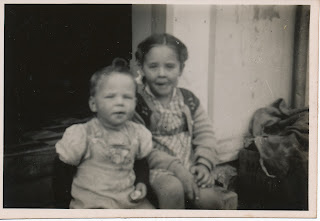
 Above: My sister & me (a 'few' years ago)

But varied evidence is not always 'equal' in validity. It all helps to shape who we think we are, what we believe, and even character, beliefs and values. An image alone, can help us to situate and understand our memories within a specific place and time. They act as anchors for 'truth'. But an image requires interpretation, so in partnership with the memories of multiple people and sources, places and events, we will end up nearer to the 'truth'.
 

My Great Great Grandfather watched a son and daughter leave Scotland in 1882 never to return to their homeland. As I began to dig out old family photos and records, and listen to the memories of those still living, a bigger and more complete story emerged of what had happened. The addition of unseen images in boxes, old newspaper clippings, ship records and so on, contributed to a bigger and more complete story; one richer than any single family member could recall. There is often much knowledge that is in common between family members, but gaps can be filled by other people and official documents. Like many families, there have been some surprises, with troubling events uncovered, and amazing stories unearthed.

As I have embraced this journey I've been reminded of the words of Alasdair Macintyre:


"The story of oneself is embedded in the history of the world, an overall narrative within which all other narratives find their place."


Of course, it is true, every story is unique, but also our personal stories reflect the stories of others before us, as well as those we live life with now. Alasdair's words seem to be very much 'big picture', but he is right. As a Christian, I believe that my story is reflective of and part of the greatest story ever told. It should not surprise us when we discover that while our personal stories are unique, they share elements with other people's stories, and are also shaped by the lives of our family members, and previous generations from our maternal and paternal relatives.


 Above: My Dad near the Forth Bridge in Scotland having returned after 60 years


I grew up in a less than perfect home. For much of my childhood both parents were 'absent' from my life for varied reasons. They had part-time lives as entertainers, and in my father's case, full-time shift work in the mines. Like all parents, they had some shortcomings; hence my older sister and I were fairly independent from about the age of 10. But we both loved them and were shaped in part by them and their lives. We both married early and found wonderful life-time partners, and set about building a different family life for our children.


I fell in love with my wife for varied reasons. These included her kindness, gentleness, quiet confidence, servant heart and the fact that she made me laugh! She is also smart and a perfect partner in life. The person she is reflects her personal history, faith and family. After joining her family, I discovered her mother and grandmother were very much the same type of women. In the last 10 years we have discovered through family history research, that earlier generations of women on Carmen's side across four centuries, shared many of the same qualities. Their lives, no doubt served to shape in part their children and ultimately later ancestors.


In my life, I've written in previous publications and posts how teachers had a strong influence on me. A few I loved and some I loathed. As teachers, how we engage and nurture the children in our care matters. The small number of teachers who did believe in me, saw me as more than just a cheeky and unkempt kid (which I also was). Whatever role we fill in life, we can have an influence for good.


Above: Terry Malone, Dr Phil Lambert & Me


I had the joy last night of attending the launch of a book from the recently retired Assistant Director of Education in NSW Dr Phil Lambert. He invited me to attend along with a former colleague I taught with 48 years ago! To our great surprise he mentioned us both in his book. As a 1st year student teacher he was assigned to my class (in just my third year of teaching). He shared that he'd considered leaving teacher training until he came to my classroom for his first period of practice teacher. He said that he observed my love of teaching, and the friendship and fun I had with the teacher in the next room Terry Malone. The fun and joy we had teaching, and the impact on the children's lives inspired him to continue. He came to the school thinking of dumping teaching, but he left keen and excited about completing his course. To learn this many years later was a joy!


I share the above story, not in any sense of pride (although I was encouraged by it), but simply to demonstrate that the lives we live each day matter. Our stories are always intertwined with other people's stories. As teachers, it is important to consider how we encourage our students to live in ways that acknowledge their true identities, while also seeking to help them grow and mature through lived experience. Just like their parents and wider families, teachers play a part in helping to shape the character of our students.


The central goal of Christian education should always be more ambitious than academic standards, cut-off scores, future jobs, sporting achievements, and so on. As Alasdair MacIntyre argues, education in our schools should lead to “purity of heart,” not just appropriate behavior and school success. As I outline in my book "Pedagogy and Education for Life":


"The role of teachers and schools is to partner with parents to create learning school communities that work in concert with the many other communities in which all students are participants. These school communities of learners will teach and nurture and indeed form the children who God gives to us, in whatever educational context we meet them."


If you're a teacher, be encouraged, and seek to place the learning of your students and their growth as people at the centre of your concerns. You serve in a noble and important profession.