Showing posts with label literature. Show all posts

Thursday, 3 July 2025

The Relationship of Story, Meaning and Imagination for Younger Writers

Writing is Shaped by Family & Community Life

Well known Australian writer Dorothy Hewett grew up on the sprawling  sheep station of 'Lambton Downs' in South Australia. Bruce Bennett suggests that this was “the seedbed of Hewett’s creative fiction” (p.xv). Hewett herself, suggested that: 


“The first house sits in the hollow of the heart, it will never go away. It is the house of childhood become myth, inhabited by characters larger than life whose murmured conversations whisper and tug at the mind”


Above: Dorothy Hewitt


My childhood was very different to Hewett’s. I didn't live on a sprawling sheep station with the richness of memories and opportunities that Hewett experienced. As well, home for me was far from being a place of harmony and security. Nor was it a place where great literature was shared. Yet, I too found inspiration and ideas for my writing, from the storytelling, yarns, poetry, and music of my childhood, and from the key events of my early life.


Above: My First Home


Looking back at my childhood, and my early writing that survives, I can see how both were shaped, in part by the home I lived in, as well as my family and early uncontrolled life. Home was not in general a happy place, but it was an environment in which storytelling was everywhere, and not just from books. The stories that surrounded me had connections to music, poetry, 'yarns' and my free range life style. The latter offered boundless opportunities through my self-made adventures, and also the varied experiences and challenges of everyday life.


The tension between my experience of story and the literature of school, was a great challenge for me, especially in high school. I lived in a home where storytelling, yarns and some more contemporary poetry were what mattered. But at school, it seemed that it was only the work of great writers that was valued. This tension for me, had an influence on how I dealt with literature in my classrooms later in life as a teacher, academic and writer. 


The Many Seed Beds of Story Telling in My Life


Sometimes, hidden within the stories our students write, are hidden echoes of their personal life. Many find personal suffering is too painful to share, perhaps a near death experience that they were too scared ever to reveal it to their parents. However, there are often hints, crumbs along the path of their lives than can offer deep insights. These might reflect an event, person, or even a deed done for which they feel deep shame.


At a distance of many decades, I can see an example of this in my early writing. One piece I wrote in my teens was titled "The Orphan Seagulls". This picture book told the story of two seagull chicks who were sometimes left alone in their nest, on a high rock cliff near the ocean. While often only the father would leave to find food for them and their mother, as they grew older and food needs were greater, both parents would at times leave them.


On one of these occasions, the two half grown chicks huddled in their nest as a Sea Eagle flew in circles above the cliff that held their nest. They were high in the clouds, looking for prey. Father was well beyond the clouds and out to sea, and Mother had gone out quickly just along the shore, to seek some easy pickings in the surf below. But she had not gone long before we saw an eagle circling above us. I wrote about it in early story this way: 


"While mother was away, we took the opportunity to sit on the edge of our nest and stretch our wings, which were now fully feathered. Suddenly, we saw an eagle above us and we realized it had spotted us. It began to circle and then descend. We looked beyond it hoping that mother might be returning. But we could not see her." 


As an adult, I often recall childhood memories of my sister and I often being left at home on a Saturday and sometimes Sunday nights while our parents were out entertaining at clubs, weddings and hotels. When it was time for bed and they hadn't returned, we would huddle under the covers and worry at every noise we heard outside. On one such evening someone came and banged on the wall outside my sister's room where we were both trying to fall asleep. We were terrified! Thankfully, it stopped but we couldn't get to sleep. When our parents arrived home at about midnight we rushed to them. Dad tried to calm us by going outside, searching the surrounds before coming back and saying it was probably a horse that had come into our yard and bumped into the house. This of course, was nonsense. 


As a teacher, when I read the writing of some of my students, I would at times hear a few faint echoes of life experiences they had which troubled them. On a few occasions, my students privately shared some of these experiences.


Growing Young Writers


I believe as teachers we can have a great influence on growing our students as writers. We will do this if we are able to inspire them with great literature and powerful story telling. As well, we need to assist them build on such literature, to grow as story tellers and writers themselves. 


Imagination is of course, a key ingredient in this quest. So, how might we inspire our students to write not just because they have to, but to release them to explore ideas and seek deeper personal insights that turns life experiences into rich story telling?


Above: A very young writer composing an early story


First, we need to flood their world with stories and poetry of all kinds. This requires skill by the teacher to introduce them to varied works, and inspire them to read and seek out books themselves.


Second, we need to model this by sharing books that would also be appropriate for them, and that open up opportunities for them to share some of their favourite books.


Third. we need to create an environment in the classroom that allows space for such personal reading, and some time when they can share these with other students. One simple way to do this is to allow students to go and read if they have finished other subject area activities and tasks. I might return to this topic in a future post.


Good Luck!

Friday, 15 September 2023

Other Worlds: Literature and Stories as Gateways

While the blog focus of this blog is pedagogy, and has been unpacking the arguments contained in “Pedagogy and Education for Life”, you might not be aware that I’ve written a number of other books. These include some on literacy and literature. One of my early books was ‘Other Worlds: The Endless Possibilities of Literature’ (T.H. Cairney, Heinemann: Portsmouth New Hampshire, 1990). I’ve been revisiting my literature book recently, as I grapple with an interesting new book about Critical Theory, (C. Watkin, Biblical Critical Theory: How the Bible’s Unfolding Story Makes Sense of Modern Life and Culture’, Zondervan Academic: 2022). Don’t stop reading just yet! I’m writing about this book somewhere else.

In this post, I want to try to explain the connection ‘Biblical Critical Theory’ and my thoughts on pedagogy and education. While Watkins book was the catalyst for me focussing again on ‘Story’, I want to look closely at the power of literature to challenge, influence and even transform us. This of course has connections to Chapter 7 in ‘Pedagogy and Education for Life’ in a chapter titled ‘Storytelling and Life’.


Watkins book has also made me revisit the work of Stanley Hauerwas, Oliver O’Donovan, and Charles Taylor who all get mentions in my pedagogy book. So, what are the connections between the more practical book I wrote about literature almost 30 years before my pedagogy book.


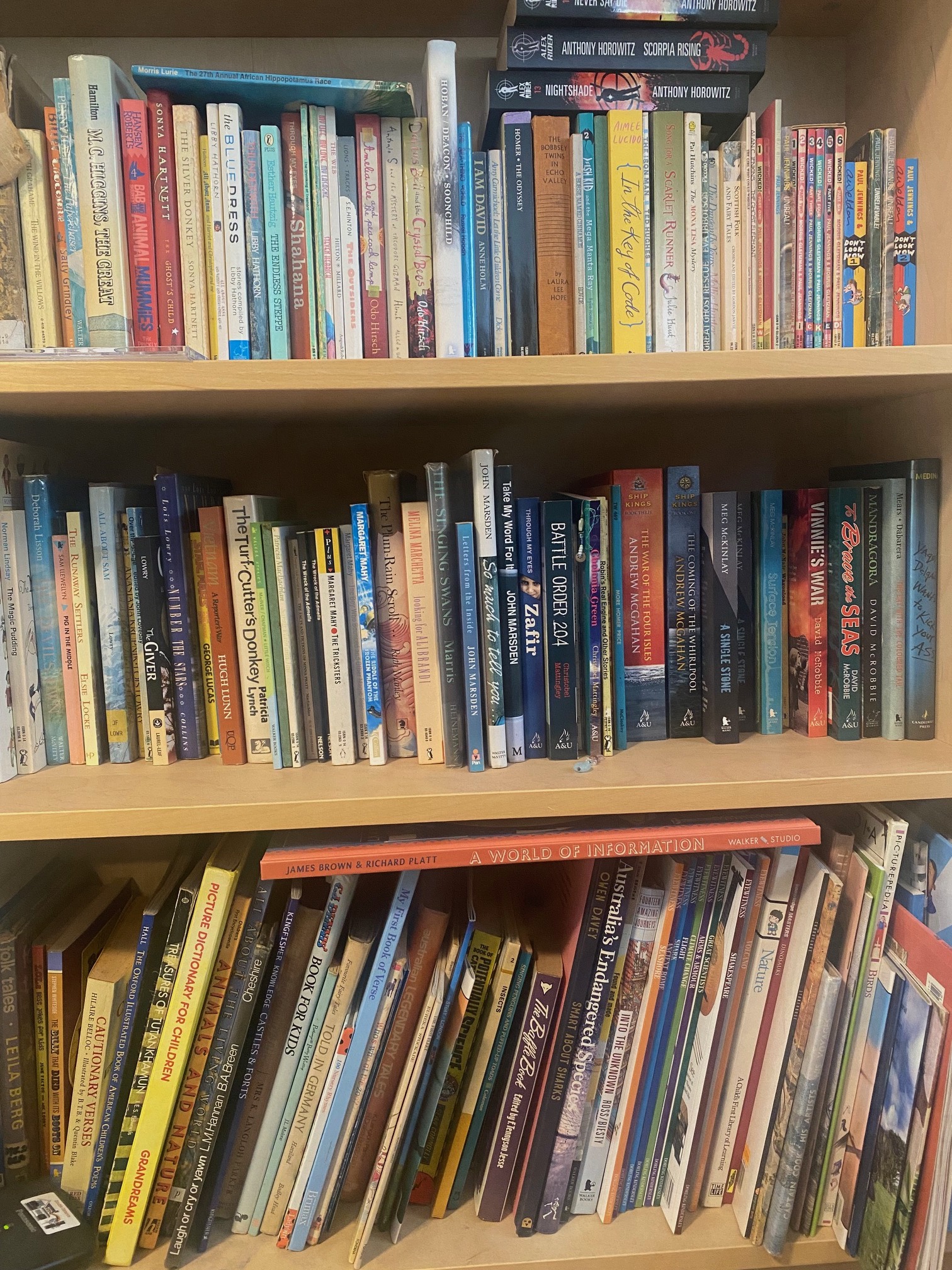
Flooding the classroom with books


Let’s skip back to the 1980s and 90s! At this time, I was fascinated with literature as a young teacher, even though I was not from a family where the value and joy of literature was modelled for me. But early in my teaching career (in the 1970s) at a difficult school in Western Sydney, I discovered how important literature could be for my students. I set about making reading and story-making central to my teaching program. These early classes in the 1970s had many students (35-40) who struggled to read, and who had little interest in literature. My solution was to flood my classroom with books. As I did this, I sought ways to encourage my students not only to read, but to gain a love of reading. 

While doing a Masters degree part-time (in my ‘spare time’) and later my PhD in the 1980s, I came upon the work of Charles Taylor who understood the power of story to change lives. I had learnt very early in my teaching career, that even difficult and disinterested children could be ‘captured’ by the power of story. Watkins work has pushed me to reflect even more on why this is so.


Going on Journeys

 As I taught my children in those early classes, I began to see stories had the ability to ‘take’ readers on journeys to places, times and experiences, and that these had the power to touch their hearts and minds. Charles Taylor was one of the writers who helped move me towards a deeper understanding of how we are affected by literature. His work on what he called “social imaginaries” was influential. These he argued lead us to imagine and reflect on our lived experiences as we read, and can even legitimise or explain much about ourselves and help shape hopes and desires.

I began to observe as a teacher for the first time, how the imagination of my students was creating frameworks that helped them to engage, understand and imagine their world through the stories, myths, dreams, and hopes they encountered through the characters in literature. For these children in quite difficult communities and families, literature was helping them to encounter ‘other worlds’ as I flooded the classroom with books. Their reading began to create rich contexts which had the potential to change and shape their lives. This of course, included what they believed, as well as their hopes, dreams and fears in life.


So, what did I learn from these experiences?

Another writer helped me on my way to a deeper understanding of what was going on. Why was my approach having such a profound impact on their lives? Anthony Esolen (Ten Ways to Destroy the Imagination of Your Child’), put his finger on one of the most fundamental insights. That is, “… imagination, memory and knowledge are not incompatible but related”. This might seem obvious, but as I read Esolen’s work along with others, I began to see connections with what I had observed in my classrooms in Western Sydney over 30 years ago. As I flooded my classroom with books, read to them regularly to enthuse them about story, and gave them access in the classroom to an ever-changing library of books that had appeal to them, I saw amazing changes as students were given access to ‘Other Worlds’ for the first time. This post has been a taster, I will return to the topic in future posts as I broaden my discussion on the things I learnt with my students.


Key References


1. Trevor Cairney, ‘Pedagogy and Education for Life: A Christian Reframing of Teaching, Learning and Formation’, Cascade, 2017, p. 122.

2. Trevor Cairney, 'Other Worlds: The Endless Possibilities of Literature', Heinemann, 1990.

3. Anthony Esolen, ‘Ten Ways to Destroy the Imagination of Your Child’. Wilmington, DE: 2010.

4. Chris Watkin, Biblical Critical Theory: How the Bible’s Unfolding Story Makes Sense of Modern Life and Culture’, Zondervan Academic: 2022.


Thursday, 22 September 2022

Building Communities of Literature & Learning in Our Classrooms

This is a cross-post from my literacy blog 'Literacy, Families & Learning'. It wasn't intended specifically for faith-based schools, but what I say has relevance NOT just for literacy, but also in informing our pedagogical ideas on how we sustain student communities in Christian and other religious schools.

One of the signs of a great book is that once it is finished you have a deep desire to tell someone about it, and perhaps even pass the book on to them. I can recall times when I reached the end of a moving novel and I would simply sit quietly, ruminating on the 'journey' I had just completed through the book. And later, there would be a deep urge to tell others about it. After a special book, we might read it again at some later point, or loan it to a friend and revisit the story in conversation with them.

Our classrooms and homes should be places where children read books and want to share their stories with others. This is certainly critical in the primary years of schooling, but so too it is possible and important within high schools. If literature is only read to prepare for exams, it is a sad state of affairs. Our classrooms can and should be 'communities of readers and writers'. But sadly, our students today are more likely to participate in groups in and outside school sharing social media videos like TikTok, talking about or sharing music, fashion, funny photos and so on online. While they are forming or supporting friendships and communities of practice, nonetheless these conversations are often trivial and superficial.

I shared in my book 'Other Worlds: The Endless Possibilities of Literature' stories from three class 'communities'. Classroom communities where literature was part of what bound the students together. One was a kindergarten in the cane fields of Queensland. As their teacher finished 'The Three Little Pigs' (Jacobs, 1969) the children shared their responses. Some repeated words or the details of the story, "the wolf wanted to eat the pigs", "he was a bad wolf", characters were mentioned and so on. Others responded more seriously and thoughtfully. "I've got a big bad wolf and I put him in water", "My big bad wolf got shot with hot rocks". Another said more reflectively, "The wolf got hurt because he tried to hurt the pigs".

I was able to observe a second reading community in a one-teacher school at which I taught many years ago. I had 31 children in a single classroom from Kindergarten (5 year olds) to Grade 6 (12 yr olds). When I arrived at the school I found many reluctant readers, and varied abilities across the grades. I set about flooding the classroom (school!) with books at all levels and with varied content. I was to observe how complex sub groups (or sub communities), developed as children read books and told others about them across grade levels. I also read to them and shared many books that stimulated their interests. 


A third reading community was a Kindergarten class; which in Australia is the first year of formal schooling for 5 year olds. I was part of the classroom for most of a school year as a co-teacher and researcher. During designated reading times, the students could grab a book and scurry off to one of many reading spaces: a secret cave in one corner; a castle made from cardboard boxes; an area created using the existing walls in one corner, as well as a cupboard for the other 'wall', and streamers hanging from the ceiling through which they entered; and as well, a small library surrounded by shelves filled with children's books.

What was common to each of the above three reading communities was that story was an essential part of the classroom life. Books were shared as a class, in groups and in informal settings. The children read together 'independently', in pairs or groups, and many opportunities were given for response and sharing. Each classroom in different ways demonstrated a number of similar things:

First, all were dynamic reading, writing and learning communities. 

Second, each exemplified how reading, while it can be solitary, is often shared with others, and that in the sharing, the desire to read is enriched and strengthened.

Third, they illustrated David Bloome's argument that "reading involves social relationships among people... including social groups and ways of interacting with others...".


If we want our children to experience reading in all of its forms, and to read literature that enriches their lives, extends their knowledge of the world, and helps them to grow as people, then community building must be a priority. The next time you watch a group of students sitting together with phone in hand sharing the latest video, ponder how the enthusiasm and excitement they are showing looking at phones, can be replicated in relation to books that can teach, inspire and enrich their lives.

Thursday, 7 June 2018

Literature, the Bible & Redemption

1. The importance of children's literature

Some readers of this blog might know that I also write a blog called "Literacy, families and learning". I've been doing it for 10 years and it aims to reach a broad audience "to provide practical, timely and sound support and advice for parents, teachers and teachers in training". It isn't written with a specifically Christian audience in mind, but if do you read it, I hope that you will see the influence of my Christian faith and worldview. This might be most evident in some of the posts I have written on Key themes in children's literature.
These posts intersect with my writing for a Christian blog that I also wrote (while the Director of CASE). The posts concerned Christian Writing for Children (here and here).

Above: J.R.R. Tolkien
In one of the posts I drew on the writings of C.S. Lewis and J.R.R. Tolkien and referred to Tolkien's view that the central Bible narrative account of God’s redemptive plan and work, is the central narrative that gives shape to all other narratives. I agree with him that in every story, there is a sense in which there is an echo of the biblical narrative.
J.R.R. Tolkien once said (to C.S. Lewis) that “The Christian story is the greatest story of them all. Because it’s the real story. The historical event that fulfills the tales and shows us what they mean.”

Tolkien also suggested to Lewis one night that "... just as a word is an invention about an object or idea, so a story can be an invention about truth."

At the core of the Bible is Salvation History; with a central narrative tracing both the history of Judaism and Christianity, and God’s redemptive plan for his people. In the beginning God created…and it was good. But sin entered the world, man rebelled against him, and so God placed a curse upon his creation that one day would end in judgement. But God always had a plan for such rebellion; a plan of redemption motivated by love. An amazing gift of grace; his own son sent to die and three days later to be raised from the dead to defeat sin and death, and one day, to usher in a new Heaven and a new Earth. This is God's plan that provides a way for his creation to be redeemed and restored.
 
In my first CASE post on Christian writing for children, I suggested that while there are many legitimate forms of writing for children (I suggested at least five types), I urged Christians to consider writing good fiction for the secular marketplace. One participant in a workshop I ran in 2008 as part of a CASE writers conference, took me at my word. Some years later 
Danielle Terceiro, wrote an interesting first novel for readers aged 12-14 years, 'Project Hot Potato' that tried to do this. While the echoes of the gospel are not strong in the book, it was an interesting attempt. In my presentation at the workshop I was arguing for the redemption of children's literature for the sake of the gospel, and suggested 5 possible responses and she attempted Type 5 where biblical links or parallels are at the thematic level. My aim at the workshop was to encourage Christians to write good publishable narratives for children that had biblical themes at their very foundation, and an absence of bad language, moral failures and sexually promiscuity and so on.
 
2. The place of God's redemptive plan for creation in literature


But in this post I want to remind readers that much literature is already suitable for parents to use as an extension of the biblical education of their children. While I'm not suggesting that literature can be a replacement for the Bible as the key text for life, what I am suggesting is that the gospel inhabits literature in stories that echo the central redemption narrative of the Bible. 

I suggest in chapter 7 of my new book 'Pedagogy and Education for Life', that to be human is to seek to understand our purpose in life. To live, is "to be immersed within an intertextual cacophony of stories that shape and influence the things we desire. From these stories, we read various representations of the future, and alternative visions of what Aristotle first called 'human flourishing'." In a sense, we are 'persuaded', 'convinced' or, as James Smith suggests, perhaps even 'lured', by these pictures and visions of the future.


Stories are always more than just disconnected and isolated accounts; they typically have a relationship to other larger metanarratives. Christian Smith in 'Moral, Believing Animals' suggested that narratives “seek to convey the significance and meaning of events by situating their interaction with or influence on other events and actions in a single, interrelated account.” 

We are shaped, at least in part, by the stories we absorb, give expression to, and help create. James K. A. Smith suggests this is no simple cognitive process (James Smith, 'Desiring the Kingdom', p.41). Rather, we are embodied creatures who absorb the stories of life and engage in rituals and cultural practices that shape our desires and our vision of the good life. This argument draws on Charles Taylor’s concept of the “social imaginary” in 'Modern Social Imaginaries'. This is discussed briefly in chapter 6 of my book. Taylor argues that societies are given direction by an imagined and hoped-for view of the world. This is not expressed simply in “theoretical terms, but is carried in images, stories and legends.” Humans are not given their major focus and direction simply by reasoning, but also through the imagination.

 
The stories that are part of our experience thus shape our vision of the good life, give focus to our desires, and direction to our lives. In exploring the relationship between love and community, Oliver O’Donovan reminds us of Augustine’s statement that a community is “a gathered multitude of rational beings united by agreeing to share the things they love.” ('Common Objects of Love', 20–24).  Stanley Hauerwas, in 'The Hauerwas Reader' suggested that in essence, a group of people come to see a common “view of the good,” and are hence capable of common action, cultural practices, and identity.

Classroom life is full of stories in varied forms, hence their importance.

3. So how do we make better use of literature?

In another book of mine 
('Pathways to Literacy', Cairney 1995, p.77-78) which I wrote some time ago for university students and teachers, I suggested that literature can act as:
  • a mirror to enable readers to reflect on life problems and circumstances
  • a source of knowledge
  • a source of ideological challenge
  • a means to peer into the past, and the future
  • a vehicle to other places
  • a means to reflect on inner struggles
  • an introduction to the realities of life and death
  • a vehicle for the raising and discussion of social issues
I'm pushing the above claims one step further in 'Pedagogy and Education for Life'. My point is simple. For many books, there are links or parallels at the thematic level, to the biblical redemption narrative. These stories demonstrate or echo biblical teaching. For example, salvation narratives, stories of redemption and restoration, parallels to biblical narratives or even biblical parables. Other less helpful books distort these biblical themes and require comment and critique. Such stories can be read at one level simply as nice tales, but at another level the key themes that parallel biblical themes can be discussed with children. We see this often in the way some authors treat the Christmas story and manage to write out the major salvation narrative. In many cases, the authors are not Christians, but Christian teaching may have indirectly influenced their writing. Many children's stories offer knowledge of events and life situations, that for the Christian would be seen as:

  • affirming that God is in control of his world and is unfolding his purposes for it;
  • acting as a mirror allowing the reader to reflect on life and their future in the light of biblical teaching;
  • leading us to consider aspects of the human condition (life and death, fear, loneliness, pain, loss, frailty, brokenness etc) that once again relate to biblical wisdom and teaching;
  • pointing to the central redemption narrative of the Bible.
Alternatively, literature can offer perspectives that Christians would see are at odds with biblical teaching and require comment. This type of critical reading of literature 'against the grain', is a vital skill for children to learn, so that as independent readers they will be better able to read books, view movies, listen to songs and read texts of all kinds with a biblical lens. Biblical engagement with literature of this type can begin very early (albeit in modest ways!).

4. An example - Teaching our children about death, human frailty and judgement

The topic of death is not a very popular one for parents. Many parents make the mistake of trying to hide the reality of death from their children, with the result that when their children do encounter it they may have difficulty coping. At this point I should confess to telling my eldest daughter (when she was about 3 years old), that our pet yellow budgerigar ("Mr Hooper") had got out of the cage and flown away. In fact, he had died. As non-Christian parents at the time, my wife and I weren't ready to deal with the topic so we simply lied about the bird's death (sorry Nicole!).

While there is little point in deliberately raising death prematurely for the child before they have the emotional maturity to deal with it, it's hard to artificially put a time frame on when it's a good time to speak of death.
While thankfully few children will have to deal with death and dying at too young an age, some will, and of course we have no way of knowing when,   and if this might be the case. Furthermore, from an early age they will be on the 'edges' of conversations and discussions that will give them their first hints that this life is not permanent for any living creature. An awareness of death may emerge very early with the death of a family member, or more commonly, through the death of an animal (typically a pet like Mr Hooper). However, more often the child's first awareness that all living things will one day die, might be through a book or a film, DVD or television program. As the child grows older, the chance of some first-hand experience of death will increase. By the teenage years a close experience with the death of a friend or loved one will be more common, and might well come in tragic circumstances.

That's where literature (and film of course) can help parents, in particular, to discuss the reality of death with their children. Books that address death can be read with children and by children themselves as a source of insight, comfort and emotional growth. Once again, I stress that this isn't a replacement for the Bible's discussion of death, and the fact that Jesus rescues us from any fear of death. But literature is a complement to our discussion of the Bible's teaching about death. At this point, I also want to stress that I am not deliberately ignoring classic works of Christian fiction that are more allegorical in their approach such as Bunyan's "The Pilgrims Progress", The Chronicles of Narnia written by C.S. Lewis, or R.C. Sproule's, The Prince's Poison Cup. This genre has a different place in our literary traditions that I won't address in this already long post.

Let me offer a few examples of how some books raise the theme of death and dying.

5. Some books that deal with death

a) Traditional fantasy and fairy tales

Fantasy has always been a common first introduction to human frailty and death. Fairy tales from many different cultural traditions have not been afraid of death as a theme. Traditional versions of 'Little Red Riding Hood', 'The Three Pigs', 'Jack and Beanstalk', 'The Gingerbread Man', 'The Little Match Girl' and many other tales, all deal with death in graphic detail. However, today it is common for such tales to be sanitised and death expunged or pushed into the background of the narrative. But traditional fairy tales, myths and legends still offer a rich array of stories that deal with death. In contemporary literature there are also many good examples of books that deal with this important theme.

b) Some books for younger readers (0-6 years of age)


I’ll always love you
, Hans Wilhelm – a delightful picture book that tells of the death of a little boy’s dog called Elfie and the impact of the death on him. This would be appropriate for children aged 3-7 years. There is so much to talk about in this story of devotion and loss. Be warned, children ask the most challenging questions about stories, e.g. "Do dogs go to heaven?"

Granpa by John Burningham - This moving book provides provides an insight into death through simple words and pictures of the relationship between a girl and her grandfather and the impact of his death. Some struggle with the staccato nature of the text (that mirrors the at times disconnected nature of child/adult interaction), but this is a wonderful book! The story shows how their relationship changes over time from the child being dependent on the adult, to Granpa beginning to show the signs of the slow creep from life to death. From dependence to 'independence' but one day when he dies, life goes on.  

Love You Forever, by Robert N. Munsch -- this book tells of the cycle of life as a child grows to be a man and a mother grows to be an old lady; and of course of the relationship between a boy and his mother as they both grow old. Some find it a little unusual, but it is an intriguing treatment of the topic from a well known children's author.

Nana Upstairs and Nana Downstairs, by Tomie de Paola - Four-year-old Tommy enjoys his relationship with both his grandmother and great-grandmother, but eventually learns to face up to their inevitable death.


c) Primary Readers (7-12 years of age)


Charlotte’s Web
, E.B. White – It’s hard to go past this classic tale of survival, hope, life and death. Even if it has been seen first on DVD it is worth reading with your children. In his masterly tale E.B. White shows through Wilbur (the pig), Fern (the little girl) and Charlotte (the spider) how death is part of life; and yet, how death is not the end. Life goes on.


Number the stars, Lois Lowry – This wonderful book tells of the escape of a Danish Jewish family by boat from the Nazis in World War II. It is a novel that touches on numerous themes such as human cruelty, life, death and survival.

Sadako and the Thousand Paper Cranes
by Eleanor Coerr - this book is based on the true story of an 11-year-old Japanese girl diagnosed with leukaemia as a consequence of the bombing of Hiroshima. Sadako Sasaki was just 2 when the atom bomb was dropped on Hiroshima. The author does not hide the horrors of death providing vivid descriptions of her pain, weakness, sadness, and loneliness. The book also shows the impact on a family of the tragic death of a child. For the Christian parent there is also the opportunity to talk about pain, suffering and judgement.


d) Teenagers

Death of a Princess, by Susan Geason - When the Pharaoh's beautiful eleven-year-old daughter, Isis, dies under suspicious circumstances, the beautician becomes the prime suspect! This mystery is set in Ancient Egypt during the reign of the mighty Ramesses II. For the older reader there is a lot to get your teeth into here, particularly the contrast of the stories treatment of death and the Bible's

Bridge to Terabithia, by Katherine Paterson - This brilliant book won the Newbery Medal in 1978. It is the story of two lonely children who create a magical forest kingdom. Paterson drew inspiration for the novel from the death of a friend of her son, who was struck by lightning at a beach. It is the story of fifth grader Jesse Aarons, who befriends his new neighbour Leslie Burke after losing a race to her at school. This touching story ends in tragedy.

6. Some final comments

What I've tried to show in this post is to try to demonstrate in 'Pedagogy and Education for Life', particularly in chapter 7, 'Storytelling and life'. If 'education is the whole of life of a community and the experience of its members learning to live this life from a specific standpoint or end goal', then we need to understand that every story, every book, offers insight into the greatest story ever told. 

  
The purpose of the post is not to encourage Christian parents or teachers to put the Bible to one side and present the gospel according to literature. Rather, the purpose is to highlight how literature has much to offer in terms of the discussion of biblical themes as part of narrative encounters in books and even film. Nor am I suggesting that parents and teachers ruin the reading of literature by dissecting books to such an extent that children are not given the opportunity to simply enjoy the narrative themselves. And I'm definitely not saying that we should all become bibliotherapists, although some psychologists use some of the books I've mentioned as part of their clinical work. 

But I do want to stress that literature offers many possibilities for rich discussions with our children that have significance for their developing faith in Christ.


AN UPDATE - Availability of 'Pedagogy, Education and Life: A Christian Reframing of Teaching, Learning, and Formation'

My book is now be widely available throughout the English Speaking world now. Major sites like Amazon have it in all three forms, paperback, hard cover and Kindle version. Let me know if you have availability issues. There shouldn't be problems. The Wipf & Stock model allows for copies to be printed on demand and delivered in very short timeframes (days not weeks).

Visit the Wipf & Stock site HERE if you'd like review copies. Let me know if you have problems.