Showing posts with label children's literature. Show all posts

Sunday, 17 August 2025

Australian Children's Book Council Awards for 2025

This is a cross post from my Children's Literacy Blog - Literacy Families & Learning


Book of the Year: Older Readers

WINNER

'I’m Not Really Here' – Gary Lonesborough (A&U Books for Children and Young Adults).

"A moving coming-of-age story with so much heart. For readers who enjoyed Heartstopper." --BOOKS & PUBLISHING 

Honour Books

'Birdy' Sharon Kernot 

'Into the Mouth of the Wolf' Erin Gough (Hardie Grant Children’s Publishing)

Book of the Year Award: Younger Readers

WINNER

'Laughter is the Best Ending' Maryam Master. Illustrated by Astred Hicks (Pan Australia)

Honour Books

'Aggie Flea Steals the Show' Tania Ingram, and illustrated by A. Yi (Scholastic Australia)

'Fluff: Mess Up!' Matt Stanton (ABC Books) 

Book of the Year Award: Early Childhood 

WINNER

'The Wobbly Bike' by Darren McCallum

Have you ever helped a child to learn to ride their first bike? Most of us have and it isn't always easy. Those wobbly wobbly starts as we sit them on the bike, walk beside them, try to steady them before you let them move a little on their own? It is usually stressful for child and parent. 

In this delightful picture book Darren McCallum was inspired by his three year daughter who one day was racing out the door. She had been given a bike and one morning her Dad caught her heading outside. He asked where she was going, to which she replied, "I'm going outside to ride my wobbly bike."

Cover of The Wobbly Bike picture book showing a girl riding a bike, three birds flapping behind her
 

This experience was of course the inspiration for this wonderful picture book. He 

One afternoon when his daughter Summer was small, Darren McCallum took the training wheels off her bike. McCallum is a painter by trade who lives in Australia's hot Top End city of Darwin. He was something of a storyteller to his brothers and sisters while growing up.

When he eventually decided to give it 'a crack' (as we sometimes say in AUS), he remembered that Wobbly Bike. 

The Wobbly Bike, with illustrations by the well-known illustrator Craig Smith, is the well-deserved winner of the 'Early Childhood' Book award in 2025.

 Honour Books Younger Readers (Ages 0-6 Years)

'One Little Dung Beatle' by Heather Potter (illustrator) & text by Mark Jackson 

'How to Move a Zoo' by Kate Simson (illustrator) & Owen Simpson 

Picture Book of the Year Award 

WINNER 

'The Truck Cat' written by Deborah Frenkel (Author) and illustrated by Danny Snell 

The Truck Cat is a story about cats and humans, immigration and identity, and homes that can be lost and yet found again. 

Author Deborah Frenkel is an award-winning writer of books for children. She grew up in the 80s and 90s and thought she might just be a 'business lady'. But that wasn't to be, and after working in advertising in her day job writing ads for varied clothing brands, she changed course. She now lives in Melbourne, Australia, on the traditional lands of the Bunurong People of the Kulin Nation. 

Her delightful book is well supported by the illustrations of multi-award-winning artist Danny Snell.

Her delightful book is well supported by the illustrations of multi-award-winning artist Danny Snell. 'The Truck Cat' is the perfect book to inspire kindness and compassion in young children everywhere. Now this lead should get you in:
 
"Some cats are house cats. Some are apartment cats.
But Tinka is a truck cat. Tinka lives everywhere."

 
Tinka travels with his human owner Yacoub. But no matter how much they travel, home always feels very far away for both of them.
Yacoub drives his truck to make a living, learning the landscape of a new country along the way, and longing for connection.
 
But on one trip, Tinka and Yacoub are unexpectedly separated. But they are both determined to find one another. In doing so, they find even more than they expected …

"In
The Truck Cat, Deborah Frenkel’s beautiful writing takes the reader on a gentle and often amusing ride. Yacoub’s story is one of resilience, yearning and sighs of sadness. Tinka the cat makes sure there is sunshine and smiles along the way. Danny Snell’s gorgeous colour palette splashes movement and life on every page. From vignettes to double page spreads, the combination of art and text presents a heartfelt, hopeful story of finding home …"

Sandhya Parappukkaran, the award-winning author of 'The Boy Who Tried to Shrink His Name', suggests 'The Truck Cat' is a must-read picture book’. At a time when the world is in turmoil, much of it due to ignorance, intolerance and bigotry, there could not be a more timely choice for a book that will bring children right across the country together, in a glorious celebration and a move towards greater acceptance and empathy.

This is a lovely picture book that combines great storytelling that touch on the heartwarming emotions of loss, companionship and love. It's pitched perfectly to entertain and move young readers, as well as to gently open their hearts and minds.’

 Honour Books

 'These Long-Loved Things' (illustrator) & Josh Pyke (text)

"A moving coming-of-age story with so much heart. For readers who enjoyed Heartstopper." --BOOKS & PUBLISHING


'Afloat' Freya Blackwood (illustrator), Story by Kirli Saunders (Little Hare)

'These Long-Loved Things' Ronojoy Ghosh (illustrator), Story by Josh Pyke (Scholastic Australia) 

Other Picture Books Nominated 

'A Leaf Called GREAF' by Kelly Canby


'AFLOAT' by Kirli Saunders and text by Freya Blackwood

'The Garden of Broken Things' by Freya Blackwood 

'We Live in a Bus' by Dave Petzold. 


Book of the Year Award: Eve Pownall Award for Information Books

 Winner

'Always Was, Always Will Be' by Aunty Fay Muir & Sue Lawson (Magabala Books)

 Honour Books

'Making the Shrine: Stories from Victoria’s War Memorial' Laura J Carroll (The Crossley Press)

South With the Seabirds – Jess McGeachin (A&U Books for Children and Young Adults)

Book Of The Year - New Illustrator

 Winner

 Grow Big, Little Seed – ill. Sarah Capon (Bright Light)

Worthy Picture Books to Note but not awarded major prizes

1. 'AFLOAT' by Kirli Saunders & Illustrated by Freya Blackwood (Little Hare)

"Roam the water with me. We are here to learn.

Here to spin wisdom, to grow …"

This wonderful picture book is from award award-winning author Kirli Saunders (a proud Gunai woman) and seven-time CBCA-winner Freya Blackwood comes 'Afloat'. And what a triumph!

This is a story told in a time of climate crisis, but against a backdrop of a changed environment. An Aboriginal elder leads a child along the waterways, sharing her People's knowledge, skills like weaving and much more. All the while a child is leaning, discovering and gathering community and seeing their world extended and enriched along the way.

A wonderful new book about the skill of our Indigenous nations. In this book the skill of weaving has a special focus on weaving. But more broadly, it seeks to help young readers to remember and honour our First Nations. This wonderful book has a special focus not just on their unique skills, but also their wisdom and many lessons as they look with hope to the future.

2. 'The Garden of Broken Things' Written & Illustrated by Freya Blackwood

"One day, curious Sadie follows a cat into the tangled vines behind the lonely house at Number 9, Ardent Street.

Deep in the undergrowth, past all the twisted, rusted things, Sadie finds the cat sitting on the lap of a woman, bent with time and weariness.

Sadie has found the Garden of Broken Things." As Maura Pierlot wrote in her excellent review of this picture book in 'Reading Time'.

"A story’s first line can do so many things: capture attention, conjure emotions, pique curiosity, create anticipation, evoke nostalgia. The opening line to The Garden of Broken Things masterfully achieves all these things and more.

One day, Sadie follows a cat into the scrub behind Number 9 Ardent Street, where tangled vines concealed things from another time … things that had come to a final halt. Deep in the undergrowth, she finds the cat sitting on the lap of a woman, bent with time and weariness." 

This intriguing and unique picture book is a worthy member of the Children's Bookweek Shortlist in 2025. Freya as we've come to expect has crafted with warmth and emotion and allows us to enter into the life of Sadie as she explores her world. This includes memories, grief and loss, her natural world and her own journey as she grows older and comes to understand the changes in herself.

3. 'We Live in a Bus' by Dave Petzold


Sunday, 25 August 2024

Australian Children's Book Awards: Winners & Honour Books Younger Readers (Ages 0-12 Years)


The Winners & Honour Books Younger Readers (Ages 0-6 Years)

Voting has been completed and winners in all categories announced for younger readers.  As always there were SO many great books. Glad I'm not a judge this year! I should point out that this year we have the appointed judges of the awards, and for some reason there a group of 'Appointed Judges' also suggest winners. 

In this post I will review nominations and the winners in the 'Early Childhood' & 'Picture Book of the Year' Awards.


1. Early Childhood (0-6)

And the winner is....

'

And what a worthy winner! 

Quick! Come and see! Something fabulous, it’s . . . me!

Gymnastica Fantastica! is a joyful and exuberant picture book about a child discovering and attempting new physical skills and putting on wonderfully imperfect shows for whoever will watch them.

Gymnastica is a small person with big energy, as they bend and balance, bounce and roll, attempt a cartwheel and a spectacular trapeze flip-out finale. Written in playful rhyming text and with brightly energetic and appealing illustrations, this is a book that kids and parents alike will find irresistible to read aloud and delight in its energy and humour.

The CBCA judges commented…

This book conveys so much energy and life which children will connect with immediately. The young child’s voice permeates the tight, joyful rhyming text which includes a rich assortment of verbs, nouns and adjectives. Pencil, ink, crayon, gouache, and digital illustrations are filled with zoom in action and movement matching the equally energetic text.

And the 'Shadow Judging' winner is...


Bob Graham is one of our finest writers and illustrators. Once again he doesn't disappoint! The judges said of this book:

"An exuberant group of children spill out from the confines of a grey apartment block, finding joy in a simple box of chalk. The power of creativity and strength in community shine...  The language is simple and succinct... and rich in imagery."

 As always, his illustrations have the usual use of watercolour, pastel colours, gentleness and warmth. The illustrations are so sensitively created in watercolour, pencil and pastel colours. And as always Graham leaves the reader with a view of how the world should be.

Honour Books

Now here is an unlikely pairing! And an even more unlikely dance pairing.

Bear and Duck are best friends, but they are very different. Duck likes to try new things, and Bear ... well, Bear likes not to.

When Duck needs a friend for her dance class, Bear reluctantly agrees. Bear’s big size causes problems at first, but he soon discovers that he might just be a very good dancer.

 'Grace and Milligan' Caz Goodwin & Illustrated by Pip Kruger

Grace lives next door to old Mr Milligan and his goat Charlie. They are the best of friends. But when Mr Milligan’s beloved goat dies, everything changes. Will Grace be able to help her friend overcome his sadness?

Grace and Mr Milligan is a heart-warming story of grief, love and the healing power of friendship.

2. Book of the Year Picture Books (Ages 0-18 Years)

Entries in this category should be outstanding books of the Picture Book genre, in which the author and illustrator achieve artistic and literary unity or, in wordless picture books, where the story, theme or concept is unified through illustrations. Ages 0-18 years.

Note: Some of the books in this category may be for more mature readers

Winner Picture Book

'Timeless' by Kelly Canby


Emit (whose parents turned back time to name him) is surrounded by busyness. Dad's too busy to read stories, Mum is too busy to play games and Emit’s brother and sister are simply too busy doing nothing, to do anything at all. Emit tries everything he can think of to get more time... but it’s not until Emit tries to 'buy' some time, that he learns the secret which is, if you want time, you have to make it.

Note: This award is for picture books that are relevant and of interest for readers 0-20 years of age.

BUT: Amazon lists it as suitable for children 0-8. Parent discretion should be exercised.

And the Shadow Judging Winner is...

A little lone werewolf prowls the nights on his own until he finds friendship in the most unexpected of places. This is a  whimsical and tender picture book in the spirit of Julie Fogliano’s 'My Best Friend'.

Every night at midnight, Felix turns into a wolf. His hands and feet turn into velvety paws, his senses become sharper, and he grows a long, furry tail. Felix loves exploring on four legs, and he has the nighttime world to himself. There’s no one else like him.

During the day, Felix is human, but it still feels like there’s no one like him. The other kids used to invite him to play, but now they keep their distance. That’s fine, though, Felix doesn’t need anyone else. But after a chance encounter, Felix the little lone wolf starts to wonder whether he might find his pack after all.

 There were other awards as usual in additional categories:

3. Book of the Year: Eve Pownall Award

This award is for factual books.

Entries in this category should be books which have the prime intention of documenting factual material with consideration given to imaginative presentation, interpretation and variation of style. Ages 0-18 years.

Winner: 'Country Town'

Friday, 15 September 2023

Other Worlds: Literature and Stories as Gateways

While the blog focus of this blog is pedagogy, and has been unpacking the arguments contained in “Pedagogy and Education for Life”, you might not be aware that I’ve written a number of other books. These include some on literacy and literature. One of my early books was ‘Other Worlds: The Endless Possibilities of Literature’ (T.H. Cairney, Heinemann: Portsmouth New Hampshire, 1990). I’ve been revisiting my literature book recently, as I grapple with an interesting new book about Critical Theory, (C. Watkin, Biblical Critical Theory: How the Bible’s Unfolding Story Makes Sense of Modern Life and Culture’, Zondervan Academic: 2022). Don’t stop reading just yet! I’m writing about this book somewhere else.

In this post, I want to try to explain the connection ‘Biblical Critical Theory’ and my thoughts on pedagogy and education. While Watkins book was the catalyst for me focussing again on ‘Story’, I want to look closely at the power of literature to challenge, influence and even transform us. This of course has connections to Chapter 7 in ‘Pedagogy and Education for Life’ in a chapter titled ‘Storytelling and Life’.


Watkins book has also made me revisit the work of Stanley Hauerwas, Oliver O’Donovan, and Charles Taylor who all get mentions in my pedagogy book. So, what are the connections between the more practical book I wrote about literature almost 30 years before my pedagogy book.


Flooding the classroom with books


Let’s skip back to the 1980s and 90s! At this time, I was fascinated with literature as a young teacher, even though I was not from a family where the value and joy of literature was modelled for me. But early in my teaching career (in the 1970s) at a difficult school in Western Sydney, I discovered how important literature could be for my students. I set about making reading and story-making central to my teaching program. These early classes in the 1970s had many students (35-40) who struggled to read, and who had little interest in literature. My solution was to flood my classroom with books. As I did this, I sought ways to encourage my students not only to read, but to gain a love of reading. 

While doing a Masters degree part-time (in my ‘spare time’) and later my PhD in the 1980s, I came upon the work of Charles Taylor who understood the power of story to change lives. I had learnt very early in my teaching career, that even difficult and disinterested children could be ‘captured’ by the power of story. Watkins work has pushed me to reflect even more on why this is so.


Going on Journeys

 As I taught my children in those early classes, I began to see stories had the ability to ‘take’ readers on journeys to places, times and experiences, and that these had the power to touch their hearts and minds. Charles Taylor was one of the writers who helped move me towards a deeper understanding of how we are affected by literature. His work on what he called “social imaginaries” was influential. These he argued lead us to imagine and reflect on our lived experiences as we read, and can even legitimise or explain much about ourselves and help shape hopes and desires.

I began to observe as a teacher for the first time, how the imagination of my students was creating frameworks that helped them to engage, understand and imagine their world through the stories, myths, dreams, and hopes they encountered through the characters in literature. For these children in quite difficult communities and families, literature was helping them to encounter ‘other worlds’ as I flooded the classroom with books. Their reading began to create rich contexts which had the potential to change and shape their lives. This of course, included what they believed, as well as their hopes, dreams and fears in life.


So, what did I learn from these experiences?

Another writer helped me on my way to a deeper understanding of what was going on. Why was my approach having such a profound impact on their lives? Anthony Esolen (Ten Ways to Destroy the Imagination of Your Child’), put his finger on one of the most fundamental insights. That is, “… imagination, memory and knowledge are not incompatible but related”. This might seem obvious, but as I read Esolen’s work along with others, I began to see connections with what I had observed in my classrooms in Western Sydney over 30 years ago. As I flooded my classroom with books, read to them regularly to enthuse them about story, and gave them access in the classroom to an ever-changing library of books that had appeal to them, I saw amazing changes as students were given access to ‘Other Worlds’ for the first time. This post has been a taster, I will return to the topic in future posts as I broaden my discussion on the things I learnt with my students.


Key References


1. Trevor Cairney, ‘Pedagogy and Education for Life: A Christian Reframing of Teaching, Learning and Formation’, Cascade, 2017, p. 122.

2. Trevor Cairney, 'Other Worlds: The Endless Possibilities of Literature', Heinemann, 1990.

3. Anthony Esolen, ‘Ten Ways to Destroy the Imagination of Your Child’. Wilmington, DE: 2010.

4. Chris Watkin, Biblical Critical Theory: How the Bible’s Unfolding Story Makes Sense of Modern Life and Culture’, Zondervan Academic: 2022.


Monday, 6 June 2022

The Role of Story in Shaping Hearts & Minds

I devote a whole chapter in my book ‘Pedagogy andEducation for Life’ to stories and storytelling. In this post, I just want to make three points about story, which cannot be emphasised too many times. I’ve just posted on my ‘Language & Literacy’ blog about some wonderful children’s books, which prompted me to discuss the impact that stories have on children’s lives. I’m not simply speaking of stories in books, but rather the impact of stories of all kinds on how our children see the world. Three quick points:


First, stories in whatever form, can shape our hopes, goals, desires and views of the world. So, as teachers and parents, the choices we make - when we share stories and literature with our children, or when we allow them to watch specific television programs and movies - matter!


Second, stories can shape our vision and desires for life. Oliver O'Donovan reminded us of Augustine’s statement that a community is “a gathered multitude of rational beings united by agreeing to share the things they love.” Such groups whether friendship groups, teams, classrooms, clubs etc, influence our ‘hearts’ and minds. In essence, through them we can come to have a common “view of the good.” Or, put another way, the things that matter to them and shape their lives.


Third, one’s goals, desires, views of the world and varied cultural practices shaped, might be good, bad or inconsequential for our children.


My Christian readers will take comfort in knowing that the Bible is central to their lives and that of their children. As such, this can influence and shape goals, desires and views of the world. And of course, my readers who have other faiths will point to other key religious books and teachings that shape who they are. Others will trust in their children to make good choices, and simply try to influence them within the home, through their own values and actions.


But note this. Our children spend much of their lives talking and engaging with other children like them, and spending time on varied social media, much of which teachers and parents don’t use. As such, there are many influences through the varied “communities of practice” in which they live day by day. Hence, within the many and varied real and online communities that our children inhabit, there are ideas and ‘loves’ that are not scrutinized by parents or teachers.  


Margaret Meek suggested that the writing of others is “infectious”; and this she always hoped for as a writer. The stories that are part of our experience can shape our vision of the good life, give focus to our desires, and direction. And the stories that are part of our experience shape our vision of the good life, giving focus to our desires, and lead us down different paths.


Summing up, story can challenge, move us and lead us to reflect on our lives. And the stories of life in whatever form, helps us to deal with all of life’s emotions including love, hate, fear, confidence, chaos, certainty, weakness, strength, success, and failure. Stories are potentially formative, influencing our attitude toward the ultimate object of love—the God of the universe—who has made us for a future kingdom and an everlasting hope and glory.


Sunday, 27 February 2022

When Fears Rush In: How can we help our children to overcome fears in times of crisis?

When fears rush in, how can we support our children?

In light of the crisis in Ukraine, while nations seek to push back an international bully, parents across all nations will wonder, how can we encourage and reassure our children? As children see and hear newsflashes that adults seem very interested in, what might they be thinking. And if they ask questions about the situation in Ukraine, what might we say? 

This is a cross post from another blog I write. I don't usually do this, but I think the practical challenge to read to, and with our children, at this time is important. People of faith will of course place their trust not just in self and circumstances. But for our children, it will be helpful to spend more time with them and allow opportunities for them to ask questions and allow their fears to surface. Families will talk and pray with their children. As well, they might use literature as a context for further reflection and opportunities to chat about their fears.

Throughout history, stories have been helpful to allow humans to gain insights into specific life situations, as well as comfort and encouragement not to allow fear to take a hold of them. This post looks briefly at a number of wonderful books that might be helpful to share at this time to allow any lingering fears within our children to be discussed. These aren’t necessarily, the ‘magic’ books that will help to remove all fear, they are examples of books that might allow parents to open up difficult fears, shine a light on them and offer comfort and hope to our children.


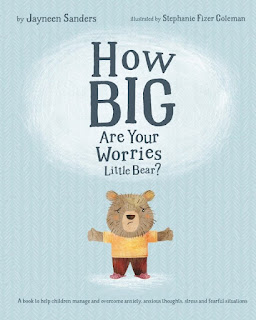
1. 'How Big Are Your Worries Little Bear?' by Martin Waddell & illustrated by Barbara Firth


Little Bear is a worrier. He worries about everything! But with Mama Bear’s help, he soon learns his worries are not so big after all. 

Through this engaging and beautifully illustrated story, children will learn that everyday worries and fears can be overcome. It just takes a willingness to share with a helpful listener, and an understanding that making mistakes is how we learn. 

Also included are Discussion Questions for parents, caregivers and educators, and extra hints to help children manage anxiety.

Recommended age: 3 and up


2. 'What a Bad Dream' by Mercer Mayer


Nightmares happen to everyone, including Little Critter. One night, one of his dreams starts out great, with him skipping baths, eating fudge pops for breakfast, and getting a gorilla as a pet. But it quickly turns into a nightmare when he realizes his family is nowhere to be found, so he has no one to read to him, tuck him in, and give him a hug. Everything is better when he wakes up to his mom and dad comforting him.


3. 'Wilma Jean the Worry Machine by Julia Cook and Illustrated by Anita Dufalla 


"My stomach feels like it's tied up in a knot.
My knees lock up, and my face feels hot.
You know what I mean?
I'm Wilma Jean,
The Worry Machine."


Anxiety is a subjective sense of worry, apprehension, and/or fear. It is arguably the number one health problem in most nations. While common, anxiety in children is often misdiagnosed or even overlooked. Everyone can feel fear, worry and apprehension occasionally. 


This is a fun book that addresses the challenge of anxiety in a way that relates to children of all ages. It also offers strategies for parents and teachers to use with children to lessen the severity of anxiety. The book aims to helpchildren develop tools to feel more in control of anxiety. The book also includes a note to parents and educators with tips on dealing with an anxious child.


4. Can't You Sleep Little Bear? by Martin Waddell & illustrated by Barbara Firth


Little Bear can t sleep. There is dark all around him in the Bear Cave. Not even Big Bear s biggest lantern can light up the darkness of the night outside. But then Big Bear finds the prefect way to reassure Little Bear and help him fall fast asleep 


Martin Waddell is widely acknowledged as one of the greatest living writers of books for children. His work includes Farmer Duck, Owl Babies and the 1989 Kurt Maschler Award-winning The Park in the Dark, also illustrated by Barbara Firth. In 2004 he won the prestigious Hans Christian Andersen Award. 


Barbara Firth won the Kate Greenaway Medal for Can't You Sleep, Little Bear? She illustrated over 30 picture books in her lifetime, including You and Me, Little Bear; Sleep Tight, Little Bear; Let's Go Home, Little Bear; Tom Rabbit; and the 1989 Kurt Maschler Award-winning The Park in the Dark.


 5. 'The Invisible String' by Patrice Karst & illustrated by Joanne Lew-Vriethoff 


‘The Invisible String’has been acclaimed as a wonderful tool for helping children to cope with separation anxiety, loss, and grief. It is a relatable and reassuring contemporary classic. The story centres around a mother who tells her two children that they're all connected by an invisible string. "That's impossible!" the children insist. But still they want to know more: "What kind of string?" Their mother says it is simple. There is “An Invisible String made of love. Even though you can't see it with your eyes, you can feel it deep in your heart, and know that you are always connected to the ones you love."


The book poses many questions. “Does everybody have an Invisible String? How far does it reach? Does it ever go away?” It is a wonderful picture book for all ages. It explores questions about the intangible yet unbreakable connections between us, and those who love and care for us. The book will allow deeper conversations about love, fear, security and hope.


The book has been recommended and used by parents, bereavement support groups, foster care and social service agencies. It has also been embraced by military library services, church groups, and educators. This special book offers a simple approach to dealing with loneliness, separation, and loss.  with an imaginative twist that children easily understand and embrace, and delivers a particularly compelling message in today's uncertain times.


6.  'When Hitler Stole Pink Rabbit' by Judith Kerr


This is a book for older readers 10-13. It is a semi-autobiographical classic, written by the beloved Judith Kerr, it tells the story of a Jewish family escaping Germany in the days before the Second World War. It tells the story of Anna living in Germany in 1933. As a child, she has not listened to talk of a leader called Adolf Hitler. She is too busy with her schoolwork, Friends and tobogganing.


This beautiful new edition celebrates the fifty-year anniversary of an adventure that Michael Morpurgo called “The most life-enhancing book you could ever wish to read.” But one day Anna and her brother Max are rushed out of Germany in alarming secrecy, away from everything they know. Their father is wanted by the Nazis. This is the start of a huge adventure, sometimes frightening, but also funny and always exciting.


Judith Kerr wrote the book based on her own journey, so that her own children would know where she came from and the lengths to which her parents went to keep her and her brother safe. It is recognized today as a classic that is required reading for children all over the world. 


Saturday, 30 October 2021

Revisiting the Imagination: A gift to help us find true 'life'

In the past week, I've been doing a lot of thinking about the imagination. It's a topic I've been exploring for over 30 years. I've just uploaded a post on another blog 'Literacy, Families and Learning' concerning how children access and help make sense of their world through stories. I've been writing my literacy blog since 2007, and it was and still is for a very broad audience of teachers, parents, librarians, literacy and Literature fanatics. Readers of the blog come from many nations. The majority are not Christians, and probably not people of faith at all; although a number from the Middle East, are believers in God. 


As I wrote the content I posted yesterday, I was reminded, that there is still much suspicion of the imagination and the power of stories in some religious circles. But, as well there is just as much suspicion of it pedagogically, the way we teach and encourage it in practice. There is also great misunderstanding of how it can be used as we learn; even amongst people of no faith! And yet, as I wrote in 'Pedagogy and Education for Life: A Christian Reframing of Teaching, Learning and Formation', God who himself is imaginative, made us as "creatures who can use our imaginations to understand his purposes for us" (p.122).


The imagination is not something that people of faith should find problematic. No, it is a gift from God! In my book, I quote another very helpful book by Veith and Ristuccia, titled 'Imagination Redeemed' which has much to which I say Amen! People of faith must reclaim the imagination at creation for the good purposes of our God. It isn't to be feared, except when used for ungodly purposes. We were gifted with the imagination to enhance our communication with one another, as we express our sense of wonder and surprise in those ‘aha’ moments of life, but also to communicate with one another (as does the novelist) to surprise and challenge us to look beyond ourselves to the one who made us, and all that was for our good. 


As I write in my book, the imagination is as an "intellectual activity of the mind that connects prior and new knowledge and experiences with our grasping after the unknown. It is part of the way we make sense of and respond to our world, but it also helps us to ponder the world beyond" (p.122).


If you are a teacher, or have your own children, you should not be afraid to stimulate their imaginations. Nor, should you see it as mere frippery; just something to encourage only after the 'real' study or work is done. No! The imagination is a gift of God to be embraced and used as we seek to know him and his plans for our lives. Never, of course as a way to dismiss what he teaches in his word; it is another way that he has gifted us. As my colleague (and namesake) Trevor Hart writes in 'Between the Image and the Word' in quoting Richard Kearney, the imagination is pervasive "a feature of our existence". 


Hart argues that the imagination is a critical part of our humanity, with many connections to the mundane and everyday activities of life. It can involve mental activities like “expecting, planning, exploring, fearing, hoping, believing, remembering, recognizing, analyzing, empathizing, loving, conjecturing, fantasizing, pretending,” as well as the more specialized creative activities of life that also reflect our ability to imagine. These include of course, language, art, literature, music, and invention.


In my literacy post published yesterday, I explored in detail the topic of Intertextuality, which in is in essence means, the interconnection between texts written and read. Such connections might affirm ideas, offer us new insights, or help us to grasp the depth of meaning of something in those “aha” moments, when another text challenges, inspires, or perhaps even create dissension. As Christian parents or teachers this might raise worries and concerns, but we must not fear the imagination. Instead as creative beings ourselves, we need to engage and discuss our imaginative interpretations and insights so they are accessible for evaluation, testing and the discerning of ultimate truth.