Showing posts with label faith centered education. Show all posts

Tuesday, 30 August 2022

Why 'Kidwatching' is critical for parenting and teaching.

One of the greatest challenges for Christian education institutions, is how to build and sustain the centrality of their Christian beliefs, with pedagogy that is consistent with this faith. While a specific faith would have underpinned all religious schools when first established, maintaining such a focus and foundation can be difficult. Far too many faith-based educational institutions end up measuring their success based on the maintenance of academic, cultural and sporting standards and whether parents are satisfied ‘customers’. This is not to say that these things are unimportant, although parents are partners not 'customers' or clients! Faith-based institutions were always meant to offer so much more. They were established to educate and shape students spiritually, not simply academically. To help students grow in body, mind and soul!


Any faith-based institution will find after successfully founding and growing a school or university, that over time the pursuit of excellence in academic, sporting and school rankings of all kinds will begin to dominate key decisions and practices.  If this drift occurs, we should ask, is it still possible to achieve the original founders’ goals? A key factor critical in achieving this aim, is whether teachers actually get to know their students well enough to have an impact on their character and lives, not just their success in public exams, sporting achievements and career outcomes.


A key starting point is that teachers need to get to know their students more deeply. They need to observe and be concerned for more than just school results and behaviour in class, but also their wellbeing and moral character. What is the key to doing this? I believe that teachers need to be ‘Kidwatchers’ (Owocki & Goodman, 2002). I’ve written about this in my book ‘Pedagogy and Education for Life’ in detail. But in essence, it requires teachers to be more attentive to student life in our classes and schools, and even in the playground.


As teachers, we need to use our eyes to observe the behaviour of students, and ears to listen to the things they say. Not just in class, but in the ‘cracks’ of school life. Perhaps as students gather on arrival at our classes, or simply by observing their behaviour in the playground. Why? So that we might understand our students’ priorities, passions and interests? Who are the people who seem to have greatest influence on them? Other students and friends! We need to understand what they are learning from other students that shape their values and beliefs? ‘Kidwatching’ is one of the twenty actions in my ‘Framework for Christian Pedagogy’. Teachers need to have or develop this key ability (Cairney, 2018, 138-155).


One of the most helpful discussions of the challenges in sustaining focus in Christian education is offered by Smith & Smith (2011, 9-10). When discussing the work of Alasdair MacIntyre, they remind us that Christian schools and educators fight on two key fronts. One concerns the objects and focus of our students’ attention, and the other is the ‘absorbing’ and ingraining of habits, skills and dispositions (‘Habitus’) as they live and learn together within varied communities of practice in and outside school. Each and every student we teach takes on an “embodied history, internalized as a second nature” (Bourdieu, 1990, p.56).


Etienne Wenger (1999) has contributed much to our understanding of how groups work together. Our students are part of many formal and informal physical and virtual communities of practice, and over time some of these ideas and practices become accepted as part of life together. Their life together in such groups can extend even to the incorporation of specific ‘secret’ codes that reify certain ideas and beliefs as part of the community. Of course, as I have said already, most of this ‘life’ is unseen by teachers and parents. Taylor suggests that below the surface of life, imagination is at work helping our students to consider stories, myths, dreams and hopes. They begin to imagine the world as they would want it to be (Taylor, 2004; Smith, 2009; Smith & Smith, 2011).


Every day our students share their lives, their hopes and dreams for the future, and the unseen struggles that occur along the way. We need to understand that most critical discussions of things that ‘matter’ to them, do not occur with parents and teachers, but rather with their friends. If they do have adult ‘influencers’, they usually have celebrity status in the wider world. They do this by consuming large amounts of social media each day, where ‘influencers’ promote ideas, values, challenges and hopes. Sadly, we can discover far too late, that our children and students can have double lives. 


In my own writing, I find James Gee’s (Gee, 1996) idea of being ‘apprenticed’ to social groups as a partial explanation of what occurs in our classrooms and schools. The behaviour of our children, their beliefs, the activities they value, and the personal image they seek to create, is shaped by others as part of group life. This is not to say that parents and teachers are powerless in such things, just that we cannot assume they will look to us first for guidance and even their values (Cairney, 2018).


What can we do about the issue that I highlight? As I have already said, first place a priority on becoming ‘kidwatchers’ (Owocki & Goodman, 2002). This is 'simply' being attentive to student life in and out of class. As I said above, use our eyes to observe behaviour, and ears to listen to what is said in different situations. Primarily in class, but also in the 'cracks' of school life. What are their passions and interests, the people who influence on them most, their hopes and dreams? Kidwatching is one of my twenty key actions I believe teachers should demonstrate in their classroom and school practices (Cairney, 2018, 138-155). If you want to know you will find additional detail in the book.

Monday, 6 June 2022

The Role of Story in Shaping Hearts & Minds

I devote a whole chapter in my book ‘Pedagogy andEducation for Life’ to stories and storytelling. In this post, I just want to make three points about story, which cannot be emphasised too many times. I’ve just posted on my ‘Language & Literacy’ blog about some wonderful children’s books, which prompted me to discuss the impact that stories have on children’s lives. I’m not simply speaking of stories in books, but rather the impact of stories of all kinds on how our children see the world. Three quick points:


First, stories in whatever form, can shape our hopes, goals, desires and views of the world. So, as teachers and parents, the choices we make - when we share stories and literature with our children, or when we allow them to watch specific television programs and movies - matter!


Second, stories can shape our vision and desires for life. Oliver O'Donovan reminded us of Augustine’s statement that a community is “a gathered multitude of rational beings united by agreeing to share the things they love.” Such groups whether friendship groups, teams, classrooms, clubs etc, influence our ‘hearts’ and minds. In essence, through them we can come to have a common “view of the good.” Or, put another way, the things that matter to them and shape their lives.


Third, one’s goals, desires, views of the world and varied cultural practices shaped, might be good, bad or inconsequential for our children.


My Christian readers will take comfort in knowing that the Bible is central to their lives and that of their children. As such, this can influence and shape goals, desires and views of the world. And of course, my readers who have other faiths will point to other key religious books and teachings that shape who they are. Others will trust in their children to make good choices, and simply try to influence them within the home, through their own values and actions.


But note this. Our children spend much of their lives talking and engaging with other children like them, and spending time on varied social media, much of which teachers and parents don’t use. As such, there are many influences through the varied “communities of practice” in which they live day by day. Hence, within the many and varied real and online communities that our children inhabit, there are ideas and ‘loves’ that are not scrutinized by parents or teachers.  


Margaret Meek suggested that the writing of others is “infectious”; and this she always hoped for as a writer. The stories that are part of our experience can shape our vision of the good life, give focus to our desires, and direction. And the stories that are part of our experience shape our vision of the good life, giving focus to our desires, and lead us down different paths.


Summing up, story can challenge, move us and lead us to reflect on our lives. And the stories of life in whatever form, helps us to deal with all of life’s emotions including love, hate, fear, confidence, chaos, certainty, weakness, strength, success, and failure. Stories are potentially formative, influencing our attitude toward the ultimate object of love—the God of the universe—who has made us for a future kingdom and an everlasting hope and glory.


Sunday, 27 February 2022

When Fears Rush In: How can we help our children to overcome fears in times of crisis?

When fears rush in, how can we support our children?

In light of the crisis in Ukraine, while nations seek to push back an international bully, parents across all nations will wonder, how can we encourage and reassure our children? As children see and hear newsflashes that adults seem very interested in, what might they be thinking. And if they ask questions about the situation in Ukraine, what might we say? 

This is a cross post from another blog I write. I don't usually do this, but I think the practical challenge to read to, and with our children, at this time is important. People of faith will of course place their trust not just in self and circumstances. But for our children, it will be helpful to spend more time with them and allow opportunities for them to ask questions and allow their fears to surface. Families will talk and pray with their children. As well, they might use literature as a context for further reflection and opportunities to chat about their fears.

Throughout history, stories have been helpful to allow humans to gain insights into specific life situations, as well as comfort and encouragement not to allow fear to take a hold of them. This post looks briefly at a number of wonderful books that might be helpful to share at this time to allow any lingering fears within our children to be discussed. These aren’t necessarily, the ‘magic’ books that will help to remove all fear, they are examples of books that might allow parents to open up difficult fears, shine a light on them and offer comfort and hope to our children.


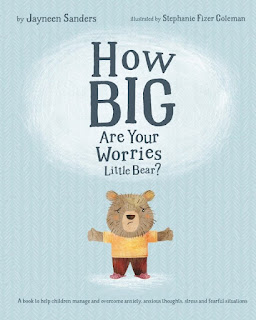
1. 'How Big Are Your Worries Little Bear?' by Martin Waddell & illustrated by Barbara Firth


Little Bear is a worrier. He worries about everything! But with Mama Bear’s help, he soon learns his worries are not so big after all. 

Through this engaging and beautifully illustrated story, children will learn that everyday worries and fears can be overcome. It just takes a willingness to share with a helpful listener, and an understanding that making mistakes is how we learn. 

Also included are Discussion Questions for parents, caregivers and educators, and extra hints to help children manage anxiety.

Recommended age: 3 and up


2. 'What a Bad Dream' by Mercer Mayer


Nightmares happen to everyone, including Little Critter. One night, one of his dreams starts out great, with him skipping baths, eating fudge pops for breakfast, and getting a gorilla as a pet. But it quickly turns into a nightmare when he realizes his family is nowhere to be found, so he has no one to read to him, tuck him in, and give him a hug. Everything is better when he wakes up to his mom and dad comforting him.


3. 'Wilma Jean the Worry Machine’ by Julia Cook and Illustrated by Anita Dufalla 


"My stomach feels like it's tied up in a knot.
My knees lock up, and my face feels hot.
You know what I mean?
I'm Wilma Jean,
The Worry Machine."


Anxiety is a subjective sense of worry, apprehension, and/or fear. It is arguably the number one health problem in most nations. While common, anxiety in children is often misdiagnosed or even overlooked. Everyone can feel fear, worry and apprehension occasionally. 


This is a fun book that addresses the challenge of anxiety in a way that relates to children of all ages. It also offers strategies for parents and teachers to use with children to lessen the severity of anxiety. The book aims to helpchildren develop tools to feel more in control of anxiety. The book also includes a note to parents and educators with tips on dealing with an anxious child.


4. ‘Can't You Sleep Little Bear?’ by Martin Waddell & illustrated by Barbara Firth


Little Bear can t sleep. There is dark all around him in the Bear Cave. Not even Big Bear s biggest lantern can light up the darkness of the night outside. But then Big Bear finds the prefect way to reassure Little Bear and help him fall fast asleep 


Martin Waddell is widely acknowledged as one of the greatest living writers of books for children. His work includes Farmer Duck, Owl Babies and the 1989 Kurt Maschler Award-winning The Park in the Dark, also illustrated by Barbara Firth. In 2004 he won the prestigious Hans Christian Andersen Award. 


Barbara Firth won the Kate Greenaway Medal for Can't You Sleep, Little Bear? She illustrated over 30 picture books in her lifetime, including You and Me, Little Bear; Sleep Tight, Little Bear; Let's Go Home, Little Bear; Tom Rabbit; and the 1989 Kurt Maschler Award-winning The Park in the Dark.


 5. 'The Invisible String' by Patrice Karst & illustrated by Joanne Lew-Vriethoff 


‘The Invisible String’has been acclaimed as a wonderful tool for helping children to cope with separation anxiety, loss, and grief. It is a relatable and reassuring contemporary classic. The story centres around a mother who tells her two children that they're all connected by an invisible string. "That's impossible!" the children insist. But still they want to know more: "What kind of string?" Their mother says it is simple. There is “An Invisible String made of love. Even though you can't see it with your eyes, you can feel it deep in your heart, and know that you are always connected to the ones you love."


The book poses many questions. “Does everybody have an Invisible String? How far does it reach? Does it ever go away?” It is a wonderful picture book for all ages. It explores questions about the intangible yet unbreakable connections between us, and those who love and care for us. The book will allow deeper conversations about love, fear, security and hope.


The book has been recommended and used by parents, bereavement support groups, foster care and social service agencies. It has also been embraced by military library services, church groups, and educators. This special book offers a simple approach to dealing with loneliness, separation, and loss.  with an imaginative twist that children easily understand and embrace, and delivers a particularly compelling message in today's uncertain times.


6.  'When Hitler Stole Pink Rabbit' by Judith Kerr


This is a book for older readers 10-13. It is a semi-autobiographical classic, written by the beloved Judith Kerr, it tells the story of a Jewish family escaping Germany in the days before the Second World War. It tells the story of Anna living in Germany in 1933. As a child, she has not listened to talk of a leader called Adolf Hitler. She is too busy with her schoolwork, Friends and tobogganing.


This beautiful new edition celebrates the fifty-year anniversary of an adventure that Michael Morpurgo called “The most life-enhancing book you could ever wish to read.” But one day Anna and her brother Max are rushed out of Germany in alarming secrecy, away from everything they know. Their father is wanted by the Nazis. This is the start of a huge adventure, sometimes frightening, but also funny and always exciting.


Judith Kerr wrote the book based on her own journey, so that her own children would know where she came from and the lengths to which her parents went to keep her and her brother safe. It is recognized today as a classic that is required reading for children all over the world. 


Thursday, 12 August 2021

The Importance of ‘Hope’ to Developing Resilience

The word resilience is a buzz word that people in all walks of life use frequently. This has certainly been the case in schools as COVID-19 has led to enforced home-schooling and disrupted lives. But what do we mean by resilience, and how do we identify and develop it in our children? In the midst of this pandemic I’ve been wondering, might people’s understanding of resilience be too limited?


The Oxford dictionary defines resilience as “being able to withstand or recover quickly from difficult conditions.” But is it a natural and innate human quality, or can we develop, strengthen or even lose it? Does the resilient person simply develop more positive attitudes, and apply themselves well to the tasks at hand? Or perhaps, do they ‘grow’ and achieve a “positive mindset” to quote a common but vague expression? I want to suggest that in all such discussions, the place of “hope” is often overlooked.


Paul’s Letter to the Roman’s in the Bible is just one place where we are reminded that with hope, all things are possible. Paul encouraged the church and its people to offer themselves in love as living sacrifices (Rom 12:1-8). He also urged acceptance for the weak and strong in faith (Rom 14) and that the strong in faith were to bear with the failings of others (Rom 15:7). But sitting atop all of these qualities he stressed there should be hope! We are to “overflow with hope by the power of the Holy Spirit” (Rom 15:13). 


The Bible and even secular sources, show that ‘true’ resilience requires hope. But what we actually place our hope in is also critical. In the midst of a pandemic, trusting in your own health, fitness, or even young age, is not the answer. The type of hope the Apostle Paul talks about is more than just wishful think, or “hoping for the best”. No, this is a certain hope, one based on an understanding that God, can be trusted, and that we can have a confident hope in our future (Heb. 6:9-12). 


For over 18 months, COVID-19 has been a dominant factor shaping lives and opportunities around the world. I suspect that hardly a day goes by for teachers, and parents without talking about coping with life and of course resilience. But where do we go in search of resilience?


It has been instructive to observe governments, schools, hospitals and individuals responding to the challenge, and seeking to control the risks and circumstances of their worlds. I suspect that calling on God to control and end COVID-19, has rarely been a consideration for many. So, from where is hope being sought? Quite simply, from human ingenuity and solutions, led by clever scientists, skilled doctors and governments enforcing controls.


I have pondered whether people of faith, including Christian parents, teachers and leaders, are looking in the same places for encouragement and solutions? I can’t answer this question, but I suspect that even in Christian circles there has been as much fear and self-reliance as outside the church. As I argue in my book 'Pedagogy and Education for Life' "education is the whole of life of a community, and the experience of its members learning to live this life". As we teach and nurture our students towards 'true' life, we are constantly supporting, encouraging and teaching them to seek the hope that can only be found in God. This hope is vital to their growth in resilience. 


A well-known secular book on resilience, outlines 10 key factors in achieving it. These include:

  • Confronting fears and remaining optimistic.
  • Seeking and accepting support.
  • Imitating 'sturdy' role models.
  • Relying on an 'inner compass'.
  • Embracing religious practices (i.e. believing in something greater than yourself).
  • Accepting what we can't change.
  • Taking care of our bodies and well-being.
  • Seeing bad experiences as an opportunity to grow. 
  • Seeking to improve and change, and
  • Taking personal responsibility for own care.


It is instructive to see that even in key texts for secular audiences, the human need for hope is found not just in one’s self. The need for hope is also seen as a key foundation for the development of resilience in the face of suffering. As we confront the burden of Covid-19, our best response is to encourage one another. Not by lamenting what we have lost, but in faith, seeking to hold onto the hope of the Cross. We must act with urgency to help others to understand that beyond the pandemic and this short life, is an eternal hope that surpasses any number of days on this earth. My encouragement to all at this difficult time, is to seek hope beyond experts and self-help schemes to our God, the author of life and the sustainer of all things.


Reference

Steven M. Southwick & Dennis S. Charney, ‘Resilience: The Science of Mastering Life's Greatest Challenges’, Cambridge University Press: Cambridge, 2018


Monday, 31 May 2021

Honesty & Service: What is the relationship between these traits in the Christian classroom?

I’ve been thinking a lot recently about the role of honesty in encouraging our students towards service and support to one another. In particular, I'm interest in the part it might play in challenging others about behaviour, language and even beliefs.


You may recall that I wrote about "Christian Service" as the third key plank in my pedagogy within my book 'Pedagogy and Education for Life'. I still believe that modelling and encouraging ‘service’ is a critical principle in biblical Christian education. But I particularly want to reflect or ruminate on the place that ‘honesty’ plays in relation to service within a Christian community. Do we give enough much thought to honesty when discussing Christian service? In recent times, I’ve observed again and again, that people of faith seem afraid to offer a contrary view when brothers and sisters say things that they feel are inappropriate to us and perhaps even unbiblical. Do we avoid the awkward conversations? Or simply go quiet when someone says something with which we don’t agree? Perhaps, we simply change the conversation?


I’m sure that we’ve all observed members of the church, staff in schools and or students in classrooms, expressing views that are unbiblical. Unbiblical ideas might be expressed in post-church conversation, within the workplace, or just as a group of friends sharing life and aspects of faith. Within the school, such ideas might be shared in the playground, during informal class activities like group work, or after school chapel. But what do we do when we hear such words? And what do our students do? Do we simply remain silent to keep the peace, or are we courageous enough to speak the truth in love?

In Ephesians 4 Paul teaches how we are to challenge wrong ideas in order to ensure unity and maturity as we live together as a community of believers. In doing so, he urges us to “speak the truth in love” (Ephesians 4:15a), and to put off “falsehood” and the while as we speak "truthfully" to others (Eph 4:25). Do we seek to do this with our neighbors and Christian friends? Do we encourage our students to do the same? Or, at times is our default to keep quiet, and not challenge wrong and sometimes dangerous ideas. Paul challenges his readers to avoid such passivity, and to speak up, for we are all members of one body (Eph 4:4-6). As such, we must encourage one another and sometimes, even graciously rebuke each other.


I can recall a Christian colleague within a secular university over 30 years ago who had a big impact on my life with some well-chosen honest words. I had been a Christian for just 3 years and was his boss! And yet, after a meeting, in which he and I were the only Christians, he pulled me aside. He said, “Trev, when you said the Vice-chancellor was an idiot in the meeting because of his actions, you weren’t really setting a great example for our colleagues. As Christians, we need to speak the truth at all times, and in particular, we need to be careful how we speak about our boss, and show respect.”


The key illustration here, is not in my words and actions, but in Fred’s honest and wise words which I have never forgotten. His simple response not only strengthened our relationship, but also our combined witness to colleagues. His words set an example for me concerning the need for honesty in Christian community, and I have never forgotten it.  


As teachers, do we sometimes fail to offer wise and honest words to our students at opportune times, words that might encourage them to be different. If we do fail to do this, then we are failing to speak the truth in love as part of our Christian witness and service.


God our Servant King made us to be servants to him, but also to one another. Jesus, of course, is the perfect model of service, having given his life for us (Phil 2:7; Matt 20:25–28). In shepherding and watching over his flock, he was never afraid to speak the truth when it needed to be spoken (1 Pet 5:3).


What might this look like in our classrooms? You might talk to your colleagues about how honest your conversations are with one another, as you serve our God within the school. Do you avoid saying some things for fear that you might upset others? 


Please note, I’m not suggesting that you lecture colleagues about their behavior and lack of godliness, for this could quickly lead to a display of pride and arrogance. Alternatively, we need to ask ourselves, do we often see and hear staff and students saying things that are inappropriate and unhelpful to building communities. Remember, service to one another is a central trait of Christian communities. We need to keep asking ourselves, do I sometimes fail to offer a godly comment when needed with the right motives as Fred did?


As teachers, we need to add ‘honesty’ to community conversations as a key part of our service to one another. This includes both staff and students. If we do grow in our willingness to speak the truth in love, we will collectively continue to become more Christ like. This in turn will strengthen the collective witness of our school communities.

Monday, 25 January 2021

Can the Christian School Serve as its Own Apologetic?

Have you ever met a person of faith and been so impressed by them that you say quietly to yourself, "I could never be as good as him or her"? And when you met them, or spent time with them over a longer period, did you quietly distance yourself from them, or did you find yourself being drawn to the person, wanting something of what they seemed to have in their life? I won't share my personal testimony of coming to faith here, but I will say that it wasn't till I was 31 years of age that I came to faith. In large part God used the lives of a number of people who I knew, to challenge me to consider what was central to my life. For a long time, I looked at Christians critically and thought, I can't be like him or her. In time, some people did have an impact on me. And they did this because, in a sense, they were their own "apologetic for Christ". In time, instead of ridiculing and running from them, I found myself being attracted to them and their lives.

In Chapter 2 of my book 'Pedagogy and Education for Life: A Christian Reframing of Teaching, Learning, And Formation', I talk about education being the "whole of life of a community". As Christians and believers in God we are in a sense our own apologetic. The school community likewise can serve this apologetic function. The very lives of Christian students and teachers can be a witness to the things they believe. The foundation of their faith of course, is God and the Savior in whom we trust. So too our faith-based schools and communities can serve as their own apologetic. The Apostle Peter challenged the early church to:

"Live such good lives among the pagans that, though they accuse you of doing wrong, they may see your good deeds and glorify God on the day he visits us." 1 Peter 2:12 

He didn't do this because the observation of people of faith is the way God saves us. Nor was he talking about social action. No! Nothing could be further from the truth. Rather, our observations of people who live with God at the centre, are part of the way God awakens in us the reality that this life is not all there is. He expects us to place him at the centre of our lives.

This is a serious challenge for faith-based schools, because as I've already written in previous posts, it's easy for our Christian schools to lose sight of the fact that the standing of our students before God is far more important than their standing in academic rankings.


In just two days most Australian children will go back to school. Their families have the choice to send them to government run 'public' free government run education, or private largely faith-based schools if they can afford them. You can be certain that there will be different priorities for all of them. Could I suggest you ask yourself a few key questions as you visit and consider the school website, prospectus and comments made by the principal and staff? What does the school you are considering say are their priorities and unique characteristics?

If you're a pedant like I can be, you might even count the number of times the following things are mentioned:

  • Academic achievements
  • Sporting achievements
  • Cultural activities
  • Teacher quality
  • Discipline
  • Post school achievements of the alumni
  • Quality of the staff
  • Non-academic achievements of the students

Once you've finished considering the above, consider how often the following are mentioned:

  • The faith-based foundations of the school
  • The importance of Christian character development
  • The priority given to growth in faith
  • The support and discipling of students of faith
  • Worship at school
  • Christian activities in the school 


Why have I stressed the above? Because if the school is serving as its own apologetic, it will show! What do I mean by this? Is the school promoting the truth of Christianity, God's sovereign control of his world and our place and purpose within it as his children? The things that are talked about in any school reflect the things that are important to the teachers and students. Try to be less impressed by the quality of the buildings, the sporting facilities and the well-groomed playgrounds. Look instead to the quality and faith of the teachers and the executive and the character of the students you are able to observe who graduated from the school. Is the education offered in the Christian school set within the "whole of life in the school, and is this in turn situated within the child’s life that transcends varied and multiple communities of practice, both real and virtual"? If you visit the school, ask students "what's so good about this school"? The answers they give might offer a different perspective compared to the prospectus or website.

I quote Bernard Meland in my book, who suggests that the ultimate goal of education is not technical information, useful practices, or specific moral values, but a search for a “higher goodness.” Our schools are to provide space for developing our students in other ways that are also reflective, imaginative, and spiritual. The education we offer that truly matters - i.e. growth in character shaped by God - is situated within the child’s complete life which transcends varied and multiple communities of practice, both real and virtual. As you consider the best school for your child think about these things.


Tuesday, 29 September 2020

The Place of Justice in Schools - Principle 17

The 17th principle in my Framework for Christian Pedagogy in 'Education and Pedagogy for Life' is critical for all faith-based schools. A key question all schools and teachers should ask: "Is justice sought and modelled within your class and school community life?"


As I write in my book, God is just! What's more, his justice is an expression of his holiness. In the book of Micah in the Old Testament, God brings charges against his people for their failure to obey his word leading to wickedness and rebellion. God had acted justly with them and had repeatedly shown mercy, and yet they had failed to show justice and mercy in their lives.


He has shown you, O mortal, what is good.
    And what does the Lord require of you?
To act justly and to love mercy
    and to walk humbly with your God
(Micah 6:8).


Because our God, acts justly and shows mercy, we too must seek and demonstrate justice and mercy in the world (Mic 6:8). Is this demonstrated in the way justice is delivered within our schools? Or are we inconsistent in how punishment is distributed and rewards given? Does the curriculum and the attitude we display show a concern for a limited part of our world beyond? Do you we favouritism in life and teaching? For example, are we shocked and saddened when a famous celebrity dies, and barely notice when thousands die in distant nations from disease or violence?


Classrooms must be places turned towards the world and yet aware of the inequities and injustices within it. Our pedagogy must demonstrate a sense of justice and a broad concern for other people. But even if we as teachers might have compassionate hearts and a strong sense of justice, how do we develop these qualities in our students? And how do we encourage our students to demonstrate this to one another and also the stranger?


An important question for any teacher, and in fact, any school is, how do we show a love of and desire to seek justice? And as a follow up, how do we encourage empathy and respect for others? There is no doubt that what we teach, including our attitudes to and engagement with the world, will have an influence on our students. How are we preparing our students to love their neighbors? “To act justly and to love mercy and to walk humbly with your God” (Micah 6:8)?


I attended school as a student from 1956 to 1969! Many forms of the punishment used then would still be recognisable in 2020. Children are still kept in, lines are still written, forgotten homework is sometimes done at lunchtime, privileges are still withdrawn for bad behavior, and so on. But the varied forms of physical punishment that I experienced at school, would not be seen today. As a primary school child, I was caned many times. In fact, by Grade 4 I’d been caned about 40 times (yes, I was badly behaved). This was usually 1 or 2 cuts of the cane across outstretched hands, often in front of my classmates. However, most attempts at punishment failed to change my behavior. But of course, justice isn’t simply about punishment.


When I grew up and became a teacher, I had to learn very quickly that the ability to exercise discipline and shape behavior in my classroom, was a very important part of what it meant to be an effective teacher. I started teaching as a 19-year-old! True. And thanks to some good teaching by my College lecturers, I had a strong sense instilled in me of the requirement to set standards, to ensure that they were met, to reward those who attained these standards, and to moderate the behavior of those who didn’t.


One of the first lessons during my training was that discipline needs to be distributed with consistency and in proportion to the matter that requires the discipline. But there was little talk about the administration of discipline, simply that once I had decided on the need for punishment, it was important to do it and apply it fairly and consistently. But why was I disciplining children? What was my ultimate purpose in moderating specific behavior? And how did I arrive at my decisions? What influenced my decisions concerning the extent and nature of the discipline? And what were the standards against which the need for punishment was determined? Wojciech Sadurski has some wisdom to share in response to my questions.


Our God is just, and his justice is an expression of his holiness. Hence, God expects his people to seek justice in the world and demonstrate it (Mic 6:8). Is this seen in the way justice is delivered within the school community and through the curriculum? Do the curriculum and the attitude of teachers show a concern for the world? (Wojciech Sadurski in ‘Giving Desert Its Due: Social Justice and Legal Theory’ 1985).


As I write in my book, classrooms must be places turned towards the world and aware of the inequities and injustices within it. How do we demonstrate kindness to others and actively promote compassionate hearts in our students? Do we encourage empathy and respect for others? Do we demonstrate and ‘teach’ justice, forgiveness and mercy?


The first step in answering many of the questions I have posed is to reflect together as professional colleagues on current practices in your classroom and school. In my book (pp 159-160), I share a case study on ‘Justice and Forgiveness’ that deals with these questions. Could I suggest that as first step in assessing current practices that staff might find it helpful to read and discuss the case study together as colleagues.