Showing posts with label telos. Show all posts

Wednesday, 5 March 2025

The Relationship Between Pedagogy and Student Formation in Schools

1. Formation as the ‘Practice of many Practices’


I write in my book 'Pedagogy and Education for Life' that:


“Education is the whole of life of a community, and the experience of its members learning to live this life, from the standpoint of a specific goal”.  


And of course the formation of our students is a critical part of how this occurs as we enact this through our pedagogy.


The challenge within our schools is that our students arrive from at times very different backgrounds. This might well have included growing up in a Christian home, and attending a church with strong biblical teaching. They may have been challenged by God’s word, to live in ways consistent with the Scriptures. Of course, if only this was always the case, our job as teachers would be much easier.


Christian and in fact, all faith-based schools have a significant role to play in an environment where students not only learn and grow as students and people, but also in faith and character.


Faith-based schools whether Christian or of another faith, make a commitment to the spiritual formation of our students. Hopefully, this is not just by sending them off to Chapel once or twice a week. True formation occurs in multiple communities, or groups as the “Outcome of the ‘Practice of many Practices.” I borrowed this excellent comment, from Craig Dykstra and Dorothy Bass.


I point out in my book that this might not be realistic in all faith-based schools. When I wrote the book I was thinking of Christian schools. It's worth noting that I’ve been invited to speak to staff at varied faith-based schools in recent years, and all have shown considerable interest in my work. Other religions also see much which resonates with their own desire to see their children grow spiritually. For example, a large number of school leaders, teachers and parents read my blog in Muslim countries.  It seems, they also want their schools to demonstrate pedagogy and school communities that are true to their faith.


2. Going Deeper, to consider the subtle and almost unseen practices of our schools


Dykstra and Bass in their work, comment on formation and issue a challenge to teachers to bring to “consciousness the hidden dimensions embedded in and through our actions and relations.” (see p. 91). This sounds anything but practical, but hang in there. They define “Christian Practices” as:


“… the things Christian people do together over time to address fundamental human needs in response to and in light of God’s active presence for the life of the world.”


In short, Christian schools help students to see, respond to, and navigate all the practices of life (Christian and non-Christian), with a telos that is shaped by and directed toward the kingdom of God. NB: “telos” is an ancient Greek word meaning “ultimate end”, “purpose”, “goal” or “action”.


It is important to stress, that our task as Christian schools and teachers is NOT just to put our energy into inculcating our students with ideas, whether this is dressed up as “virtues”, “values”, "church traditions" or even “worldview”. If ideas become the focus of pedagogy, there is less chance of us inscribing a “Habitus” that actually ‘primes’ and shapes their actions.


Pierre Bourdieu developed the concept of “Habitus” (or Habit) and saw it as rooted in family life, and conditioned by social class. What’s more, “Habitus” is part of Aristotle’s teaching on Ethics. In a sense, it is within family life, and the way we bring our children up, that there is significant influence on how our children and students see ourselves in later life.


3. Being Shaped by ‘That Which is Invisible’


It is also important to discuss how the invisible things of life, have an influence on us and of course our students. I draw on the work of Charles Taylor and Lev Vygotsky in helping us to understand what I mean by this.


Charles Taylor argues that we need to stop assuming only ideas move people. James Smith makes a similar point drawing on Taylor. Taylor suggests that beneath any cognitive or intellectual discussion by a group or institution (e.g. a school), we have human imagination at work (p.99). This helps us to engage with stories, dreams, hopes, myths, images etc, and connect them with past and present experiences, as well as imagining the way we’d like the world to be.


Vygotsky used the word Obuchenie to discuss this ‘invisible’ action. In essence, this word points to the way that in life, as we live in communities, we adjust to one another. The teacher student relationship is a context in which this is very important. He argues that simply passing on knowledge doesn’t change people. If we follow his argument and apply it to our school context, then growing our students in knowledge and faith, might require us to make some subtle changes to our pedagogy.


Rather than simply transmitting knowledge about Christian faith which we hope students will accept and replicate, we need to grasp that our students must see connections themselves between such a life underpinned by faith, and the myriad of communities of practice they already inhabit. This of course, requires them to reflect on and adjust to these multiple communities.


So what might our role look like in such a context? Daniel Estes ('Ten Ways to Destroy the Imagination of the Child'), suggests that:


“The metaphor of the teacher as a guide includes both direction by the teacher and active involvement of the student in the learning process.”


As teachers in Faith-based schools, this needs to be part of our role. My hope is that at the very least, our focus in Christian schools should enable teachers and schools to “help students see, respond to, and navigate all of the practices of life (Christian and non-Christian), with a telos that that is shaped by and directed toward the Kingdom of God." Above, all we hope they will not take on different personas depending on where they are and who they are with. Rather, our goal with our students and our own children, should be for them mature in faith and understanding and seek to live consistent lives that honour their God.


Tuesday, 23 April 2019

Helping students to take responsibility for their learning – Principle 8

In ‘Pedagogy and Education for Life’ I suggest that while teachers must exercise authority over students, and their students in turn must learn to respect the authority of their teachers, self-responsibility should be nurtured. This requires more than simply seeking to instill the right community values, virtues, or even a Christian worldview. The challenge for teachers and parents is how to keep the two seemingly equal and opposite forces of teacher authority and student self-responsibility in healthy tension. In my book, I argue that this requires a pedagogy that gives considerable attention to how “… teachers orchestrate and sustain classroom life… driven by an intent and telos.” The 'telos' of course is an ancient Greek word referring to an ‘end’ or goal. Alisdair MacIntyre in his book ‘After Virtue: A Study in Moral Theory’, draws on the work of Aristotle to suggest that “every activity, every inquiry, every practice aims at some good”. Within the school and classroom, there is a purpose in all that we do and each and every event, activity or practice points to an ‘end’.
 
As a principal, teacher or parent, we might well seek to instill Christian values, virtues, and a Christian view of the world in our students. We might even manage to obtain ascent within the controlled world of the classroom or school to some of these things. But, if these are in conflict for our students’ inner purposes, goals, hopes and desires, then little ‘real’ long term change will occur. Unless, of course, God disrupts these internal goals by his Spirit, through the teaching of his word and the influence a Christ-centred community life within our classrooms and schools.

Craig Dykstra offers us a helpful insight into the challenge for every Christian teacher when discussing the work of Thomas Chalmers (a leader of the Free Church of Scotland) in the nineteenth century. Chalmers argued that: 

Beneath the level of norms, roles, institutional structures, rituals, stories, and symbols lies the level of our fundamental communal intentions toward one another and the world, which govern how we live in our roles and rituals and by means of which we apprehend the mystery of our existence.

Above: Thomas Chalmers

Chalmer’s famous sermon “The Expulsive Power of a New Affection” offers some wonderful insights into the human condition. In his sermon he suggested that: 

"Such is the grasping tendency of the human heart, that it must have a something to lay hold of and which, if wrested away without the substitution of another something in its place, would leave a void and a vacancy as painful to the mind, as hunger is to the natural system."

If you wish to change student behavior, and help them to rid themselves of a specific behaviour or sin, you don’t replace it with a vacuum. Nor do you achieve this simply with a religious program, the teaching of a virtue ethic and so on. You replace it with an even stronger passion for something good. The teacher must seek to orchestrate and influence the whole of life of the classroom and school, with the hope that all that is done in structuring this school ‘life’, might impact on the rest of our students’ lives. Such a school and classroom life will be focussed on clear teaching from God’s word centred on Christ.


James Smith has also reminded us in his book ‘Desiring the Kingdom: Worship, Worldview andCultural Formation’, that our desires are aimed at specific ends or goals, and set the trajectory for our lives. “A vision of the good life captures our hearts and imaginations.”


The Christian teacher’s key role extends well beyond structuring curriculum, and teaching well. It requires him or her to structure and influence the whole life of the classroom, to disrupt entrenched views of life’s purpose, and instead embed a ‘telos’ that shifts our students’ attention away from the values of the world towards a view of humanity's purpose centred on faith in Jesus Christ. This requires us to place at the centre of all we do and say, the Gospel of Christ, and God’s promise of redemption in and through him, to those who believe and accept him as their saviour. I will say much more about the practical implications that such a view of the world has for pedagogy in future posts.


Monday, 27 August 2018

What Matters When We Teach? What is our purpose?


In Australia, we have a number of system wide tests. These are designed to assess in objective ways what children know and don't know, as well as what they can do and not do. Standardized tests that are designed to assess, monitor system wide student achievement, areas of strength and weakness, and in some cases, guidance in relation to curriculum content. But ..., and the teachers reading this knew there would be a 'but', these tests are rarely used in accordance with their purpose, and they have unintended consequences. We have just finished administering what is known as NAPLAN that is administered to students in grades 3, 5, 7 & 9. NAPLAN tests "... the sorts of skills that are essential for every child to progress through school and life, such as reading, writing, spelling and numeracy." The assessments are undertaken nationwide, every year, in the second full week in May, and by August we are castigating our schools and teachers for failing to teach well enough to the test (see HERE). Since their inception, the tests have gone from a means to provide advice to teachers and systems about the areas of curriculum where students need additional help. However, it is clear now that teachers have (not surprisingly) increasingly taught to the test. That is, shaped their curriculum and methods based on their expectations of what might be in the test. My question? Is this the best we can do? Is this the highest purpose that we can have for education?
  
I entered teaching in the 1970s as an unlikely member of the profession. I was an escapee from engineering, after having a lifelong desire to become a mechanical engineer. Hence, I was a somewhat ‘accidental’ teacher.  And yet, within months of entering a classroom I was captured by the desire to know why some of my students were able to read and write, while others were struggling. I began doing my own ‘action research’, devising new methods and testing ideas to try to unlock the capacity of some of my students to do things which seemed to be basic and foundational. For me there was a direct link between what I observed in my classroom each day and my students' performance. This made an incredible difference and children who couldn't read, began to read, while those who didn't read well in this working class and culturally diverse community, began to read. I chose methods that were appropriate for them, and the only tests that mattered were those that helped me to monitor their progress and help them to grow as learners.

But while my purposes were more directly connected to the success of the current epidemic of system-wide testing and schools 'teaching to the test', my purposes were still quite utilitarian. I had been thinking a great deal about ‘what’ and ‘how’ I would teach, but I had thought little about the question ‘why’? Clearly, the answer to 'why' was obviously so that they could learn and grown in ability. So my ultimate purpose for teaching my students for them to do well at school. Is this the full extent to our purposes in education? Well, probably not. I was wanting them to do well so that they might do well at school and one day gain jobs etc. But was this it? Or, was I also concerned for the growth of their character, rather than just their minds? I'm sure that I did have concerns for my students to be happy, to succeed in life, to grow up gain jobs, have families and (in this community) stay out of trouble. But how much did I think about my role in this? Did I see that I had a role in their growth in character? Was their well-being simply seen as an associated outcome, or did I understand that I had a key role to play?

In those early years, I thought little about the ultimate purpose of my teaching and the education of my classes. As a young Atheist, I had no real framework for the choices that I made other than what might work, and what led to success. I sensed that there needed to be a higher purpose for what I was doing each day, but this wasn't the main game. The goals I set for my teaching did not go much beyond the need for the personal success of my students, and perhaps a driving sense of the seeming injustice that some were so ill-prepared for their futures.   

But over time, as I grew in character and maturity myself, I began to grasp that education is more than the sum total of the curriculum, methods, teaching strategies and the measurement of educational success. I also began to realize that my purpose wasn't simply to train or teach children to reproduce skills, knowledge and tasks. I began to understand that a narrow kit bag of methods, and a commitment to testing and revision, was not a fool-proof way to ensure universal success and well-being. My book ‘Pedagogy and Education for Life: A Christian Reframing of Teaching, Learning, and Formation’ represents a distillation of my many years as a teacher and researcher, and how after coming to faith in my early 30s, many questions arose in relation to teaching and pedagogy. I slowly grasped that education is much more than content, methods and curriculum. 

Authentic education must always have an articulated purpose or end goal in mind. I realized that I needed to develop a pedagogy that did not consist simply of knowledge of good practice and appropriate curriculum content. As this was going on my life, as a young teacher and (by then) a researcher in my 30s I came to faith as a Christian. This significant life event not only changed me as a person, it changed me as a teacher. Under the influence of varied secular and Christian educators, I slowly realized that children learn in relationship to others, and that these relationships and the practices they engaged in day by day, are always embedded within shared communities, consisting of people who hold many understandings, beliefs and practices. The definition that has shaped the pedagogy within my book reflects the end point of my personal life journey as a teacher.
“Education is the whole life of a community, and the experience of its members learning to live this life, from the standpoint of a specific goal”
A key facilitator of my growing understanding of pedagogy, was the realization that the teacher is but one member of a classroom. True, they have authority and knowledge that their students might not possess, but as we teach young people, we must realize that they are not our learning captives. We cannot lock them in a room and program their minds for life. Rather, they need to navigate a world of endless meanings, and knowledge beyond our mind’s capacity for consumption. And I realized that this takes place embedded within numerous and varied physical and virtual daily practices and events. My children arrived each day as travellers and citizens of many communities, and I was largely at the centre of just one of them. Hence, my influence was at best minor in relation to their character and formation as people. For they were interacting in and outside school with numerous friendship groups, indeed communities of practice. Wenger & Lave describe communities of practice as “...groups of people who share a concern or a passion for something they do and learn how to do it better as they interact regularly.” A fundamental question for me as a teacher is what impact do I have on my students' participation in such communities, and how effective might that make me in shaping their character? For formation occurs in relationship to others.
 
As Arthur Holmes reminds us, from ancient times we have been aware that we learn with others. The Greek rhetorical tradition of Socrates, which influenced Holmes’ work, recognized that we learn best with others. In ancient Greece, this was very much a case of young boys sitting at the feet of a learned teacher. Nonetheless, foundational to this approach was an understanding that the young are formed as they tussle with ideas and knowledge in dialogue with others. Not surprisingly, Augustine’s Confessions were founded on the understanding that such learning ultimately has a greater foundation in God. As Holmes reminds us:
“… every good (one) experiences, and all truth (one) learns come ultimately from God and are occasions for praise. God is the being by whom all things are true that are true, and all things are good that are good.” (Arthur Holmes, ‘Building the Christian Academy’).
A central claim in my book is that while there are varied almost limitless methods that we can use as teachers, pedagogy must be central. And people of faith need to understand pedagogy must always must be driven by a central purpose or goal, as the Greeks expressed it telos. As a Christian, I turn to the Bible for this central purpose. Christian education is to be kingdom focused, and in turn, must communicate the intended end goal of education. This will be a telos that is centered on the kingdom of God, not simply earthly success and achievement. And of course, there is a relationship between our priorities shaped by the gospel, our faith in Christ, how we live out and speak of this faith, and our actions (Phil 1:27; Jas 2:14-26). Hence, the things we teach and the way we do it cannot be separated from the life of the school community, nor for that matter, communities outside the school. Our pedagogical practices will lead to the creation of a classroom life, that has the potential to ‘speak’ to our students about what is important in the world of the classroom, and consequently, what matters most.

For the above reasons, I see formation as central to the model of pedagogy advocated in my book. This is a pedagogy that reflects and is interwoven into the daily life of any community; a pedagogy that will see classes, schools and students transformed. The Bible’s central message is centred on our transformation in and through Christ. We are what we live, not just what content is learned, the worldview the teacher holds, success on the exams sat, assignments completed, and so on. It is within the life of the community that character is shaped. In effect, pedagogy as I am defining it, is a term that attempts to encompass the essence of how teachers orchestrate and sustain classroom learning and life, and this of course it is driven by an intent and telos.

It must be pedagogy that determines our focus, and enables us to place our mark on children in ways that truly differentiate faith-based schools from secular schools. In a sense, pedagogy is the ‘what’, the ‘how’ and the ‘why’ of teaching, all rolled together. But it is worth noting, that while we have freedom to change the ‘what’ and ‘how’, the ultimate ‘why’ should not change, for it is shaped by our higher purpose. If ‘Christian Education’ is to be authentic, then all that we do, say, sanction and plan, should be centered on the end goal of seeing young people growing as people who one day will be a part of the family of God.

In my book, I outline a 20-point framework that I believe is the distillation of the type of pedagogy that I believe is essential in faith-based institutions. I provide examples and a series of case studies to illustrate how elements of the framework will shape pedagogy. This framework is the basis of the pedagogy that I have used to challenge teachers to reflect on their practices and the telos that is central to their teaching. 

The Framework

The framework below is structured under three major headings, which reflect the theology that has informed the whole book, as well as the biblical theology of person hood. Three broad biblical truths give shape to the framework: ‘God is Creator’; ‘God’s creatures are meant to be learners’; and, ‘God made us for communion’. Under each key truth I list a number of key components of my pedagogy. 

In my next post, I will begin to provide some examples of how I believe that the framework can be used for staff professional development.


Each point of course is explained in detail in the book with examples and case studies.

a) God made us as unique creatures

Identify that which is valuable in each child.
Build on the foundations of the family.
Demonstrate and encourage service.
Develop a right view of work and effort.

b) God made us as creatures who learn

Develop meaning-makers who interpret language and knowledge to know ‘truth’.
Develop humble learners.
Understand the diverse nature of learners, and identify and respond to individual
needs.
Create opportunities for students to take responsibility for learning.
Foster the development of imagination and creativity.
Encourage creative risk-taking and problem solving.
Utilize varied methods to facilitate learning in diverse learners.
Act as “kidwatchers” observing and monitoring student learning and well-being.
Evaluate the ends towards which our pedagogy is directed.
Make our classrooms places where just punishment and discipline are evident.

c) God made us for communion

Demonstrate forgiveness and seek repentance in students as hearts are trained.
Model and promote self-sacrifice and generosity.
Seek and model justice within class and school community life.
Ensure learning in the classroom is related to the world beyond.
Promote the importance of ‘story’ in your classroom and school.
Implement pedagogical practices that demonstrate a relationship between education
and discipleship.


Wednesday, 10 January 2018

Learning Occurs Within Communities NOT Just Classrooms

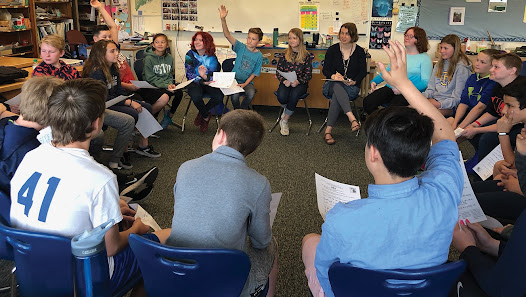
For decades, we've talked about classroom as communities, but often this has been rather superficial. Many who speak of community are concerned with little more than an understanding that every class is a rich social context where relationships are vital to the life of an exciting classroom environment. But when I speak of learning occurring within communities, I am speaking of rich and varied communities of practice.

In 'Pedagogy and Education for Life' I argue that in the day-to-day life of the classroom and school, children learn more than curriculum content. Indeed, they learn about "... life and faith, beauty, loneliness, rejection, truth, humiliation, love, companionship, hate, sadness and so on".

Good education requires more than just sound curriculum, appropriate teaching methods, and classroom and school discipline. So too, it also requires more than chapel services and a Christian Studies program. At its foundation, a concern for community, requires a pedagogy that is different, and which is informed by our faith.

My belief is that if we focus our energy simply on curriculum as content or even practice, we do little to create a distinctive education leading to student formation. For it is a teacher’s pedagogy, more than their curriculum or methods, that will have an influence on the formation of our students. And these terms are not synonymous.

In 'Pedagogy and Education for Life', I argue that pedagogy is concerned with the way we shape the life of the classroom and school. The life of the classroom is always shaped by the teacher with the participation of all others. Our Pedagogy is central to this, and in a sense cuts across and interacts with the ‘how’ (teaching, including method) and ‘what’ (curriculum) of education. Educational pedagogy is the collective shaping of the habits, beliefs, knowledge, dispositions, actions and words of classroom or school members, that will incline individuals and the institution towards the telos or end purpose and goal of education.

Alasdair McIntyre in his book 'After Virtue: A Study in Moral Theory' reminds us that the focus of transformative education, should always reflect our end goals. He stresses that the 'means' of education should follow the 'telos', that is, the 'good' or aimed for goal or purpose of schooling. Indeed, he argues that:

"every activity, every enquiry, every practice aims at some good".

I argue in my book that pedagogy is the embodiment of what we believe good research and our biblical understanding of personhood and God’s ultimate purposes for us in Christ, would suggest we should do. At times the orchestration of classroom and school life will be dominated by curriculum in the form of method, content, assessment and so on. But always, the habits, beliefs, knowledge, dispositions, actions and words of its members will incline them towards the end goal of education that we are seeking. And of course, an authentically Christian education needs to show a central concern for children seeking and being able to imagine, desire and embrace the Kingdom of God.


A school has relationships to multiple communities beyond its boundaries. For just as a class is not completely separate from the school, so too, the school can never be completely separate from the wider community. But I will say more about this in a later post.

Building effective Christian school communities requires an understanding that and school consists of a patchwork of related and overlapping ‘communities’. They are essentially communities of belief and practice. Understanding this is foundational to the creation of authentic Christian education and pedagogy.

Bernard Meland suggests that the ultimate goal of education is not technical information, useful practices, nor specific moral values, but a search for a “higher goodness.” God made us with an inner desire to seek the one who made us.

As Ecclesiastes 3:11 reminds us: "He has made everything beautiful in its time. He has also set eternity in the human heart; yet no one can fathom what God has done from beginning to end."

How do we create classroom communities of practice where we will witness the awakening of 'eternity' in the students we teach each day at school? This is major purpose of my book.


NEXT Post:  'Imagination and Community Life'