Showing posts with label community. Show all posts

Friday, 29 April 2022

Our lives are always embedded within a personal history & story

I've been working on my family history. I set myself the task of compiling the story of the previous 3-4 generations of my family history in words (yes, a ‘small’ task!). As I wrote, I found myself revisiting images of people, places and events. I knew that any family history is always shaped primarily by memories and perspectives of varied family members (and non-family members too), who often have different lived experiences and accounts. Even two or more siblings can have slightly different memories of the same events, person and relationships. I began to see that as well as the family stories handed down across the generations, that photographic evidence and documents also matter!


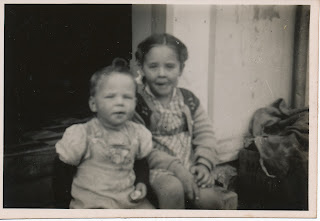
 Above: My sister & me (a 'few' years ago)

But varied evidence is not always 'equal' in validity. It all helps to shape who we think we are, what we believe, and even character, beliefs and values. An image alone, can help us to situate and understand our memories within a specific place and time. They act as anchors for 'truth'. But an image requires interpretation, so in partnership with the memories of multiple people and sources, places and events, we will end up nearer to the 'truth'.
 

My Great Great Grandfather watched a son and daughter leave Scotland in 1882 never to return to their homeland. As I began to dig out old family photos and records, and listen to the memories of those still living, a bigger and more complete story emerged of what had happened. The addition of unseen images in boxes, old newspaper clippings, ship records and so on, contributed to a bigger and more complete story; one richer than any single family member could recall. There is often much knowledge that is in common between family members, but gaps can be filled by other people and official documents. Like many families, there have been some surprises, with troubling events uncovered, and amazing stories unearthed.

As I have embraced this journey I've been reminded of the words of Alasdair Macintyre:


"The story of oneself is embedded in the history of the world, an overall narrative within which all other narratives find their place."


Of course, it is true, every story is unique, but also our personal stories reflect the stories of others before us, as well as those we live life with now. Alasdair's words seem to be very much 'big picture', but he is right. As a Christian, I believe that my story is reflective of and part of the greatest story ever told. It should not surprise us when we discover that while our personal stories are unique, they share elements with other people's stories, and are also shaped by the lives of our family members, and previous generations from our maternal and paternal relatives.


 Above: My Dad near the Forth Bridge in Scotland having returned after 60 years


I grew up in a less than perfect home. For much of my childhood both parents were 'absent' from my life for varied reasons. They had part-time lives as entertainers, and in my father's case, full-time shift work in the mines. Like all parents, they had some shortcomings; hence my older sister and I were fairly independent from about the age of 10. But we both loved them and were shaped in part by them and their lives. We both married early and found wonderful life-time partners, and set about building a different family life for our children.


I fell in love with my wife for varied reasons. These included her kindness, gentleness, quiet confidence, servant heart and the fact that she made me laugh! She is also smart and a perfect partner in life. The person she is reflects her personal history, faith and family. After joining her family, I discovered her mother and grandmother were very much the same type of women. In the last 10 years we have discovered through family history research, that earlier generations of women on Carmen's side across four centuries, shared many of the same qualities. Their lives, no doubt served to shape in part their children and ultimately later ancestors.


In my life, I've written in previous publications and posts how teachers had a strong influence on me. A few I loved and some I loathed. As teachers, how we engage and nurture the children in our care matters. The small number of teachers who did believe in me, saw me as more than just a cheeky and unkempt kid (which I also was). Whatever role we fill in life, we can have an influence for good.


Above: Terry Malone, Dr Phil Lambert & Me


I had the joy last night of attending the launch of a book from the recently retired Assistant Director of Education in NSW Dr Phil Lambert. He invited me to attend along with a former colleague I taught with 48 years ago! To our great surprise he mentioned us both in his book. As a 1st year student teacher he was assigned to my class (in just my third year of teaching). He shared that he'd considered leaving teacher training until he came to my classroom for his first period of practice teacher. He said that he observed my love of teaching, and the friendship and fun I had with the teacher in the next room Terry Malone. The fun and joy we had teaching, and the impact on the children's lives inspired him to continue. He came to the school thinking of dumping teaching, but he left keen and excited about completing his course. To learn this many years later was a joy!


I share the above story, not in any sense of pride (although I was encouraged by it), but simply to demonstrate that the lives we live each day matter. Our stories are always intertwined with other people's stories. As teachers, it is important to consider how we encourage our students to live in ways that acknowledge their true identities, while also seeking to help them grow and mature through lived experience. Just like their parents and wider families, teachers play a part in helping to shape the character of our students.


The central goal of Christian education should always be more ambitious than academic standards, cut-off scores, future jobs, sporting achievements, and so on. As Alasdair MacIntyre argues, education in our schools should lead to “purity of heart,” not just appropriate behavior and school success. As I outline in my book "Pedagogy and Education for Life":


"The role of teachers and schools is to partner with parents to create learning school communities that work in concert with the many other communities in which all students are participants. These school communities of learners will teach and nurture and indeed form the children who God gives to us, in whatever educational context we meet them."


If you're a teacher, be encouraged, and seek to place the learning of your students and their growth as people at the centre of your concerns. You serve in a noble and important profession.

Saturday, 22 August 2020

Principle 16 - Does my classroom model and promote self-sacrifice and generosity? 

1. How serious are we about self-sacrifice and generosity?

How important are the human qualities of self-sacrifice and generosity to us as Christian educators? Truthfully! How often would we say to another Christian “You need to be more sacrificial.” Or, “you know, I think you could be more generous towards other people.” In fact, as teachers, how often might we have a quiet word to a student we see acting selfishly? Now, I’m not suggesting that we run around to our students, friends and family saying this regularly, but as educators we do need to have a close look at the messages our schools give out about self-sacrifice and generosity. Let’s all agree that we’re not going to start a new compulsory unit of study called “Self-sacrifice and Generosity – 101”. But how important are these special qualities to us as Christian teachers in any educational context? How are they modelled in schools? Do we demonstrate that they are valued, and recognized? 

If you teach in an independent school, perhaps look at the student leadership. Are they the people who are most likely to be known for their servanthood, self-sacrifice and generosity? As well, how significant are the awards ‘Dux of Self-sacrifice’ or ‘School Blue for Servant-hood’ on school Speech Day? While this is said tongue in cheek, there is a serious point to my comment. Count the sporting prizes handed out at your graduation or speech nights, as well as the academic prizes. I’ll lower the bar a little, how many citizenship prizes were there? Check these against the sporting prizes. You might counter my comments by saying, “but we don’t want to promote such acts of self-sacrifice and generosity lest that breeds pride.” But of course, the same could be said of academic and sporting achievements. I’m talking about balance, priorities, and focus here, for this will reflect in some way the things that are most important to our schools.


It would be interesting to be able to ask all of my readers what has been your hardest lesson to learn, and alternatively the easiest? Where would ridding ourselves of a tendency towards self-promotion, self-protection and self-fulfillment come in the list? The world seems to scream the message, "talk yourself up!" How many times have I heard “If you don’t promote your gifts who will?” Or, “you’re doing too much, slow down, drop one or two of your church activities, do something for yourself for a change.” Whether it’s television advertising, Facebook posts, television talk shows, university graduation addresses, school promotional material, or prize giving ceremonies at schools and universities, the messaging is often in the opposite direction to self sacrifice.

2. What is our primary purpose?

As I write in my book ‘Pedagogy and Education for Life’, I believe that God’s ultimate purposes for us are that we know him, love him, serve him, and bring glory to him. Indeed Romans 12:1-2 commends us that in view of “the mercies of God” we are to present our 

“… bodies as a living sacrifice, holy and acceptable to God, which is your spiritual worship. Do not be conformed to this world, but be transformed by the renewal of your mind, that by testing you may discern what is the will of God, what is good and acceptable and perfect.” 

Some might respond by saying “hang on Trevor our students are just kids, give them a break, most adults we know (and their teachers) struggle to live such lives of sacrifice.” While this is true, my point goes to the heart of what we prioritize, what things shape the very ethos of our schools. In fact, how ‘Christian’ are our schools, and what are the signs, practices and priorities that demonstrate that they are?


We need to be careful as teachers and school leaders to ensure that our words and our actions as teachers and school communities demonstrate where our hope rests in life? Do we encourage our children to imitate Jesus in service, self-sacrifice, and generosity towards others? Is this the basis of community in the Christian school?

3. Aligning our School Practices with the Bible's Teaching

In the education world, competition seems to be expected, and is a key means to promote effort. Seeking to do well and to succeed is not wrong, but if it becomes an unhealthy obsession, where our students need to win and succeed at any cost, we know their efforts are wrongly motivated. To do well is good, but to do so simply to be better than others is not. How we encourage our students to have a right attitude toward success at school and to seek God’s glory, not our own, is an important matter for all teachers. As I say in chapter 9 of my book:

Our students need to be encouraged to support other students who need help, to be humble when they do better than others, and to be generous in how they contribute to group projects and non-individual assignments and activities. Whether participating in academic, sporting, cultural, or community service activities, we should encourage our students to support the work and efforts of others, not just their own (p. 153).

Above: Students volunteering and caring for others (Wiki Commons)

Finally, as Christian teachers, we must always look to Christ as the example to whom we need to focus our attention. We are in a sense servants seeking to encourage servanthood in our students. Our schools need to demonstrate this with actions, not simply words on a school website.  

“For even the Son of Man came not to be served but to serve, and to give his life as a ransom for many.” Mark 10:45

Tuesday, 6 August 2019

Why has God given us imaginations?

This post is based on the ideas in my book 'Pedagogy and Education for Life'. The content was delivered in the form of two talks to the staff and leadership of Pacific Hills Christian School in Sydney in July 2019.
 
Veith & Ristuccia in Imagination Redeemed, suggest that the imagination allows us to “relive the past and anticipate the future”. But of course, remembering and speculating do this as well. How is the imagination different? Some ask, “Isn’t it just another kind of thinking?” Well yes, but at the same time no!

My formal definition of imagination is that “it is an intellectual activity of mind that involves the connection of prior and new knowledge and experiences to help us grasp beyond the known and the understandable” Cairney (p.124). Creativity on the other hand is a response to our imaginations, that helps us to express, understand and share, that which otherwise might seem almost unknowable. Creativity also allows us to transform these deep meanings into forms that help us and others, grasp something of the meaning being communicated.

As a Christian, while I believe that God reveals truth through his word by the power of his Spirit, I also believe he gave us imaginations that can help us as we plumb the depths of the truth in his word. But of course, we must exercise care with our imaginations as we seek the knowledge of God and what he teaches us from his word. We are warned in many places in Scripture against the improper use of the mind. For example, in 2 Corinthians 10:5, where Paul is defending his ministry against opponents who were discrediting him, he wrote “We demolish arguments and every pretension that sets itself up against the knowledge of God, and we take captive every thought to make it obedient to Christ” (NIV).

I believe that as educators and Christians we have been badly served by the improper sidelining of the gift of the imagination, that God in his kindness gave to us alone, and not to any other creatures. I argue in my book that there are 4 primary reasons that God gave it to us.

First, the imagination is a human characteristic that is part of who we are; it is part of the CHARACTER God gave to us.

Second, it has been given to us by God to help us understand who he is, as well as to grasp something of our purpose as his creatures, who he made to be supported within COMMUNITY.

Third, the imagination is implicated in how God reveals truth to us, and draws us into a relationship with him through our SALVATION in and through Christ.

Fourth, the imagination is a human quality that is implicated in how our desires are shaped, and our true IDENTITY found as his chosen children.

1.    Imagination and CHARACTER

The human imagination is one of the cornerstones of our nature and character. While creativity is connected, and interrelated with the imagination, it is different and we should try not to confuse the two. Imagination is a gift of God that allows us to appreciate, understand, respond to, and marvel at the things he has done.

God is of course imaginative, and in his kindness and mercy, he made us as creatures able to use imaginations to help us understand his purposes for us as creatures made in his image.
  
TrevorHart writes, that “Imagination acts to perpetuate a fragment of beauty already in the world” (Hart). They are part of the way we receive and reciprocate the knowledge and beauty of God.

Imagination is expressed and used in varied ways, including our words, emotions, actions, and imaginings, and they can reveal knowledge and truth, as well as directing our passions and motivations.

I see it as the intellectual activity of the mind that connects prior and new knowledge and experiences, with our grasping after the unknown. It is part of the way we make sense of and respond to our world, but it also helps us to grasp that there is a world beyond.

BernardMeland suggested that beyond “constructive understanding” is another level of application of the imagination, that is implicated in questions or reflections on one’s human destiny. This he suggested requires metaphysics and theology as well. Only at the intersection of these varied resources for thinking and imagining can we grapple with truth and the unknown. This is character shaping!

2.    Imagination and COMMUNITY.

While the imagination can be a solitary task, it is also something that we use and exercise within COMMUNITY. Communities are relational groups of humans in which we live with others and seek to love, explore, learn, understand and support one another.

In many ways, this is why the informal networks of life beat the formal structures of education hands down. They can have a  strong influence on the ‘heart’, life priorities, hopes and dreams. It is in communities, where young people are able to ‘speak into’ the lives of their friends in ways that few teachers and even parents can. As Lave &Wenger stressed, our students dwell together in multiple communities of practice that shape minds, lives, expectations, imaginations and hoped for futures.

Sadly, some children in our schools see little relevance for school to their worlds and the things that matter to them. The communities that matter most for them are outside the formal structures and life of school.

The extent to which we engage the world with our imaginations has a strong relationship to the multiple communities in which we are participants, members and dwellers. And in particular, it influences the allegiances we form with varied ‘Communities of Practice’.

The Apostle Paul understood the need for human transformation, as the early church emerged and people from varied backgrounds came together. In his writing, he often challenged followers of Christ to imagine different futures, different possibilities, different communities centred on Christ as early Christians lived, served and grew in community. And imagination was implicated! In Ephesians 2:1-10, we read how Paul challenged this new community of believers to grasp that they were no longer bound by their past. How else can we grasp the enormity of what God promises us in verses 6 & 7.

And God raised us up with Christ and seated us with him in the heavenly realms in Christ Jesus, in order that in the coming ages he might show the incomparable riches of his grace, expressed in his kindness to us in Christ Jesus. 8

3.    The imagination and ETERNITY

Christian formation in the school and family is also about nurturing and growing the citizen on this earth with an orientation toward the next. We are ‘in-between’ people. Our students need to keep firmly in mind that this life isn’t all that there is. They must have a focus on eternity!! What we want our children to become in the world today, should be directed to what they are destined to become in the kingdom of God. Our true citizenship is elsewhere! Paul wrote to the Philippians:

Join together in following my example, brothers and sisters, and just as you have us as a model, keep your eyes on those who live as we do. 18 For, as I have often told you before and now tell you again even with tears, many live as enemies of the cross of Christ. Their destiny is destruction, their god is their stomach, and their glory is in their shame. Their mind is set on earthly things. But our citizenship is in heaven. And we eagerly await a Savior from there, the Lord Jesus Christ, who, by the power that enables him to bring everything under his control, will transform our lowly bodies so that they will be like his glorious body.” (Phil 3:17-21)

The focus of a Christian pedagogy is not the building of better citizens to successfully take their place in civil society (although this might be important), but rather the maturing of children in Christ.

As Paul tells the Philippian church, “our citizenship is in heaven, and from it we await a Saviour, the Lord Jesus Christ, who will transform our lowly body to be like his glorious body, by the power that enables him to subject all things to himself (Phil 3:20–21).” The stories of life have a big impact on us under the direction of God’s Spirit.

When I first heard someone teach from Matthew 11:28-30 my imagination was captured by God! Through the power of his Holy Spirit, I was able to grasp the possibility that I could have an eternal existence! ETERNITY was now emblazoned on my heart and in my mind. As well as a God-given capacity to think, understand, comprehend and reflect, my God given capacity to imagine was implicated in how I was able to grasp God’s revelation to me through his word.

I had caught a glimpse of God’s kingdom and his Son. My imagination had been captured by God! I was able to glimpse that I could have an eternal existence! ETERNITY was now emblazoned in my heart and mind.

4.    Imagination and IDENTITY

God also uses our imaginations in shaping our IDENTITY. Only God can help our students to grasp that this life isn’t all that there is. As they are confronted by the truth of the Bible, God will can open their minds to reconsider the things that matter. Their minds and imaginations also be captured by God as our students begin to grasp that their very IDENTITY must be established in Jesus if they are to be the people God made them to be! Only in relationship to him can they live the fulfilled life that they were meant to live in and through a relationship with the Lord Jesus Christ.  


We are to strive to make school a place where CHARACTER is shaped in COMMUNITY, as we teach our students and nurture them towards ETERNAL salvation in Christ. We are to help them to grow, and understand that their true IDENTITY is to be found only in Christ. What we want our children to become in the world today, should be directed to what they are destined to become in the kingdom of God.

But you are a chosen people, a royal priesthood, a holy nation, God’s special possession, that you may declare the praises of him who called you out of darkness into his wonderful light. 10 Once you were not a people, but now you are the people of God; once you had not received mercy, but now you have received mercy. (1 Peter 2:9-10)

As our students arrive in our schools and classrooms, they don’t come as clean slates. Instead, they come with memories and hopes, and imagination is related to both. And of course, their imaginations may well have taken them to places other than God!

Our experiences and memories in concert with our imaginations can take us in many directions. These are ‘identity forming’ experiences in life. Some of our memories can lead to a range of human emotions including pride, bitterness, lust, anger, even regret. But God can take our memories captive as well as our imaginations.

In 1 Corinthians (15:33-38) - a passage in which Paul that urges his readers to stop sinning - we find him urging his readers and hearers to a conversion of the imagination. As Richard Hays in 'The Conversion of the Imagination' explains, “He was calling Gentiles to understand their identity anew in light of the gospel of Jesus Christ”.

Jews and Gentiles were being challenged by the gospel to reevaluate their identities. Such a profound shift in perspective - so profound that our very imaginations are captured - requires reason, memory, and the imagination as the Spirit of God transforms us.

This transformation in the early church was achieved as Paul constantly fostered and sustained by what Richard Hays calls “a process of bringing the community’s beliefs and practices into critical confrontation with the gospel story.” This Hays suggests calls for a “conversion of the imagination.”

As a teacher, you witness young people before your very eyes seeking to transition from one identity to another. As children and adults transition from one state to another, there is always the possibility for reinvention. And of course, the imagination is implicated in such identity shifts.

Imagination is central to how our student minds are engaged, hopes are formed, aspirations are primed, friendships are conceived, and supported. As students engage in the life of the school and the communities of practice they inhabit, imagination plays a key role in connecting who they are, who they wish to become, and what is critical to their sense of belonging.

Summing Up

Imagination is a gift from God. He made us to know and worship him, and built within us, the capacity to imagine the future and to try to make sense of the past. Nowhere is our imagination more important than in helping us understand the depth of meaning of God’s word to us spoken by the prophets, teachers, disciples, and of course through his Son.

The imagination is a gift from God for life and indeed is part of the way he draws us to himself. Anthony Esolen in 'Ten Ways to Destroy the Imagination of your Child' has a delightful way of expressing the tension between what we know and what we do not know and have yet to discover:

“The imagination opens out not principally to what it knows and finds familiar, but to what it does not know, what it finds strange, half hidden, robed with inaccessible light.”

This of course, is why stimulating the imaginations of our children is so critical.

Like knowledge, skills, and abilities of varied kinds, imaginations are given to us in order to glorify God. Our God reveals the purposes for which he created us, as we seek to cope and respond to life’s experiences. He does this in parallel with our encounters with his revealed word. At God’s initiative, he uses his word and our imaginations to convict, rebuke, and turn us from rebellion to acceptance of him as Lord and Savior. 
Friday, 12 January 2018

Imagination, Learning & Life

Teachers often speak of the importance of imagination as the foundation of creative activities, but how often do we consider the vital part it plays in wider learning, life and faith? I want to suggest that imagination is central to life, and is used by God as he draws us to himself. It is within communities of interest and practice, that our view of the world, and our place within these multiple communities, are shaped. James Smith has argued, that as we live with other people, our views, aspirations, goals, hopes and identities are influenced and changed. Our imaginations are implicated in much of the activities of life.[1]

The Apostle Paul understood that because of this, our imaginations need to be ‘captured’. As the early church emerged and people from varied backgrounds came together, they brought varied stories from the past and hopes for their futures. In Ephesians 2 we read how Paul challenged this new community of believers to grasp that they were no longer bound by their past, and hence he gave them a vision for their future. He reminded them that because of Christ we are “… no longer foreigners and strangers, but fellow citizens with God’s and also members of his household” (Eph 2.19). They were to seek transformed lives within a community where there was no longer Jew nor Greek, slave nor free. Jew and Gentile alike, needed to be able to imagine a new future, a new identity and a new world. 

In his letter to the church in Rome (Romans 6:11-13), Paul also reminded his readers that they could experience a new unity and standing before God, not shaped by their past, but by their hoped for future. This required them to seek and know God and embrace membership of God’s kingdom. This was not simply a cerebral assent of the mind, it involved them reimagining their futures.

Above: The Pantheon in Rome
In their helpful book, Veith and Ristuccia[2] suggest that imagination expressed within community is an important way that God transforms us. As we express, test and consider our imaginings with others, we are transformed and so are they. As our students share their lives, and as they imagine their futures, they are influenced and changed. Our imagined, as well as our reasoned discussions of God and his word, rarely do as well in isolation. Journeys towards faith are generally community projects.[3] God redeems our imaginations as well as our minds and wills. Like us, our students flourish in relationship to other people who they not only know, but who they trust.

The teacher must grapple with the reality that in the mainstream activities of classroom life, there may well be little that binds members together; little shared concern, or even common hopes for the future. If our classroom activities fail to engage the imaginations of our students, they will exercise these in pursuing other activities, goals, hopes and dreams.[4]

Maurice Friedman suggests that “ … the true teacher is not one who pours information into student’s head as through a funnel – the old-fashioned ‘disciplined’ approach – or the one who regards all potentialities as already existing within the student and needing to be pumped up – the newer ‘progressive’ approach. It is the one who fosters genuine mutual contact and mutual trust. “[5]

The key to reducing the generational distance between teacher and child, and to establishing classrooms and schools as communities that are transformative and allow ‘space’ for the ‘imagination’, would seem to be a better means to developing understanding of one another.

How is this discussion of dialogue, and relational communities connected to imagination? Imagination is a foundational part of how such communities are formed. Veith and Ristuccia, in their book 'Imagination Redeemed' suggest that "... human imagination is where a vision for life is set, where mind and heart and will converge." 

Imagination is central to how our student minds are engaged, hopes are formed, aspirations are primed, friendships are conceived and supported. As students engage in the life of the school, and the communities of practice that they inhabit, imagination plays a key role in connecting who they are, who they wish to become, and what is critical to their sense of belonging. The role of the imagination in education, pedagogy and 'life' is a key component within my latest book - 'Pedagogy and Education for Life' - that will be released in March/April by Wipf & Stock

NEXT Post - 'The Power of Story'


[1] James K.A. Smith, ‘Educating the Imagination’. Case Quarterly No. 31, 2012, pp9-14.
[2] Gene E. Veith & Matthew P. Ristuccia, Imagination Redeemed, Crossway: Wheaton Illinois, 2015, 135-136.
[3] Ibid., 136.
[4] Trevor Cairney, Pedagogy and Education for Life, Wipf & Stock: Eugene OR, In Press.
[5] Friedman, ‘Introduction’, in Martin Buber, Between Man and Man, Routledge & Kegan Paul: New York, 1947, xvii-xviii.

Wednesday, 10 January 2018

Learning Occurs Within Communities NOT Just Classrooms

For decades, we've talked about classroom as communities, but often this has been rather superficial. Many who speak of community are concerned with little more than an understanding that every class is a rich social context where relationships are vital to the life of an exciting classroom environment. But when I speak of learning occurring within communities, I am speaking of rich and varied communities of practice.

In 'Pedagogy and Education for Life' I argue that in the day-to-day life of the classroom and school, children learn more than curriculum content. Indeed, they learn about "... life and faith, beauty, loneliness, rejection, truth, humiliation, love, companionship, hate, sadness and so on".

Good education requires more than just sound curriculum, appropriate teaching methods, and classroom and school discipline. So too, it also requires more than chapel services and a Christian Studies program. At its foundation, a concern for community, requires a pedagogy that is different, and which is informed by our faith.

My belief is that if we focus our energy simply on curriculum as content or even practice, we do little to create a distinctive education leading to student formation. For it is a teacher’s pedagogy, more than their curriculum or methods, that will have an influence on the formation of our students. And these terms are not synonymous.

In 'Pedagogy and Education for Life', I argue that pedagogy is concerned with the way we shape the life of the classroom and school. The life of the classroom is always shaped by the teacher with the participation of all others. Our Pedagogy is central to this, and in a sense cuts across and interacts with the ‘how’ (teaching, including method) and ‘what’ (curriculum) of education. Educational pedagogy is the collective shaping of the habits, beliefs, knowledge, dispositions, actions and words of classroom or school members, that will incline individuals and the institution towards the telos or end purpose and goal of education.

Alasdair McIntyre in his book 'After Virtue: A Study in Moral Theory' reminds us that the focus of transformative education, should always reflect our end goals. He stresses that the 'means' of education should follow the 'telos', that is, the 'good' or aimed for goal or purpose of schooling. Indeed, he argues that:

"every activity, every enquiry, every practice aims at some good".

I argue in my book that pedagogy is the embodiment of what we believe good research and our biblical understanding of personhood and God’s ultimate purposes for us in Christ, would suggest we should do. At times the orchestration of classroom and school life will be dominated by curriculum in the form of method, content, assessment and so on. But always, the habits, beliefs, knowledge, dispositions, actions and words of its members will incline them towards the end goal of education that we are seeking. And of course, an authentically Christian education needs to show a central concern for children seeking and being able to imagine, desire and embrace the Kingdom of God.


A school has relationships to multiple communities beyond its boundaries. For just as a class is not completely separate from the school, so too, the school can never be completely separate from the wider community. But I will say more about this in a later post.

Building effective Christian school communities requires an understanding that and school consists of a patchwork of related and overlapping ‘communities’. They are essentially communities of belief and practice. Understanding this is foundational to the creation of authentic Christian education and pedagogy.

Bernard Meland suggests that the ultimate goal of education is not technical information, useful practices, nor specific moral values, but a search for a “higher goodness.” God made us with an inner desire to seek the one who made us.

As Ecclesiastes 3:11 reminds us: "He has made everything beautiful in its time. He has also set eternity in the human heart; yet no one can fathom what God has done from beginning to end."

How do we create classroom communities of practice where we will witness the awakening of 'eternity' in the students we teach each day at school? This is major purpose of my book.


NEXT Post:  'Imagination and Community Life'

Wednesday, 3 January 2018

Is there such a thing as Christian Pedagogy?

In my soon to be released book - 'Pedagogy and Education for Life' (Wipf & Stock) - I explore what a 'Christian' pedagogy might look like. One of my key arguments is that any education claiming to be Christian should be shaped by biblical wisdom and understanding. Christian pedagogy isn't simply a specific methodology, a defined worldview, or unique curriculum content and methods assessed through varied 'Christian' lenses. Instead, I offer a simple definition of what Christian education might be:

Education is the whole of life of a community, and the experience of its members learning to live this life, from the standpoint of a specific end goal.

A central premise of the definition and the book, is that Education is about the “whole of life” of a community, not simply curriculum or method. The students and teachers who are the central participants in any school need to “learn to live this life” together from a particular standpoint. As such, at the very foundation of any Christian pedagogy is not ‘what we should teach?’ or ‘how we should teach it?’, but ‘why we teach?’


The Bible teaches that our lives are to be centered on knowing and honoring God in the here and now, with an eye on the future as we await Christ’s return and the coming of the kingdom of God. Our true and ultimate home is not on Earth. Indeed, we are called to live out our lives as “foreigners” or “aliens and strangers” (1 Pet 1:17b; 2:9–12). We live between two worlds: the current one, and the next to come. This can be a confusing place for children!

If education is the whole of life of a community, and the experience of its members learning to live this life, from the standpoint of a specific end goal, then we have more to consider than curriculum and methods.

 
Avoiding Ends-based Education

One of my common observations of schools (religious and otherwise), is that they offer an education focused on the ends, rather than the means of education. But I argue that ends and means must always be seen in relation to the ultimate problems of life, problems that concern the nature and destiny of humankind. This should lead to a pedagogy that reflects an understanding that God made us in his image as creative, problem-solving beings, to seek him and live in relationship to him and one another. While doing this, God also called us to love, serve, and work with a knowledge of his risen Son in order to bring God glory. Education is a process of cultivation and formation. Put another way, the task of the teacher is the nurturing and transformation of habits of body and mind that enable children to fulfill God’s purposes for their lives centered in Christ.

My book should be out in March or April, but in the meantime, I intend to write a number of posts that will prepare my readers for the arguments that will be outlined in detail in the book.

In future posts I will discuss some of the many topics that I cover. Not all will be as separate posts, but all will be at least introduced:
  • The role of the imagination in education
  • Forming & connecting communities that matter in education 
  • Why the 'whole of life' of any community is what matters
  • Children's worlds: A myriad of competing 'Communities of Practice'
  • Making belief, desires and views of the world are observable and discussible in supportive contexts
  • The place of 'formation' NOT indoctrination: What might it look like?
  • Helping students to engage with their world
  • Helping our students to navigate the world
  • Why does 'standpoint' matter?
  • Understanding why God made us as creative beings
  • The power of story
  • The place of truth and the One who is the author of truth
  • Wholeness, and why it matters
  • A pedagogy that intersects and connects other different worlds
  • Where do values, worldview and virtues fit in?
  • A concern for meaning, understanding, truth & critical thinking
  • Classroom life & the teacher's role within it
  • Storytelling and Life
  • Imagination & Life
  • A framework for Classroom & School Life
 I look forward to engaging with you in future posts.

NEXT Post: 'Learning Occurs Within Communities Not Just Schools'