Showing posts with label Vygotsky. Show all posts

Saturday, 31 January 2026

Back to School 2026 - Getting Ready for the Year Ahead

School Resumes in Australia

For the information of my international readers, schools return on the 2nd February in Australia from the school Summer Vacation. Some will be sad, others ready for a new year. There will be stresses for students as classes change and their friends aren't necessarily with them anymore. Parents will breath a sigh of relief. Teachers of course will be a little stressed as they prepare for the year, and await their new students. 

For children entering Primary School (Elementary school as many know it in other countries) some will be excited. They might well have enjoyed preschool, and the chance to spend time with one of their parents, or a grandparent who encouraged them at home when not at preschool as well as teaching them many things. But now they are off to 'Big' school as some young ones call it at first. While some are nervous, Primary school will open up a whole new world of learning.


1. How to Support Children in this Transition Phase?

a) Being positive about school

There will be a vast array of emotions about school commencing. Those well advanced in their education will be excited to catch up with old friends.Those attending school for the first time will have a different experience. Some will be excited, others not so! 

Parents might do varied things to ease the transition, such as organising 'play dates' prior to the first day of school between their child and their friends. This has the secondary benefit of being able to 'talk up' the good things that will happen at school with their existing friends as well as new ones.

b) Shopping for School things

As well as shopping for school uniforms, there will be new back packs, and perhaps even a small desk for them to use at home while they prepare for school. You may need to shop for pencils, crayons, water bottles and other things too. Most children will enjoy getting these new things, and again, this will be preparing them for the 'excitement' of school.


In Australia, the school year commences in February which is late Summer. Many will be returning from beach holidays and fun at home to go to school, where the temperature might be quite high. This will be challenging. There are so many things that can make these first days and weeks difficult, especially for children new to a school. But hopefully, there will be excitement as well.

2. Adjusting to New Teachers and Class Mates

It's important to talk to your children before and after school in the first weeks and even months is very important. Students can be brutal to one another in new classes. As James Gee suggests, these early days require students to be "...apprenticed to new social groups". These groups begin to shape their position and status in groups. I talk about this in "Pedagogy and Education for Life" and offer examples of how this occurs in everyday school life. Barbara Rogoff takes the apprenticeship metaphor further, by arguing that students are effectively apprenticed into thinking in quite specific ways.


As well as the students who have an impact on one another, the teacher has an important role in leading these young apprentices into classroom and school life too. The words and actions of teachers matter! If we teach, we inevitably signal to our students what we see as appropriate, as well as the roles in life that are possible, important and valuable.

The things teachers sanction in classroom discourse as appropriate and valuable, will also be important. The teacher's role is not to try to be liked by simply reflecting the values, habits and hopes of the students. They need to shape attitudes by creating frameworks for classroom life, that encourage and create predictable behaviour and outcomes [see Chapter 5 of 'Pedagogy and Education for Life' for more details on this topic].

3. The Role of Guided Participation

To create the right environment in classes, teachers must understand the perspectives of the students, and in turn, students need to understand those of the teacher. American Psychologist Jerome Bruner saw this as a type of 'exchange' taking place, helping both to understand one another. 

This notion of 'exchange' will of course look quite different for the teacher of 5 year olds compared to later Primary and Secondary. 

If we observe our students holding unhelpful views of the world, or engaging in practices that are problematic, we will also need to guide them into new ways of seeing and acting on and in the world. Vygotsky, Bruner, Rogoff and others all suggest that as we create positive communities in classrooms, it is possible to exchange meanings and help students to grow. This in turn, will lead to common goals and pursuits.

4. Wrapping up

Parents might find it helpful to reflect on your own distant memories of school and the challenges of each year. As well, if we think about the challenges of the adult world of work and relationships, this should help us to have empathy for our children. 

I hope that all teachers have a great start to the new school year in Australia. I also wish my many international readers have endurance as in some cases you are entering the second half of the school year. Some will be doing so in cold weather where the students have less chance to get outside. Go well! 

You can explore this and other topics of educational interest in my book 'Pedagogy and Education for Life'. 


Wednesday, 5 March 2025

The Relationship Between Pedagogy and Student Formation in Schools

1. Formation as the ‘Practice of many Practices’


I write in my book 'Pedagogy and Education for Life' that:


“Education is the whole of life of a community, and the experience of its members learning to live this life, from the standpoint of a specific goal”.  


And of course the formation of our students is a critical part of how this occurs as we enact this through our pedagogy.


The challenge within our schools is that our students arrive from at times very different backgrounds. This might well have included growing up in a Christian home, and attending a church with strong biblical teaching. They may have been challenged by God’s word, to live in ways consistent with the Scriptures. Of course, if only this was always the case, our job as teachers would be much easier.


Christian and in fact, all faith-based schools have a significant role to play in an environment where students not only learn and grow as students and people, but also in faith and character.


Faith-based schools whether Christian or of another faith, make a commitment to the spiritual formation of our students. Hopefully, this is not just by sending them off to Chapel once or twice a week. True formation occurs in multiple communities, or groups as the “Outcome of the ‘Practice of many Practices.” I borrowed this excellent comment, from Craig Dykstra and Dorothy Bass.


I point out in my book that this might not be realistic in all faith-based schools. When I wrote the book I was thinking of Christian schools. It's worth noting that I’ve been invited to speak to staff at varied faith-based schools in recent years, and all have shown considerable interest in my work. Other religions also see much which resonates with their own desire to see their children grow spiritually. For example, a large number of school leaders, teachers and parents read my blog in Muslim countries.  It seems, they also want their schools to demonstrate pedagogy and school communities that are true to their faith.


2. Going Deeper, to consider the subtle and almost unseen practices of our schools


Dykstra and Bass in their work, comment on formation and issue a challenge to teachers to bring to “consciousness the hidden dimensions embedded in and through our actions and relations.” (see p. 91). This sounds anything but practical, but hang in there. They define “Christian Practices” as:


“… the things Christian people do together over time to address fundamental human needs in response to and in light of God’s active presence for the life of the world.”


In short, Christian schools help students to see, respond to, and navigate all the practices of life (Christian and non-Christian), with a telos that is shaped by and directed toward the kingdom of God. NB: “telos” is an ancient Greek word meaning “ultimate end”, “purpose”, “goal” or “action”.


It is important to stress, that our task as Christian schools and teachers is NOT just to put our energy into inculcating our students with ideas, whether this is dressed up as “virtues”, “values”, "church traditions" or even “worldview”. If ideas become the focus of pedagogy, there is less chance of us inscribing a “Habitus” that actually ‘primes’ and shapes their actions.


Pierre Bourdieu developed the concept of “Habitus” (or Habit) and saw it as rooted in family life, and conditioned by social class. What’s more, “Habitus” is part of Aristotle’s teaching on Ethics. In a sense, it is within family life, and the way we bring our children up, that there is significant influence on how our children and students see ourselves in later life.


3. Being Shaped by ‘That Which is Invisible’


It is also important to discuss how the invisible things of life, have an influence on us and of course our students. I draw on the work of Charles Taylor and Lev Vygotsky in helping us to understand what I mean by this.


Charles Taylor argues that we need to stop assuming only ideas move people. James Smith makes a similar point drawing on Taylor. Taylor suggests that beneath any cognitive or intellectual discussion by a group or institution (e.g. a school), we have human imagination at work (p.99). This helps us to engage with stories, dreams, hopes, myths, images etc, and connect them with past and present experiences, as well as imagining the way we’d like the world to be.


Vygotsky used the word Obuchenie to discuss this ‘invisible’ action. In essence, this word points to the way that in life, as we live in communities, we adjust to one another. The teacher student relationship is a context in which this is very important. He argues that simply passing on knowledge doesn’t change people. If we follow his argument and apply it to our school context, then growing our students in knowledge and faith, might require us to make some subtle changes to our pedagogy.


Rather than simply transmitting knowledge about Christian faith which we hope students will accept and replicate, we need to grasp that our students must see connections themselves between such a life underpinned by faith, and the myriad of communities of practice they already inhabit. This of course, requires them to reflect on and adjust to these multiple communities.


So what might our role look like in such a context? Daniel Estes ('Ten Ways to Destroy the Imagination of the Child'), suggests that:


“The metaphor of the teacher as a guide includes both direction by the teacher and active involvement of the student in the learning process.”


As teachers in Faith-based schools, this needs to be part of our role. My hope is that at the very least, our focus in Christian schools should enable teachers and schools to “help students see, respond to, and navigate all of the practices of life (Christian and non-Christian), with a telos that that is shaped by and directed toward the Kingdom of God." Above, all we hope they will not take on different personas depending on where they are and who they are with. Rather, our goal with our students and our own children, should be for them mature in faith and understanding and seek to live consistent lives that honour their God.


Monday, 26 June 2023

How our Students are Apprenticed into School Communities

1. Apprenticeship in the Classroom

Students can be brutal to one another in school and also outside school. James Gee talks about this as "...being apprenticed to a social group" which in effect is the shaping of what we believe, accept and reject. I talk about this in "Pedagogy and Education for Life" and and offer some examples of how this occurs in everyday school life. Barbara Rogoff takes the apprenticeship metaphor further by arguing that students are effectively apprenticed into thinking in quite specific ways.

Of course, while students have an impact on one another, the teacher also has an important role in leading these young apprentices into life too. The words and actions of teachers matter! If we teach, we inevitably signal to our students what we see as appropriate, the roles in life that are possible, important and valuable.

The things teachers sanction in classroom discourse as appropriate and valuable, are important. The teacher's role is not to try to be liked by reflecting the values, habits and hopes of the students. Rather we need to shape attitudes by creating frameworks for classroom life, that encourage and create predictable behaviour and outcomes [see Chapter 5 of 'Pedagogy and Education for Life' for more details].

2. The Role of Guided Participation


If a teacher hopes to have a positive influence on their students they must understand the perspectives of the students, and in turn, students need to understand those of their teacher. Bruner saw this as a type of 'exchange' taking place, helping both to understand one another. As we observe our students holding unhelpful views of the world, or engaging in practices that are problematic, we need to guide them into new ways of seeing and acting on the world. Vygotsky, Bruner, Rogoff and others all suggest that as we create positive communities in classrooms, it is possible to exchange meanings and help students to grow. This in turn, will lead to common goals and pursuits.

3. Orchestrating Community Life

Bourdieu's work has been particularly helpful in enabling teachers to grasp how teachers and schools can influence students positively for "the Good". He used the concept of "Habitus" to explain how in our world we relate to one another in a collective way, with accepted practices, perceptions, action and so on. These practices in turn shape our view of the world, leading to the valuing of specific things, desires, clothing and habits over others. Families and institutions also do this, but friendship groups are powerful. But classroom communities also matter and should have an impact on school life.

Teachers have a critical role to monitor and intervene if necessary if we observe practices that are not helpful to student well being, as well as classroom and community life. I offer a number of vignettes in my book to illustrate how practices inside and outside school classrooms can at times be problematic and in need of intervention. Let me share a few of these.

4. Influencing and Negotiating Changes in Community Life

Within any school or educational institution you will be able to identify practices within the school community that are unhelpful. The first step is to know your students well enough to identify them. For example, in my book I describe a practice within a College where I was Master, and how tricky it was to change. It involved a form of ritualistic behaviour known as 'Basining'. It was seen as funny by many young males to drag someone into the male bathroom on their birthday, when they'd been seen as doing something 'dumb', or simply for fun. They would hold them down and splash water all over them, in spite of any protestations. Men and women! This had to stop!

Changing such 'secular liturgies' (as James Smith calls them), can shape how students see community life, and what is required to be accepted by others. In our schools we will observe many examples. Some are as trivial as the clothes or shoes students wear, or perhaps the things they value most, music, personal interests and so on. Others include rejecting someone who doesn't 'fit in' (code for who 'likes the things we do', or 'dresses like us' etc), or in some cases, removing threats to the person who seems to 'rule' the group.

5. Is Influencing Community life Possible and Feasible?

Some teachers will respond to my comments by saying, "this isn't possible", "I have enough to do just teaching", "that's the parents' job not mine". I can understand these responses, but in reality to be a teacher is more than just presenting knowledge and teaching subject skills and content. Such responses ignore the imperative of any faith-based school to "nurture, inspire, form and influence for the good, the children God gives us" ('Pedagogy and Education life', Cairney, p.13). 

Bryan Cowling points to worrying inconsistencies in how schools articulate key goals. He concluded that the "weight" of language and emphasis of many Christian schools is "lifelong learning, citizenship, tradition, academic performance, community, curriculum, standards, quality, self esteem, heritage, culture, sport, well-being, justice and innovation" (Cowling, "The Context of Anglican Education", pp 25-40; Cairney et al., 'New Perspectives in Anglican Education', pp 77-88). 

These might sound good, but notice what is missing in relation to faith and spiritual maturity.

6. Summing Up

The task of religious schools is difficult. Of course, if the primary aim is to keep students and their parents happy by 'guaranteeing' greater success in life, then the task is easier. But if the faith-based school sees worldly success as important but not the key driver, the task is harder. In short, we must not allow ambitious parents - who place more value on worldly success than deep faith in our God and eternal life - to shape our school life, we have failed. Apprenticing our students into Christian School communities requires much more. 


Sunday, 1 November 2020

Principle 18: How much is learning in my classroom related to the world beyond?

The 18th Principle in my pedagogical framework flows very much from the discussion in the 6th chapter of my book devoted to ‘Classroom Life’. One of my recurring observations of education in schools during my career as a teacher, teacher educator, school leader, and researcher, has been the frequent discontinuity between the life of the School and that of the world. Hang on, I hear you saying, isn’t this what we want?! Well yes, but at the end of the day, we seek students so transformed by the Word of God, that as they live in the wider world, it will be obvious to all that they are different in all the contexts and roles they will fill in life. We don’t want students who only display faith at school, we want transformed lives for our students. I have much to say about education as formation in 'Pedagogy and Education for Life' within Chapter 2 titled ‘Education as Formation in Communities’. The chapter is framed by a quote from the work of Douglas Barnes who addresses some of the ideas I explore in my book:

Education is “embodied in the communicative life of an institution, the talk and gestures by which pupils and teachers exchange meanings even when they quarrel.”


In the 1990s when I began to consider, evaluate and apply my previous research and writing in secular schools in the context of Christian education, I was surprised to see that in many religious schools there was a tendency to ‘build walls’ around the school. Metaphorical walls, but nevertheless, significant artificial barriers meant to shut the world out while children were shaped within. In a sense, when schools go down this path, they spend much of their time critiquing and opposing the practices, values and worldviews experienced outside the students’ school. The problem with a strong emphasis on this approach, particularly with older elementary and secondary students, is that students begin to learn that they can mouth the right answers and tell us what we want to hear, without any personal inner transformation and commitment.


Such an approach can often be observed in schools that embrace Worldview approaches to religious education. Many will say in response to my comments, “but why wouldn’t any parent not want the school to shield their children from philosophies and practices that aren’t consistent with the family faith”. True, we would want to do this, but life and child development is not that simple. It is difficult to separate our children from the world and its philosophies, practices and worldviews. We need to ask ourselves, will isolation and instruction in a form of worldview favoured by a school, ensure inner Christian formation and equip them for later independent living. While we can teach children a faith position and how to respond to questions posed by the world, only God can truly transform the hearts and minds of our children. Romans 12:2 speaks of the need for our hearts and minds be transformed; this includes our children.


“2 Do not conform to the pattern of this world, but be transformed by the renewing of your mind. Then you will be able to test and approve what God’s will is – his good, pleasing and perfect will.”


The role of the Christian teacher is not simply to teach the Bible and rebut the views of the world, they must create open environments in which students can express doubts and challenges within the varied communities of practice that make up their life, so that they can test them against the Word of God. The Christian teacher must nurture, inspire, transform, and influence the children God places in our schools for ‘the good’. The chief task of the teacher is to:


“… create contexts for education that assist children’s formation as learners, mature humans, communicators, people who work, and people who can cope in community as knowers, lovers, and desirers of God. As James Smith states, the key task of education is the formation of our loves and desires that, in turn govern and generate action (both individual and collective).” (‘Pedagogy & Education for Life’, p.13.)


The challenge for us as Christian educators and teachers is not simply to seek Christian distinctiveness in our school by shaping curriculum to incorporate and reflect specific values, worldview, virtues, and so on. While such concerns and practices are legitimate in Christian education, transformative education needs to be shaped by end goals not simply based on continuous downloads of knowledge, worldviews and Christian values. For our ‘means’ surely follow from our telos, that is “the good” or aimed-for end, or goal of schooling. The teaching of community values, virtues, and alternative worldviews have little impact if in conflict with one’s goals. That is, if they do not represent the telos. They must be in harmony if education is to be transformative. Communities of practice that permit students to be open and even vulnerable are critical.


God has created for us a world with unparalleled complexity, co-dependence, integration, and diversity. And yet all people are our neighbors (Luke 10:29–37). This understanding should shape our response to the world. In our Christian schools, I would encourage teachers to ask questions such as the following of each other. Do we offer opportunities for learning that place great value on seeing knowledge, our world, and our place within God’s world, in an integrated way under God’s sovereign rule? Do we promote our students’ understanding of their role as global citizens, and an understanding that God has plans for the future of his world?


My hope is teachers can challenge and support the emergence of our students’ views of the world, undergirded by an emerging, growing or existing faith. Such a focus is necessary in the broad educational contexts that I find of interest. As a result, I am not convinced that by “naturalizing Christian practices” as Dykstra and Bass suggest, it will lead to the changes we hope for in the ‘hearts’ of our children. I don’t accept that Christian practices are “unique” and that teaching them should be our focal strategy. Love is not unique to Christians, although we might suggest that Jesus is the epitome of love, having sacrificed himself for us.


The central approach I explore in ‘Pedagogy and Education for Life’ is not where Dykstra and Bass end up. That is, seeking as teachers to identify and replicate Christian practices within life. Instead, my focus is on how Christian teachers and schools can help students to see, respond to, and navigate all of the practices of life (Christian and non-Christian), with a telos that is shaped by and directed toward the kingdom of God. We need to remember that many of the students in Christians schools are not in fact Christians at all, so they are on a journey toward an understanding of how Christians might respond in specific situations. 


David Smith and James Smith make a significant contribution to our understanding of these issues by seeking to clarify what we might mean by Christian practices. I agree with their view that teaching ‘Christian ideas’ - regardless of whether by this we mean virtues, values, or even worldview theory - is not the primary solution to the transformation of our children. If ideas become the focus of our pedagogy, then the prospect of Christian habits reflecting Biblical understanding, and faith constituting a second nature, rather than simply compliant practices, will not be realized.


In contrast to the approaches advocated by some of the writers I explore in my book, I suggest that teachers need to be as concerned with the ‘invisible’ things in school communities and children’s wider worlds, not just the more ‘visible practices’ and liturgies. Two writers whose work can help shape such a pedagogy are Charles Taylor and Lev Vygotsky. I discuss these ideas in full chapters 6 and 7 of my book.


Charles Taylor’s notion of the “social imaginary” has the potential to widen our focus and offer a lens that can assist us to make sense of how children are formed in school contexts. Taylor argues that to understand culture we need to stop assuming only ideas move people. This is also a strong message in the work of James Smith. Taylor suggests that beneath the surface of the cognitive and intellectual arguments of a group or institution, we have human imagination at work which helps the individual to engage with stories, myths, images, iconic hopes and dreams, and connect them with our own present and past experiences, as we imagine the world as we would like it to be. Taylor suggests all groups and individuals are motivated by a “social imaginary.” This helps them imagine the context of their lives and their place within its present and future. I discuss Taylor’s work more fully in chapter 8 of my book, when I consider imagination and creativity.


One final point is worth making. In Chapter 5 of my book I discuss the work of Lev Vygotsky. Vygotsky’s work helps to explain why the relationship between teacher and learner (and I would add learner and learner) is so important. We must remember that classroom life is not just about the things we do or say to one another. There is a dialectical relationship between teaching and learning. Vygotsky labels this concept obuchenie. This isn’t easily translated, as it means both teaching and learning as a unified process. Obuchenie requires both the teacher and the student to adapt to one another. While the teacher has a position of authority and usually greater knowledge and world experience, this does not prevent both from listening to and learning from one another.


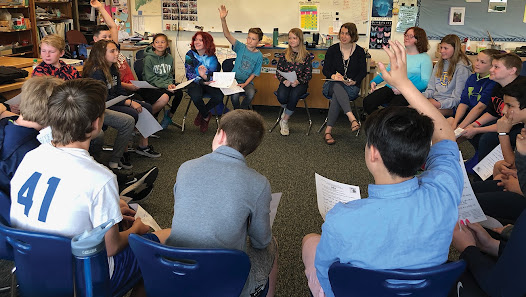
Above: Group work in action


Vygotsky was suggesting a shift toward a different context for learning, one in which the relationship between teacher and student is changed. This also requires a shift of pedagogical focus. In short, from simply transmitting knowledge or practices for students to replicate, to:


“… the creation of classrooms where students have the opportunity to see connection between the varied communities of practice they navigate each day as part of normal life.”


Such classrooms are places where teachers “guide, nudge, respond, question, listen, observe, urge, teach, and reveal truth in ways students can connect to their lived experiences” (see p.100 of my book). If you would like to explore these ideas more fully I would suggest that you spend time in Chapter Six of my book.